

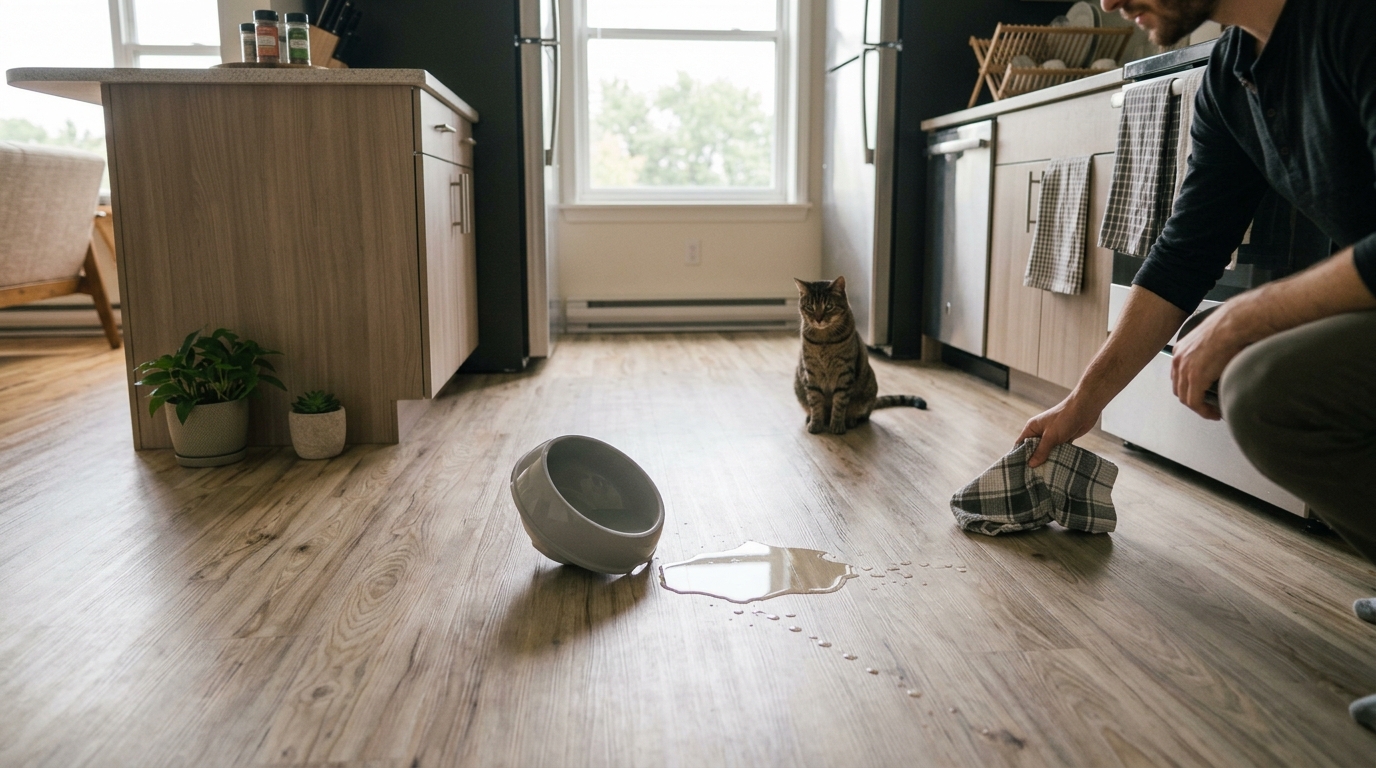
If your cat spills water by pushing, pawing, splashing, or tipping the dish, the behavior can look like deliberate chaos. In reality, repeated spilling may be reacting to the bowl itself, exploring moving water, playing with the surface, testing depth with a paw, or simply using a setup that slides too easily. There is no single proven explanation that fits every cat. The useful approach is to classify what the cat is actually doing, then fix the mechanics without making water harder to access.
First Identify How the Water Is Being Spilled
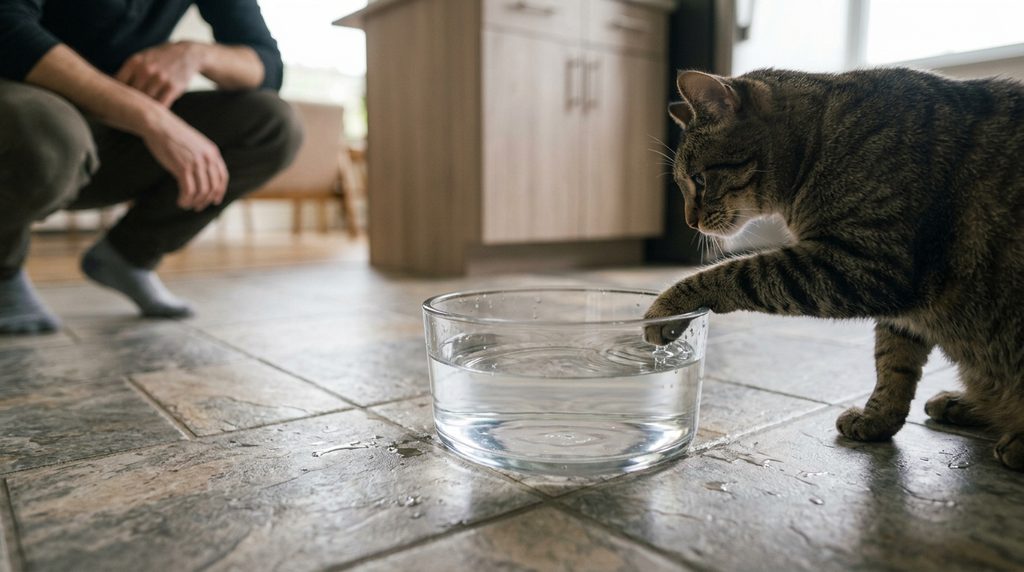
“Spilling” can describe several different behaviors. Some cats hook a paw over the rim and pull the bowl. Others tap the surface repeatedly, then drink. Some splash while playing, and some tip a lightweight dish by leaning on the edge. A cat may also drag a bowl across a smooth floor because the base has little friction. These patterns matter because each points to a different solution. A heavier bowl helps with tipping but may not stop water play. A mat stops sliding but does not change an uncomfortable location.
Watch one or two episodes instead of reacting only to the puddle. Is the cat trying to drink before the spill, or playing long after drinking? Does the behavior happen only with one bowl? Is the cat pawing at the water, the rim, or the floor underneath? Does another pet approach while the cat drinks? A quick phone video can make the pattern easier to see. The aim is not to assign a motive such as “attention-seeking” too quickly. Start with the observable mechanics.
Lightweight Bowls and Slippery Floors Make Small Movements Look Dramatic
A shallow plastic dish on tile can move with very little force. If the cat places one paw on the edge while lowering the head, the bowl may tilt or slide even without intentional play. Try a stable, broad-based bowl on a non-slip surface. Ceramic and stainless-steel bowls are common practical options when they are heavy enough and easy to clean. The bowl should not be so deep or narrow that drinking becomes awkward.
Do not solve the mess by using a tiny amount of water. Water should remain freely available. Instead, make the container harder to move. A silicone mat with a raised edge can protect the floor, but the cat should still be able to stand comfortably without stepping into a cramped tray. If a bowl holder is used, check that it does not wobble. Some cats become more interested in a dish that rocks or rattles, turning a mechanical problem into a play opportunity.
Run a one-minute stability test. Place the empty bowl on its normal surface. Nudge the rim lightly. Check whether it slides. Fill it and test again. Look for rocking. A bowl that moves under gentle pressure may be creating the problem before feline preference enters the picture.
Some Cats Paw at Water Before They Drink
Pawing at the surface is not rare. A study comparing water sources in healthy cats reported that some owners observed their cats playing with bowls or fountains. That does not tell us exactly why an individual cat does it, but it supports the simple point that water can be an object of exploration as well as a resource. Cats may be attracted to movement, reflection, sound, or the change created when a paw touches the surface.
If the cat taps the water once or twice and then drinks normally, the behavior may not need to be stopped. Protect the floor and keep the water clean. If splashing empties the bowl, add another water station elsewhere so access does not depend on one dish. The broader hydration picture includes water taken in from drinking as well as moisture that comes from food, so a messy bowl should be interpreted alongside diet and normal urine output rather than as proof that the cat is not drinking enough.
Location Can Make a Cat Interact With the Bowl Differently
A water bowl in a narrow hallway, beside a noisy appliance, or directly against a wall may feel less comfortable than one in an open but quiet area. A cat that wants to watch the room while drinking may keep lifting the head, shifting position, or reaching from the side. In a multi-cat home, another cat sitting near the route can make the drinker hesitant. The cat may paw at the bowl from a distance rather than place the head down and drink normally.
Test a second location before buying a new product. Put a familiar bowl in a quiet area where the cat can approach and leave easily. Keep the original station available during the trial. If the splashing drops dramatically in the new spot, the environment may have been part of the behavior. Water resources should be accessible without competition; Cornell notes that territorial conflict can interfere with access to drinking water. In small homes, even a furniture barrier or a second station in another room can create a safer option.
Fountains Can Help Some Cats and Fascinate Others
Moving water appeals to some cats, which is why fountains are often recommended as one option for encouraging intake. Individual preference varies. A fountain may reduce pawing at a still bowl for one cat and increase water play for another. The sound, moving stream, and pump vibration can make it more interesting. A cat that repeatedly bats at the stream is not necessarily drinking more simply because the fountain is being used.
If you try a fountain, keep a plain bowl available until you know the cat’s preference. Clean the pump and internal surfaces according to the manufacturer’s instructions because biofilm can build up where it is not obvious. Watch actual drinking behavior rather than assuming the technology is an upgrade. If the fountain becomes a toy that leaves the floor soaked and the reservoir empty, it is not functioning well as the only water source.
Keep the cleanup routine simple. Blot the floor. Replace dirty water. Dry the mat. Check that the bowl is full enough. Then move on. A predictable neutral response protects the resource. It also makes it easier to notice whether planned play changes the behavior over several days.
Do Not Reinforce the Spill With a Big Reaction
If every splash brings an immediate rush of attention, towel waving, talking, or play, the sequence can become more interesting. That does not mean the cat originally spilled the bowl “for attention.” Behaviors can acquire consequences after they begin for another reason. Keep your response practical and boring. Clean the water, reset the station, and offer play at separate predictable times rather than turning the puddle into an event.
Provide normal outlets for object play away from the water station. Short wand-toy sessions, lightweight safe toys, and food puzzles can give an active cat other things to manipulate. Do not punish the cat, spray water, or frighten it away from the drinking area. Water access is too important to make the station feel unsafe. If the behavior tends to happen at a predictable high-energy time, schedule play before that period and see whether the pattern changes.
- Use a heavier, stable bowl with a broad base.
- Add a non-slip waterproof mat without restricting access.
- Offer a second water station in a different quiet location.
- Keep water fresh even if the bowl is used for play.
- Provide object play away from the drinking area.
- Avoid punishment or making the bowl frightening.
Choose a Bowl That Is Easy to Clean and Hard to Tip
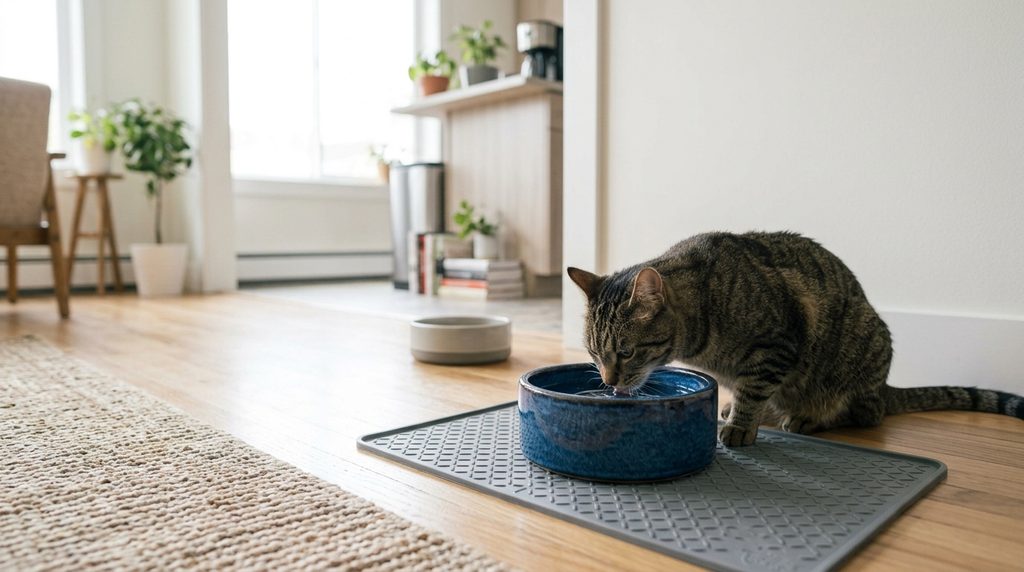
The ideal bowl does not have to solve every feline preference theory. It needs to hold enough water, stay stable, and be easy for you to wash. Wide openings can give the cat more room to position the head. Heavy ceramic or a well-designed stainless-steel bowl may resist sliding better than a lightweight dish. Inspect ceramic for chips and replace damaged bowls. Wash food and water bowls regularly rather than topping up a slimy or debris-filled surface.
If the cat deliberately scoops toys or paws into the dish, a very broad bowl may create more splash area. In that case, test a stable bowl with enough diameter for comfortable drinking but taller walls or a splash-resistant mat around it. Make one change at a time. If you change material, shape, location, and water source simultaneously, you will not know which factor mattered. Keep familiar water available while the cat evaluates a new setup.
Measure trends loosely if needed. Note how often you refill each station. Watch urine clumps. Record appetite. Weigh the cat if that is already part of normal care. Exact milliliters are not always possible in a shared home. Repeated directional changes are still useful.
When a Cat Spills Water, Watch for a Change in Drinking
Messy drinking is usually a behavior or setup issue, but a sudden change in thirst deserves context. Cats with conditions such as kidney disease, diabetes, or hyperthyroidism may drink more and produce more urine. A cat that suddenly spends far more time at water stations may create more spills simply because drinking behavior has increased. Conversely, a cat that is weak, nauseated, or has dental pain may drink less. The spill itself does not diagnose either direction.
Notice whether water bowls need refilling much more often, whether urine clumps are larger or more frequent, and whether weight, appetite, energy, or vomiting has changed. If thirst has clearly increased or the cat seems unwell, contact your veterinarian. Do not respond to increased drinking by restricting water in an attempt to reduce the mess. Fresh water should remain available while the reason for the change is assessed.
Choose floor protection that does not become another toy hazard. Avoid loose absorbent pads that shred easily. Use a washable mat with stable edges. Keep electrical cords away from splash zones. If a fountain is nearby, route the cable according to the manufacturer’s safety instructions.
Recheck the station after one week. Is the bowl still moving? Check whether the floor stays drier. Confirm that the cat is still drinking normally. Has another pet started using the new location? Keep the change only if it improves access as well as cleanup.
Why Does My Cat Spill the Water Bowl? Fix Access Before You Fix the Floor
A cat may spill water because the bowl is easy to move, because the surface is interesting to paw, because the location feels awkward, or because water play has become part of the daily routine. There is not one universal behavioral explanation. Use observation to decide whether you are dealing with tipping, dragging, pawing, or full play, then test the simplest mechanical change first.
When a cat spills water repeatedly, the non-negotiable part is reliable access. Protect the floor with a mat, use a more stable container, add another water source, and keep the station calm. If the behavior appears alongside a clear increase in thirst or other health changes, move beyond bowl troubleshooting and speak with your veterinarian.
References
- Hydration — Cornell Feline Health Center — Explains water access, individual fountain preferences, food moisture, dehydration, and how illness or household conflict can affect drinking.
- Effect of Water Source on Intake and Urine Concentration in Healthy Cats — Journal of Feline Medicine and Surgery/PMC — Small study comparing bowl and fountain use that also documented owner-reported water play in some cats.
- Setting Up the Environment for Success — FelineVMA — Describes normal object play and the importance of separated, safely accessible water and other resources in the home.
