

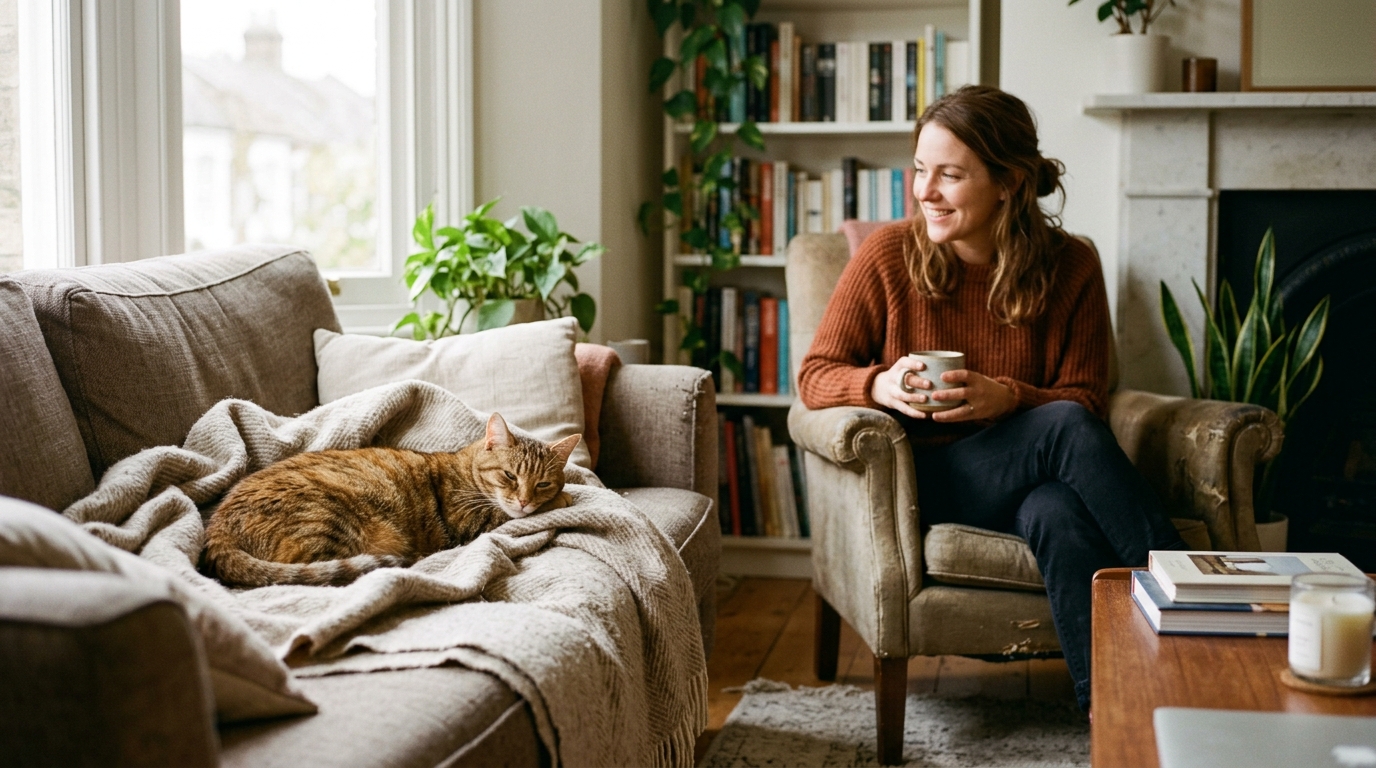
If your cat looks at you and slowly narrows or closes its eyes, you are seeing a behavior researchers call a slow blink sequence. A cat slow blink is often associated with calm, positive interaction, and experimental research suggests cats may respond to human slow blinking with more eye-narrowing movements of their own. That makes the behavior more interesting than a cute internet myth. Still, it should not be treated as a perfect translation of “I love you.” Context matters, and persistent squinting or keeping one eye closed can mean something very different from a relaxed slow blink.
A Cat Slow Blink Is a Sequence, Not Just One Long Blink
The slow blink described in research involves eye narrowing, half-blinks, and sometimes a longer eye closure. It usually happens while the cat is otherwise calm. The rest of the face and body help you decide whether you are looking at relaxed communication or a physical eye problem. A cat resting comfortably with loose posture, neutral ears, and soft eye movements creates a very different picture from a cat holding one eye tightly shut, rubbing the face, or showing discharge.
Watch the transition. A normal slow blink often begins with open eyes that narrow gradually, close briefly, and reopen without visible tension. The cat may remain where it is, turn away, continue resting, or approach. It is not necessary for the cat to stare directly into your eyes for a long time. In fact, sustained direct staring can be socially intense. The narrowing movement may reduce that intensity. Understanding how indoor cats use posture, distance, movement, and everyday behavior to communicate makes the eye signal easier to interpret without turning it into a one-word dictionary.
Do not judge the signal from a still photo. Timing matters. The eyelids should reopen normally. The cat should remain able to move away. Ears and whiskers add context. So does breathing. A calm sequence is brief and fluid, not a fixed facial pose held for many seconds.
What the Slow-Blink Research Actually Found
A 2020 study tested slow blinking in cat-human interactions rather than relying only on owner impressions. In one experiment, cats showed more eye narrowing and half-blinking when their owners performed slow-blink movements than during a control condition with no owner-cat interaction. In another experiment, cats showed more eye narrowing after an unfamiliar experimenter slow blinked compared with a neutral expression. They were also more likely to approach the experimenter’s hand after the slow-blink condition.
Those results support the idea that slow blinking can function as positive communication between cats and humans. They do not prove that every slow blink means affection, that all cats use it in the same way, or that the behavior is equivalent to a human smile. The researchers themselves noted that more work is needed to understand the emotional state and origins of the signal. A second study in shelter cats found that cats that responded more to human slow blinking were rehomed more quickly, adding evidence that the behavior is perceived positively by people and may occur in more than one social context.
Look at What the Rest of the Cat Is Doing
Body language prevents overinterpretation. A loose cat resting on its side, sitting with relaxed paws, or approaching with a softly raised tail gives you a different context from a crouched cat with flattened ears and a rigid body. Slow eye narrowing in a calm interaction is more consistent with a comfortable social exchange. Eye narrowing in a cat that is trying to create distance may be part of a more complicated emotional state. One shelter study, for example, suggested slow blinking may also occur in nervous cats responding to humans.
Ask three questions: Did the cat choose to stay? Can the cat leave easily? What happens immediately afterward? A cat that slow blinks, remains loose, then resumes grooming or comes closer appears comfortable. A cat that narrows the eyes while backing away, hiding, or keeping the body compressed needs more space. The eyes matter, but the direction of movement often tells you what the cat wants from the interaction.
- Loose body + slow blink + voluntary approach: likely a comfortable interaction.
- Slow blink while resting, then normal grooming: often compatible with relaxation.
- Eye narrowing + ears back + leaning away: reduce pressure and give space.
- One eye closed + redness, discharge, or pawing: consider an eye problem instead of social signaling.
- Sudden new squinting that persists: contact a veterinarian.
A slow blink is not permission to touch. Some cats enjoy visual contact but do not want petting. Let the cat make the next move. An approach can be followed by sniffing only. Turning away is also a valid choice. Respecting that choice keeps the signal low pressure.
You Can Slow Blink Back Without Turning It Into a Test
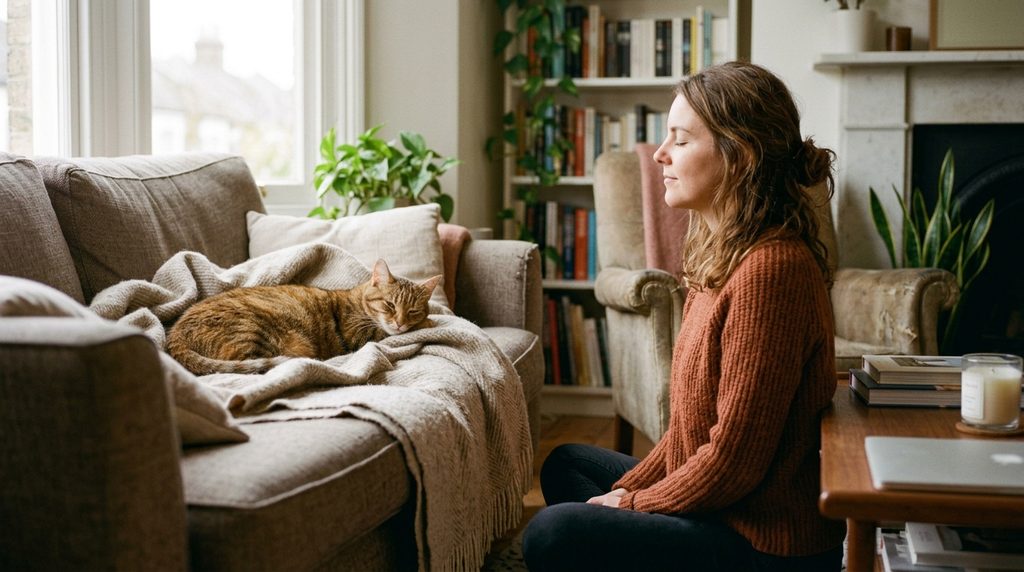
If your cat is calm and already looking in your direction, soften your face and slowly narrow or close your eyes for a brief moment. Then reopen them without leaning toward the cat. You do not need to repeat the movement rapidly or demand a response. The research used controlled repetitions, but normal home interaction does not need to become an experiment. The most cat-friendly version is low pressure: offer the signal and allow the cat to decide what happens next.
Distance matters. Sitting a comfortable distance away is better than moving directly into the cat’s face. Avoid looming over a cat or holding prolonged eye contact while waiting for a blink. If the cat looks away, that is not a failed interaction. Looking away can reduce social intensity. If the cat comes closer, let it approach rather than reaching immediately. A slow blink is most useful as one part of a respectful interaction in which the cat still controls distance.
Use the same calm posture each time. Sit at an angle. Keep your hands still. Speak softly if the cat knows your voice. Avoid reaching into a hide. Repetition can make you predictable. Predictability often matters more than trying to produce a dramatic response in one session.
Slow Blinking Can Be Useful With a Cautious Cat
A shy or newly adopted cat may not be ready for petting, but calm visual communication can let you interact without touching. Sit sideways rather than facing the cat head-on, keep your movements predictable, and avoid blocking the exit. If the cat glances toward you, a soft slow blink can be offered from a distance. Then continue sitting quietly. The aim is not to make the cat approach on command; it is to make your presence easier to tolerate.
Watch for gradual changes that matter more than one dramatic moment. A cat may begin eating while you remain in the room, groom in the open, choose a resting place closer to you, or stop retreating every time you move. Those are meaningful signs of increasing comfort. Slow blinking can fit into that process, but it should not replace providing safe hiding places, predictable routines, and choice. If a nervous cat is cornered, repeatedly handled, or deprived of hiding places, eye signals alone will not make the environment feel safe.
Do Not Confuse a Slow Blink With Squinting From Eye Pain
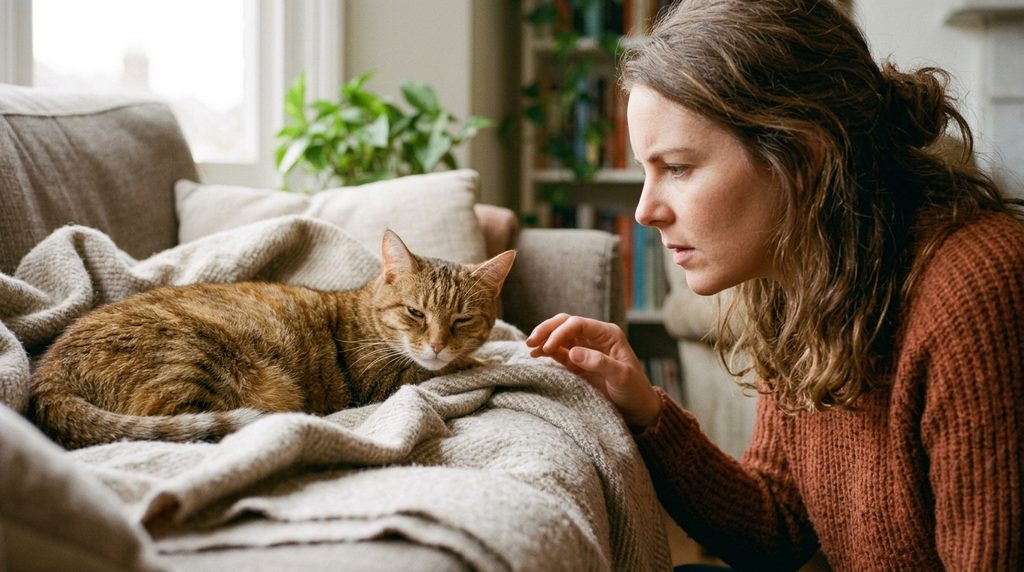
Healthy social slow blinking is usually brief and symmetrical, with the eyes reopening normally. Eye discomfort can also cause narrowing or closure, so persistent squinting deserves attention. Redness, swelling, discharge, cloudiness, visible injury, repeated pawing at the face, or keeping one eye closed are not behaviors to decode socially. Sudden light sensitivity or a change in the appearance of the eye also warrants veterinary assessment.
| What you notice | More like a social slow blink | More concerning for an eye problem |
|---|---|---|
| Timing | Brief and intermittent | Persists or repeats with discomfort |
| Eyes | Often both eyes narrow softly | One eye may stay tightly closed |
| Body | Loose, calm, normal activity | Face rubbing, hiding, agitation, reduced activity |
| Eye appearance | No obvious redness or discharge | Redness, discharge, cloudiness, swelling, injury |
Do not delay care because the behavior resembles a slow blink you have seen before. Cats can have painful eye problems that worsen quickly. When the physical eye looks abnormal, medical evaluation takes priority over behavioral interpretation.
Lighting can also fool the observer. Bright sunlight naturally narrows pupils and can change the appearance of the eyelids. A sleepy cat may keep the eyes half closed without directing a social signal toward anyone. Check the environment before interpreting the face. Context prevents an ordinary eye position from becoming a story.
Do Cats Slow Blink at Other Cats?
Cats use many subtle visual signals with one another, but the best-known slow-blink experiments focused on cat-human interaction. It is reasonable to observe eye narrowing during relaxed cat-to-cat situations, but avoid assuming the human research proves the same meaning in every feline social context. Between cats, distance, staring, route blocking, tail posture, ear position, scent, and previous relationship all contribute to the interaction.
If two cats rest near one another with loose bodies, look away easily, and move through the room without controlling each other’s routes, the social picture is likely comfortable regardless of whether you notice slow blinks. If one cat fixes the other with a stare, occupies a doorway, or causes the other to leave food or litter areas, a single eye movement should not reassure you that the relationship is friendly. Social behavior is better judged from repeated patterns of access and choice.
If you want to compare interactions, use ordinary moments. Notice the cat at the same time of day. Watch whether it is resting or alert. Record only obvious changes. There is no need to count every blink. The useful question is whether the cat looks comfortable and keeps choosing proximity.
The Meaning Changes When the Whole Routine Changes
A cat that has always slow blinked during quiet evening interactions may simply be repeating a familiar social behavior. A sudden change in eye use is more important. If a cat begins keeping the eyes narrowed for long periods, avoids bright areas, rubs the face, becomes less active, or stops accepting normal touch, look for a physical explanation. Likewise, if slow blinking disappears while the cat becomes tense, hypervigilant, or withdrawn, the broader change matters more than the missing signal itself.
Record what is new instead of counting blinks. Note whether both eyes look normal, whether appetite and activity have changed, and whether there was recent conflict, travel, a new pet, or another environmental change. Behavior becomes most useful when it is compared with the individual cat’s baseline rather than with a universal rule.
Why Does My Cat Slow Blink at Me? Read It as a Positive Clue, Not a Translation
When a relaxed cat slowly narrows its eyes at you, research supports treating the behavior as a positive social clue. You can respond with a soft slow blink and then give the cat room to choose whether to stay, approach, or look away. The behavior becomes more meaningful when it appears alongside loose posture, normal movement, and voluntary proximity.
A cat slow blink is therefore useful, but it is not a guaranteed sentence that translates to “I love you.” Read the eyes with the whole cat. And if narrowing becomes persistent, one-sided, painful-looking, or accompanied by redness or discharge, switch from behavior interpretation to veterinary care.
References
- The Role of Cat Eye Narrowing Movements in Cat–Human Communication — Scientific Reports/PMC — Experimental study showing cats produced more eye narrowing in response to human slow blinking and were more likely to approach after a slow-blink interaction.
- Slow Blink Eye Closure in Shelter Cats Is Related to Quicker Adoption — Animals/PMC — Follow-up research examining slow-blink responses in shelter cats and how the behavior may function across different social contexts.
- 2022 AAFP/ISFM Cat Friendly Veterinary Interaction Guidelines — FelineVMA — Provides broader guidance on feline emotional state, body language, distance, choice, and low-pressure interaction.
