

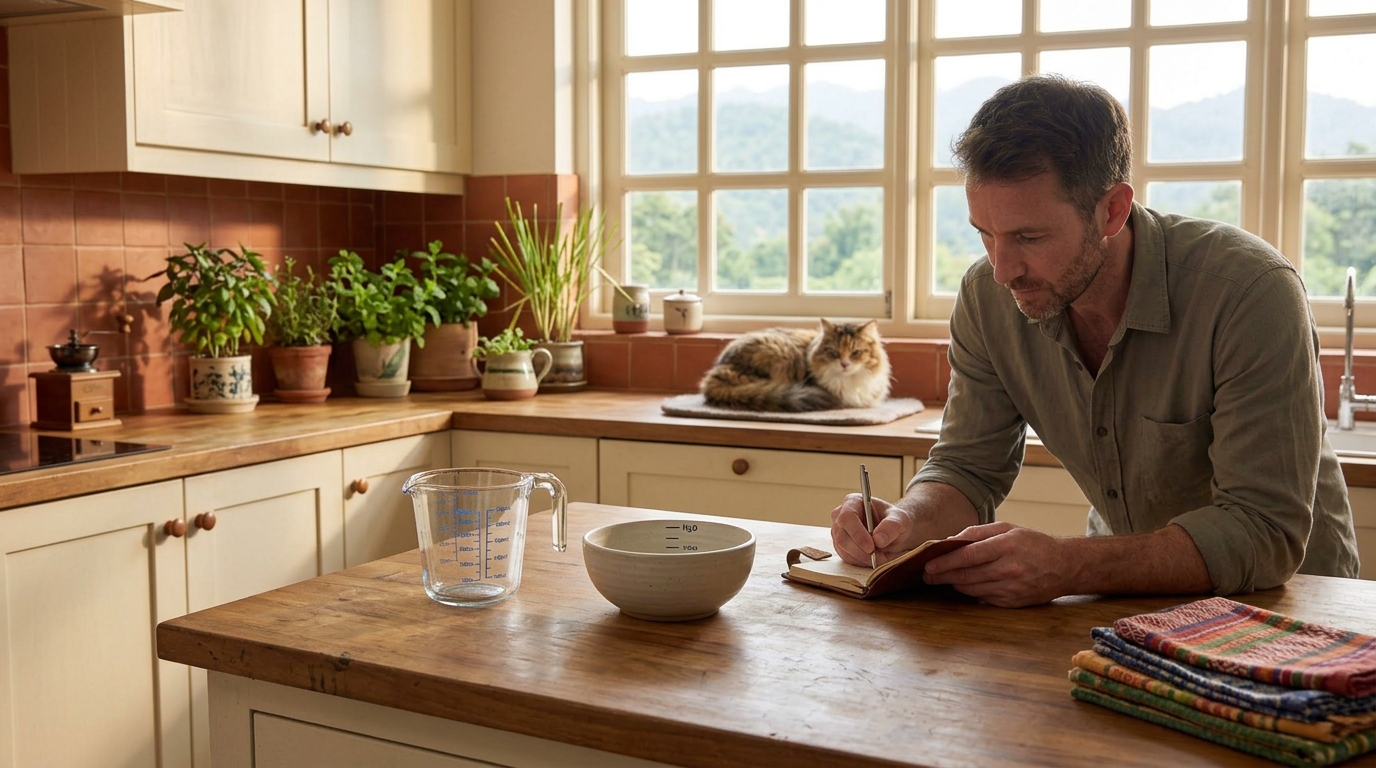
To measure cat water intake at home, you need to separate what you can measure from what you can only estimate. Water disappearing from a bowl is not the same as total fluid intake because cats also get water from food. Spills, evaporation, fountains, and other pets make bowl measurements less precise. The most useful home method is therefore a 24-hour log that records measured water offered and remaining, food moisture, obvious spills, urine-clump trends, and the cat’s normal behavior rather than pretending one bowl number is exact.
Decide Whether You Need Bowl Drinking or Total Water Intake
These are different questions. Bowl drinking means the amount the cat appears to consume directly from water sources. Total water intake includes drinking plus the moisture already present in food. A wet-food cat may drink very little from a bowl while still taking in substantial fluid. A dry-food cat usually relies more heavily on drinking water.
If you are monitoring because the cat suddenly drinks more or less, the change in visible drinking may be enough to track. If you are trying to compare intake with an estimated daily requirement, food moisture matters. A cat’s daily water need includes both what is drunk and what arrives inside food, so do not judge hydration from the bowl alone.
Measure Cat Water Intake With a Simple 24-Hour Bowl Test
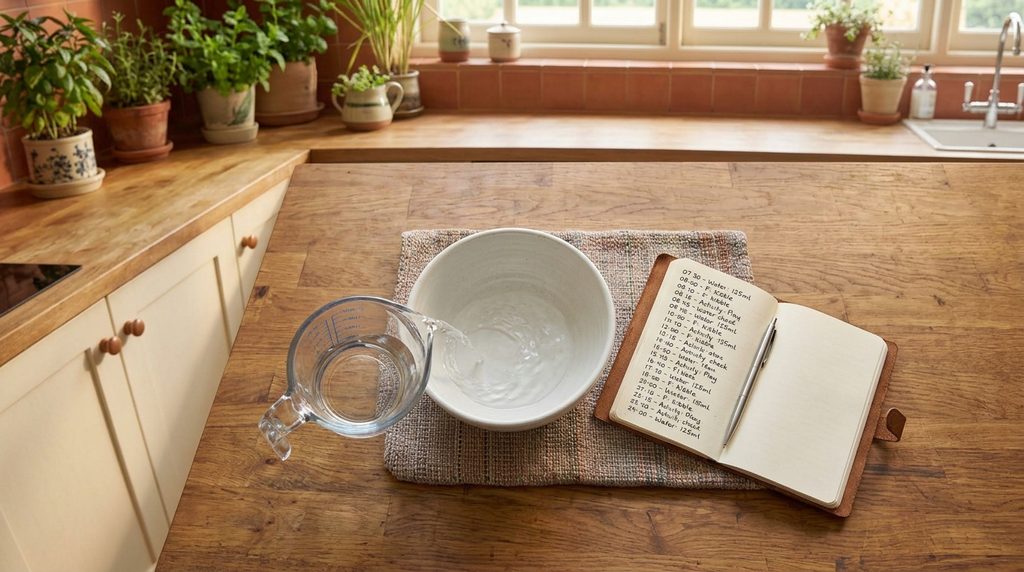
Use a measuring jug or kitchen scale. In the morning, add a known amount of water to a clean bowl. Record the amount. After 24 hours, measure what remains. The difference is the apparent water loss from that bowl. If you use grams on a scale, one gram of water is approximately one milliliter, which makes weighing convenient for small changes.
This number is still an estimate. Some water may evaporate or spill. The cat may dip a paw. Another pet may drink. If you have several bowls, measure each one and add the differences together. Keep the same bowl locations during the monitoring period so a setup change does not alter behavior while you are trying to establish a baseline.
- Measure water offered at the same time each day.
- Use the same bowls and locations.
- Record obvious spills separately.
- Measure all water sources the cat can access.
- Do not restrict water to make the measurement easier.
Use the same bowl material for the control when possible. Match water depth. Keep it away from sunlight if the drinking bowl is away from sunlight. Do not place the control beside a heater while the cat’s bowl sits on tile. The closer the conditions match, the more useful the comparison becomes. You are still estimating. The control simply removes one obvious source of error.
Run an Evaporation Control if You Need Better Accuracy
In warm, dry, or air-conditioned homes, some water disappears without being drunk. To estimate that loss, place an identical bowl with the same starting amount in a location the cat cannot access but that has similar temperature and airflow. Measure the change after 24 hours. The control does not create laboratory accuracy, but it can show whether evaporation is large enough to matter.
For example, if the accessible bowl loses 80 mL and the control loses 10 mL, apparent drinking from that bowl is closer to 70 mL before accounting for splashing. If the accessible bowl loses 30 mL and the control loses 20 mL, the result is too small to interpret confidently. Repeat several days rather than relying on one noisy measurement.
Photograph the starting fill line after each refill. Use the image only as a backup. Measurements are better than visual memory. If the fountain has a minimum-fill line, never let monitoring push the water below safe operating levels. Protect the pump first. A broken fountain creates a drinking-access problem and ruins the measurement at the same time.
Fountains Make Measurement Harder but Not Impossible
A fountain contains water in a reservoir, channels, and filter, so marking the visible top level is not enough. Start with a fully cleaned fountain filled to a known total amount. After 24 hours, turn it off and measure the remaining water according to the design. Account for the small amount trapped in filters or internal parts as consistently as possible.
Do not repeatedly dismantle the fountain if doing so makes monitoring impractical. A second measured bowl may provide a simpler observation while the fountain remains available. If the cat uses both, total visible drinking is the sum of both sources. The aim is useful trend data, not a perfect fluid-balance study at home.
Estimate Water From Wet Food Separately
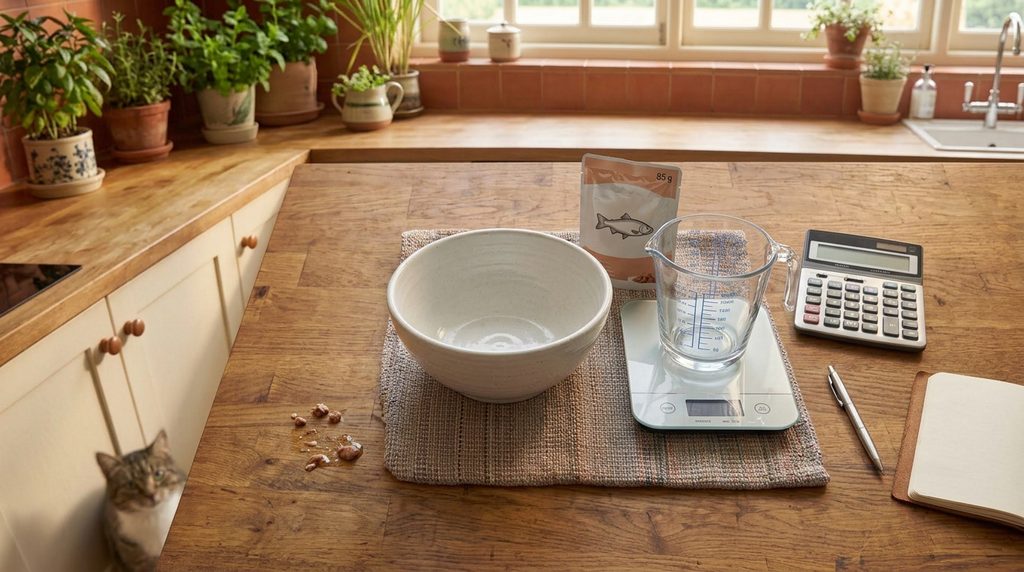
Food labels often list moisture as a maximum percentage. That can provide a rough estimate of water delivered by the food, although it is not an exact analysis of each serving. If a 100-gram food is listed at 78% moisture and the cat eats the entire portion, the meal contains roughly 78 grams, or about 78 mL, of water. If half is eaten, the estimated contribution is about half that amount.
| Food example | Moisture | Amount eaten | Approx. water from food |
|---|---|---|---|
| 100 g wet food | 78% | 100 g | ~78 mL |
| 85 g pouch | 80% | 85 g | ~68 mL |
| 100 g wet food | 78% | 50 g | ~39 mL |
Do not turn this into false precision. Moisture values on labels and food left in the bowl make the estimate approximate. Still, the calculation explains why a cat eating wet meals may make few visits to the water bowl. Record food format whenever you compare drinking between days.
Keep separation short and ordinary when possible. Use a room the cat already likes. Keep normal bedding there. Feed the usual diet. Maintain the same water bowl style. Sudden isolation can change drinking behavior, which defeats the purpose. If separation itself causes distress, tell the veterinarian. A rough shared-home trend may be more useful than a precise number collected under abnormal conditions.
Multi-Cat Homes Need Individual Access if the Number Really Matters
Shared bowls cannot tell you which cat drank the water. If one cat needs individual monitoring because of a health concern, ask your veterinarian whether temporary separation is appropriate. Give that cat its own food, water, litter box, resting space, and normal comfort during the measurement period. Separation should not create more stress than the information is worth.
Technology can help in some homes, but cameras and smart bowls still have limitations. A camera may show visits but not exact swallowed volume. A weight-sensing bowl may be disrupted by pawing or another animal. Use tools as aids, not as proof. When individual intake is medically important, veterinary testing can provide information that home bowl measurements cannot.
Use the Litter Box as a Trend Check, Not a Water Meter
Urine clumps can support the story. Learn what is normal for your cat: approximate number, size, and frequency. If measured drinking rises and urine clumps also become much larger, that pattern is more meaningful than a single high bowl reading. If drinking appears to fall while urine output also drops, note that too.
Litter clumps do not convert reliably into milliliters of urine. Litter type, clump breakage, scooping timing, and shared boxes all interfere. Straining or repeated attempts with little to no urine are not hydration measurements; they can signal a urinary problem requiring prompt veterinary attention. Use the box to notice change, not to calculate fluid balance.
Add one column for weather or room temperature only if it changes noticeably. Add another for food changes. Do not create a spreadsheet with twenty fields you will stop using. The log should take under a minute. Consistency beats detail. A short record maintained for a week is more useful than one perfect day followed by no data.
Here is a simple example. You offer 250 mL in two bowls. After 24 hours, 185 mL remains. The bowls therefore lost 65 mL. You also estimate 70 mL of water from wet food eaten that day. That suggests roughly 135 mL of total intake before correcting for evaporation or spills. Repeat the process rather than treating that one estimate as a diagnosis.
Build a Three-Day Log Before You React to One Number
Day-to-day drinking varies. A warmer day, different meal, more play, or a spilled bowl can change one measurement. Record at least three ordinary days when possible. Keep the same food and water setup unless you are responding to a medical concern. The pattern matters more than a single point.
Your log can be simple: water offered, water remaining, wet-food grams eaten, obvious spills, urine-clump notes, appetite, and energy. Add medications if relevant. If you are measuring because a veterinarian asked you to, use their requested method and reporting threshold. They may care more about a change from baseline than a universal target.
Bring the measuring method to the appointment too. Tell the clinic whether you used one bowl, several bowls, or a fountain. Mention other pets. State whether food moisture was estimated. This prevents the number from sounding more exact than it is. The veterinarian can then decide whether the trend fits the history or whether urine, blood, weight, or other testing is more informative.
Keep meal timing consistent during the comparison. A cat may drink more soon after dry food and less after a wet meal. If breakfast changes from dry to wet halfway through the log, the bowl trend becomes harder to interpret. Record any unavoidable change. The note is more useful than trying to mathematically correct every difference.
Know When Home Measurement Has Reached Its Limit
Cornell gives an approximate total daily water need of about four ounces per five pounds of lean body weight, but individual needs and food moisture matter. Do not use that estimate to diagnose dehydration or disease at home. A cat can have abnormal thirst for medical reasons even if the calculated total seems plausible, and a dehydrated cat may not drink enough to correct the problem.
Contact your veterinarian for a clear persistent increase or decrease in drinking, especially with changes in urine, appetite, weight, vomiting, diarrhea, weakness, or an existing medical condition. Seek prompt care for inability to urinate, severe lethargy, collapse, or breathing difficulty. Home tracking is useful because it gives the clinic a better timeline, not because it replaces examination and testing.
Measure the Trend, Not a Perfect Number
The best way to measure your cat’s daily water intake at home is to create repeatable conditions and accept the limits. Measure bowl water over 24 hours, estimate wet-food moisture separately, note spills and evaporation, and repeat for several days. In a multi-cat home, individual measurement may require temporary separation if the information is important enough.
Keep the result connected to the cat. Appetite, urine output, weight, energy, and recent diet changes give the number meaning. A careful home log can tell you that drinking has truly changed and by roughly how much. That is far more useful than guessing from a bowl that simply looks fuller or emptier than yesterday.
References
- Hydration — Cornell Feline Health Center — Provides an approximate total water requirement and explains how wet food, drinking, disease, and water losses contribute to feline hydration.
- Feeding Your Cat — Cornell Feline Health Center — Details the very different moisture content of dry and canned foods and why food type changes visible drinking.
- Enhancing Water Intake for Your Cat — Cat Friendly Homes — Feline-veterinary guidance on water sources, bowl preferences, food moisture, and practical ways to support drinking.
