

Wet food vs dry food for cats is not a contest with one universally correct winner. Both formats can provide complete and balanced nutrition when the product is appropriate for the cat’s life stage and fed in the right amount. The practical differences are moisture, calorie density, storage, texture, palatability, portioning, cost, and how each format fits the cat’s health and household routine. A better question is which format—or combination—lets your cat meet nutritional needs while maintaining healthy weight, hydration, appetite, and comfort.
Compare foods on the information panel, not by how “premium” the front looks. Find the calorie content. Find the life-stage statement. Check whether the food is intended as complete nutrition or supplemental feeding only. These details answer more useful questions than ingredient-list ranking alone. Two foods with very different marketing can both meet the cat’s nutritional needs when formulated and fed appropriately.
Start With Nutritional Adequacy Before You Compare Format
Wet versus dry matters less than whether the food is complete and balanced for the intended life stage. Read the nutritional adequacy statement rather than judging only the ingredient list or marketing on the front of the package. AAFCO explains that “complete” means required nutrients are present and “balanced” means they are supplied in appropriate ratios. Treats and foods labeled for intermittent or supplemental feeding should not quietly become the main diet.
Once adequacy is established, compare calorie content and feeding directions. Two foods can look similar in the bowl but deliver very different calories. A dense dry food may provide many calories in a small volume, while wet food usually occupies more volume for the same energy. The cat’s body condition and actual intake still determine whether the portion is right.
Look at the cat’s actual diet rather than the package category. Some cats eat mostly wet food but receive dry treats and snacks. Others eat dry meals with water added under veterinary guidance. Total intake matters. Keep fresh water available regardless of format. A wet diet does not remove the need for water access. A dry diet does not automatically mean the cat is dehydrated.
Wet Food Has a Clear Moisture Advantage
Cornell notes that canned food contains at least about 75% moisture, while dry food is commonly around 6–10% water. That means wet food delivers a substantial amount of water with the meal. Cats eating wet food may therefore drink less visibly from a bowl. For cats that benefit from greater fluid intake, this can be useful.
Moisture is not the same as a complete health verdict. A cat on dry food can still maintain hydration when fresh water is available and intake is adequate. Some medical conditions may change how strongly a veterinarian prioritizes moisture. The point is that water delivered by food counts. Choosing what to feed an indoor cat involves food format, life stage, portions, and the full daily routine, not moisture alone.
Use grams when accuracy matters. Cups can vary with scoop shape and how full they are. A kitchen scale makes breakfast repeatable. Write the daily gram target near the container. This helps other household members. It also makes mixed feeding easier. You can subtract the wet-food calories first, then weigh only the dry calories that remain in the day.
Dry Food Is Convenient, but Calorie Density Needs Attention
Dry food stores easily, can be used in puzzle feeders, and works well in many timed feeders. It is also compact. That convenience can make portion drift easy because a small extra handful may contain more calories than it appears to. Free feeding can work for some cats, but Cornell notes that unrestricted access can contribute to overeating and weight gain in others.
Measure dry food rather than repeatedly topping up the bowl. A kitchen scale is more consistent than estimating by volume. Store the food in a way that protects freshness and follow the manufacturer’s instructions. Convenience is a real benefit only when it does not make intake invisible.
Watch food waste as part of cost. A large can may look economical, but not if the cat refuses refrigerated leftovers. Smaller pouches may cost more per gram but waste less. Dry food can also become stale when oversized bags stay open for months. Buy a package size that fits how quickly the household uses it. Freshness affects whether the cat actually eats the diet you chose.
Wet Food Can Make Portioning and Appetite Easier to Observe
Wet food is often served in defined cans, trays, or pouches, which can make meals feel more structured. It may also be highly palatable for many cats. A cat that normally finishes a portion and suddenly leaves most of it gives you immediate appetite information. With a large bowl of dry food available all day, a gradual reduction can be harder to notice.
Opened wet food requires appropriate refrigeration and safe handling. It should not sit out indefinitely. Some cats dislike cold food straight from the refrigerator, so follow safe handling directions while finding a serving temperature the cat accepts. The extra meal preparation can be a disadvantage in busy households, but it can also encourage more deliberate portioning.
Texture and Mouth Comfort Can Change the Choice
Dental disease can make eating uncomfortable. Cornell notes that cats with periodontal problems may struggle with dry food and may prefer wet food, smaller kibble, or food softened with water. A sudden preference for soft food, dropping kibble, chewing on one side, drooling, or bad breath should not be treated as a simple format preference.
Dry food should not be assumed to replace tooth brushing or veterinary dental care. Some specially designed dental diets have evidence for oral-health benefits, but ordinary kibble is not a substitute for appropriate dental prevention. If chewing behavior changes, address the mouth rather than endlessly switching textures.
Wet Food vs Dry Food for Cats Looks Different When Weight Is the Problem
Either format can contribute to weight gain when portions are too large. Wet food often has fewer calories per gram because it contains more water. That can allow a larger food volume for a given calorie target. Dry food is more concentrated. It is also easy to over-pour. Those are practical tendencies, not guarantees that wet food causes weight loss or dry food causes obesity.
| Question | Wet food | Dry food |
|---|---|---|
| Moisture | High | Low |
| Calorie density | Often lower per gram | Often higher per gram |
| Leaving food out | Limited by food-safety handling | More practical, but intake can become hard to track |
| Puzzle/timed feeder use | Possible with suitable equipment | Often easier |
| Appetite monitoring | Defined meals can make changes obvious | Clear with measured meals; less clear with constant grazing |
Use the calorie statement on the exact food. The portion that maintains ideal body condition is more important than the volume you expect a cat “should” eat.
Introduce mixed feeding gradually when the cat is sensitive to change. Keep the familiar food stable. Add a small measured portion of the new format. Watch stool, appetite, and acceptance. Increase in planned steps. A slow transition also lets you see whether the cat prefers one texture. Do not create a buffet of several new foods at once just to encourage variety.
Mixed Feeding Can Combine Strengths if the Calories Are Combined Too
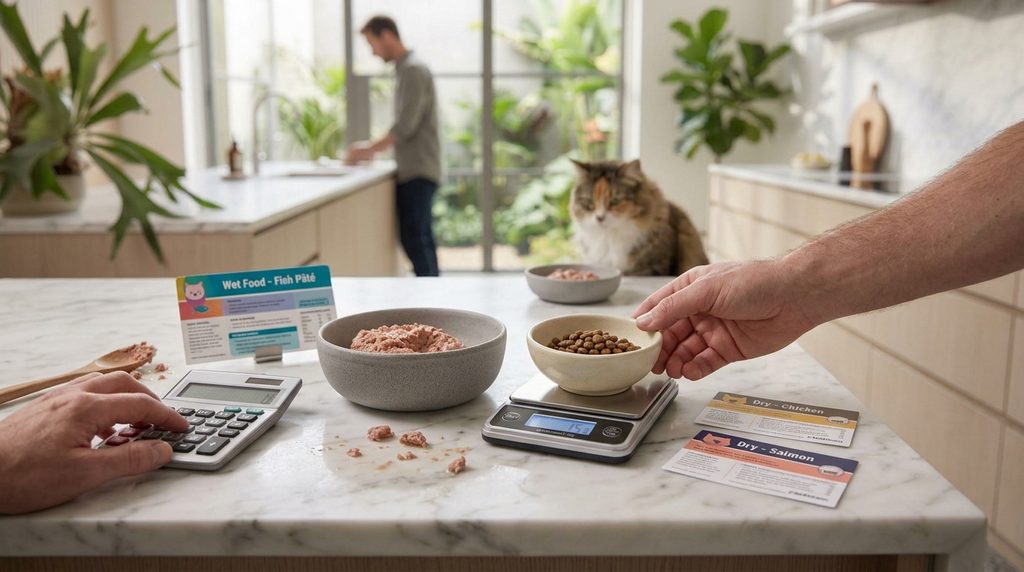
You do not have to choose one format exclusively. Many cats eat a combination. Wet meals can add moisture and provide structured feeding, while a measured dry portion can be useful for puzzle feeding or a timed meal. The common mistake is treating the dry ration as complete and then adding wet food on top as a free extra.
Calculate the daily total. Decide how many calories will come from wet food, then subtract those from the day before measuring dry food. Count treats too. Mixed feeding works when the parts add up to the right total, not when each part is fed according to its full standalone package recommendation.
Medication routines can matter too. Some cats need food with treatment. Others need a diet that should not be shared with housemates. In those homes, format interacts with access. A microchip feeder may work well for dry therapeutic food. Closed-door meals may work better for wet food. The medical target comes first. Household logistics should be built around it.
Medical Diets Can Override General Wet-vs-Dry Preferences
Kidney disease, diabetes, urinary disease, food allergies, gastrointestinal problems, dental pain, and weight-management plans can change the decision. The formulation may matter more than the format. Therapeutic diets may be available in wet, dry, or both forms, and the best choice is the one that meets the medical goal and the cat will reliably eat.
Do not switch a cat with a chronic condition simply because one format is popular online. Sudden diet changes can reduce intake, and cats should not go without food during a difficult transition. Work with your veterinarian on medical diets, transition speed, calorie targets, and how to maintain adequate intake.
Run a two-week practicality check after a planned transition. Check whether the cat finishes meals. Confirm that body weight is stable. Make sure cleanup is manageable. Note food waste and water-bowl use. Also watch whether another cat steals the food. These observations tell you whether the format fits real life. Nutrition plans fail when the household cannot repeat them consistently.
Keep one fallback option the cat already accepts during a planned transition. Reliable eating matters more than winning the format debate. A good diet still has to be eaten consistently.
Choose the Format You Can Feed Correctly Every Day
A theoretically ideal food is not useful if the cat refuses it or the household cannot serve it safely and consistently. Consider storage, cleaning, meal schedule, travel, automatic feeders, multiple cats, and budget. Measured complete-and-balanced dry food can be practical. Complete-and-balanced wet food can be practical too. A measured combination can also work well.
- Check the nutritional adequacy statement.
- Compare calories per can, pouch, cup, or gram.
- Account for food moisture when judging drinking.
- Measure the full daily ration.
- Monitor weight and body condition.
- Choose a format the cat eats reliably and the household can manage safely.
Which Is Better? The One That Fits the Cat, Nutrition, and Routine
The answer to wet food vs dry food for cats is that format alone does not define a good diet. Wet food has a strong moisture advantage and can make structured meals easy. Dry food offers storage convenience and works well for measured puzzles or timed feeding. Both can provide complete nutrition, and both can be overfed.
Choose based on nutritional adequacy, calorie needs, hydration, health, mouth comfort, preference, and what you can feed consistently. If your cat has a medical condition or a major appetite change, let the veterinary plan lead the choice. The useful comparison is not “wet is good, dry is bad” or the reverse. It is whether the actual food, portion, and routine keep your cat healthy.
References
- Feeding Your Cat — Cornell Feline Health Center — Current comparison of canned and dry food moisture, calorie density, palatability, storage, nutritional adequacy, and feeding considerations.
- How Often Should You Feed Your Cat? — Cornell Feline Health Center — Discusses complete diets, wet-food moisture, dry-food free feeding, portions, and health-related feeding changes.
- Reading Pet Food Labels — AAFCO — Explains nutritional adequacy statements, life-stage labeling, calorie content, feeding directions, and the meaning of complete and balanced.
