

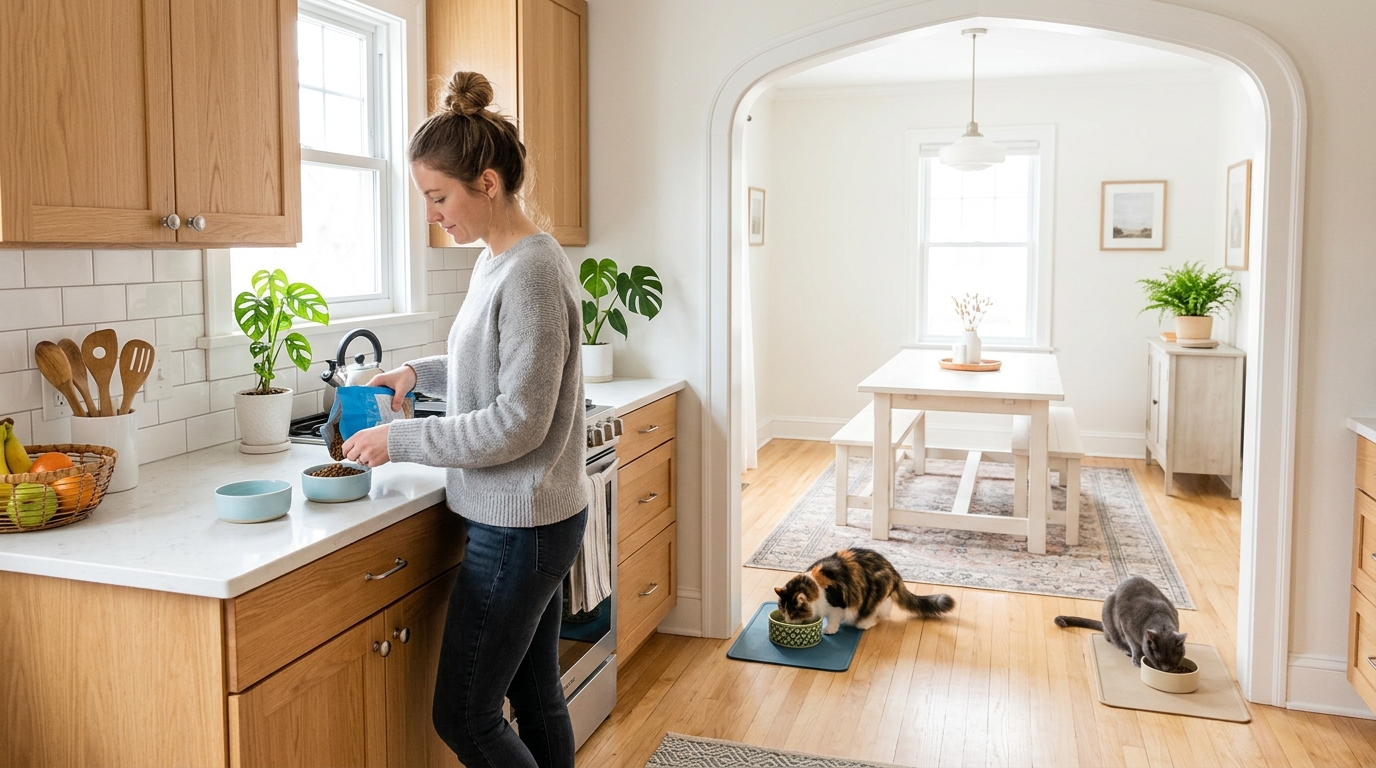
If you need to stop a cat stealing food from another cat, the useful question is not which cat is being “greedy.” It is how the feeding system allows one cat to reach food that belongs to the other. A fast eater may finish first and move bowls. A cautious cat can step away when watched. Some cats graze for hours. Meanwhile, a food-motivated housemate may treat every unattended bowl as available. The fix is usually to control access, timing, and portions so each cat can eat without having to defend a meal.
Work Out How the Food Theft Actually Happens
Watch one normal meal before changing the setup. Maybe the stealing cat finishes first and moves to the second bowl. The slower cat might leave when approached. Theft may also happen only after you leave the room. A different pattern appears in homes where food is left out all day: one cat may quietly eat most of both daily rations while nobody sees a dramatic “stealing” event. The behavior matters because each version needs a different solution.
Also look at the cat that loses food. A timid cat may not hiss or swat when another cat approaches. It may simply stop eating and walk away. Feline feeding guidance notes that cats can experience tension even when they appear willing to eat near each other. If one cat watches the room, crouches over the bowl, eats unusually fast, or repeatedly abandons meals, social pressure may be part of the problem. Protecting access is useful even when there is no obvious fight.
Stop Cat Stealing Food by Separating the Meal, Not Just the Bowls
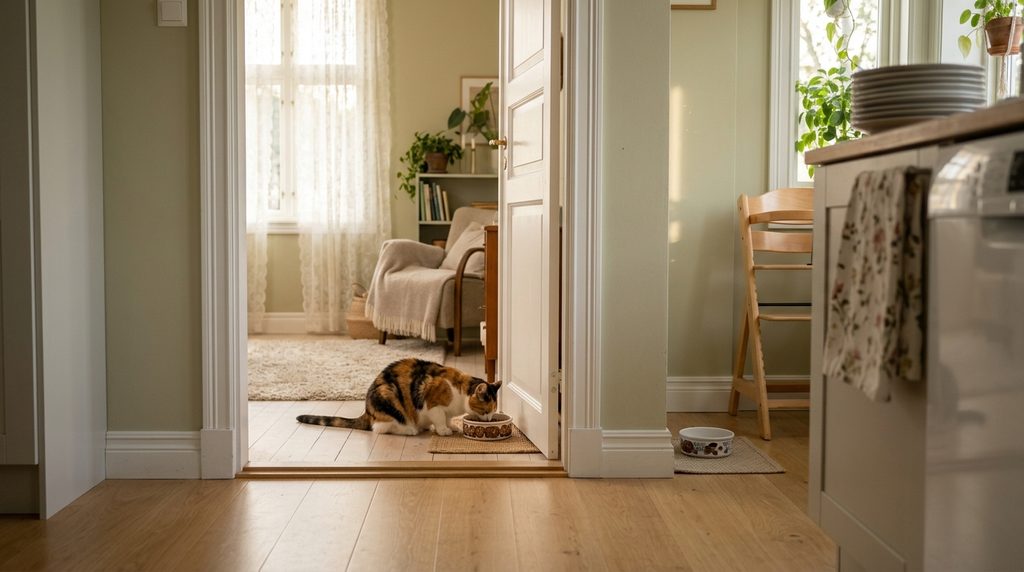
Two bowls placed a few feet apart are often still one feeding station. The faster cat can cross that distance in seconds, and the slower cat can see the approach coming. Stronger separation uses a closed door, a tall baby gate that only one cat can pass safely, different rooms, or a visual barrier that prevents direct monitoring. The right method depends on mobility, confidence, and whether each cat can be left alone with its meal.
For many homes, the simplest system is scheduled meals behind separate doors. Put each cat in its own comfortable eating area, serve measured food, then pick up leftovers after an appropriate meal window. This turns food access into a predictable routine instead of a contest. If a cat needs more time, let that cat remain in the protected space longer. The separation is not punishment. It is a way to remove competition from a resource that should be easy to access.
- Use different rooms when both cats tolerate closed-door meals.
- Add visual separation if the cats still stare at each other while eating.
- Keep water available outside meal confinement.
- Return each cat to the shared space only after food is removed.
- Use the same locations daily so the routine becomes predictable.
Use one meal as a timing test. Start both cats together. Note when each finishes. Record whether the slower cat pauses when watched. Check where the thief goes next. Repeat this on two ordinary days. A consistent thirty-second gap suggests a timing problem. A cat that abandons food before the other finishes suggests social pressure. Those are different problems, even if the missing food looks the same afterward.
Measure the Whole Day Before You Divide It Between Meals
Food stealing becomes harder to interpret when portions are estimated by eye. Measure each cat’s daily ration separately, including treats and toppers. Then divide that amount across the chosen meal schedule. If one cat gains weight while the other loses weight, you need to know whether the problem is calorie allocation, food access, or both. A measured plan makes the pattern visible.
The exact food and calorie level still need to suit each cat. Age, body condition, activity, and health can change the appropriate amount. That is why what each indoor cat eats and how much belongs in the full daily ration should be decided before you troubleshoot who gets to which bowl. Once the daily amount is known, every stolen mouthful has context instead of becoming an unmeasured extra.
Keep the protected eater’s body weight in the plan. Weigh that cat every few weeks at first. Check whether leftovers are increasing. Watch whether meals are becoming calmer. If the cat still loses weight, the system may be blocking the thief but not giving the intended eater enough comfortable access. A feeding solution has to protect calories and reduce tension at the same time.
Protect a Grazer Without Leaving Food Open to Both Cats
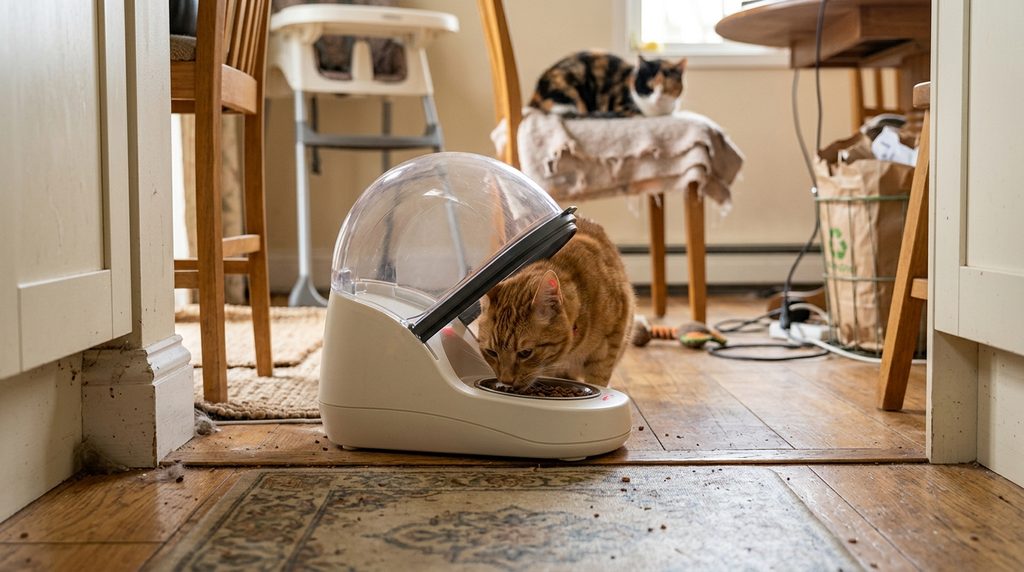
A grazer creates a special problem because the food needs to remain available longer. Simply shutting the slow eater in a room all day may not fit the household. A microchip-activated feeder can help when one cat needs protected access and the other reliably steals unattended food. The feeder opens for the registered cat and stays closed for the housemate. This can be useful when cats eat different diets or one needs many small meals.
Technology is not mandatory. You can also offer several short protected meal windows across the day. A timid grazer may eat more comfortably when given ten quiet minutes every few hours rather than one large bowl left in a shared room. Test the simplest method first. Whatever system you choose, check whether the intended cat actually eats enough. A feeder that technically blocks the thief but scares the slower cat with noise or movement has not solved the problem.
If One Cat Eats Too Fast, Slow That Cat Without Delaying the Other
Some food stealing begins because one cat finishes in a minute while the other needs ten. Instead of forcing the slow cat to hurry, make the fast cat’s own ration take longer. Divide it into several small dishes, use an easy puzzle feeder, or spread part of the kibble across safe feeding locations. The idea is to extend eating time without adding calories.
Choose difficulty carefully. A puzzle that is too hard can create frustration, while a very easy one may not change the timing enough. Wet food can be spread thinly across a suitable feeding surface or divided among several small portions. Keep the slower cat protected during this experiment. Slowing the fast eater is an additional tool, not a replacement for access control if that cat still reaches the other bowl afterward.
Do Not Make the Slower Cat Defend Its Food
People sometimes try to teach the stealing cat by standing between the bowls, scolding, clapping, or repeatedly moving it away. That may interrupt a meal, but it can make feeding more tense for both cats. The slower cat still has to monitor the thief and the person. A better system makes stealing physically difficult before it starts. Doors, distance, controlled timing, and protected feeders are clearer than repeated corrections.
Do not place responsibility on the cat that loses food either. Moving its bowl to a high surface works only if that cat can reach the height comfortably and the thief cannot. Senior cats, cats with arthritis, and less agile cats may be disadvantaged by vertical solutions. The protected location should suit the vulnerable eater, not simply be inconvenient for the other cat.
Notice whether stealing happens after every meal or only around one food. A cat may rush a highly palatable wet meal yet ignore the other cat’s dry food later. That pattern points toward preference rather than constant hunger. It still needs access control, but it changes what you report to the veterinarian. Keep the exact food names in your notes.
Watch for Hunger That Suddenly Becomes Much Stronger
If the stealing behavior is new or has intensified sharply, look beyond the feeding setup. Increased appetite can occur with medical problems, and some cats lose weight despite eating more. A sudden change in hunger deserves more attention when it comes with weight loss, increased thirst, larger urine clumps, vomiting, diarrhea, or a major behavior change. Bring those observations to your veterinarian rather than assuming the cat has become more opportunistic.
Medication can also change appetite, and diet changes can alter how satisfied a cat seems after eating. If one cat begins raiding every bowl after a new treatment or food transition, record the timing. Do not compensate by endlessly increasing the ration until you know the cat’s body condition and calorie needs. Food theft can be a household-management problem, a nutrition problem, or a clue that the cat’s appetite itself has changed.
Do a weekly reset of the feeding station. Wash bowls. Check feeder doors and batteries. Confirm labels on stored portions. Make sure the slower cat still has an easy route to its protected area. Household systems drift over time. A chair moves. Then a door starts staying open. Later, a feeder schedule changes. Small maintenance keeps the original solution working.
Use a Household Feeding System Everyone Can Follow
Multi-person homes often create accidental extra meals. One person feeds breakfast, another assumes nobody did, and the stealing cat benefits twice. Make the system visible. Pre-portion each cat’s food for the day, label containers, or use a simple feeding log. If a feeder is automated, keep the schedule written somewhere easy to check. Consistency helps you know whether stealing is still occurring.
| Problem | Useful first fix | What to watch |
|---|---|---|
| Fast cat finishes first | Separate meals plus slower feeding | Whether the fast cat still reaches the other bowl |
| One cat grazes | Protected meal windows or microchip feeder | Whether the grazer eats enough |
| Timid cat walks away | More distance and visual separation | Body posture and meal completion |
| Different diets | Closed-door meals or protected feeder | Cross-access to prescription or calorie-controlled food |
| Unclear portions | Measure each daily ration | Weight and leftovers over time |
Review the system after a week. Look at leftovers, body weight trends, and whether either cat still waits for the other to finish. A good plan makes meals boring in the best way: each cat knows where to go, receives the correct amount, and does not need to race or guard access.
If you need to leave both cats with a sitter, write the separation plan in plain steps. Name each cat’s room. List each portion. State how long the slower eater gets before leftovers are removed. Add a photo if the foods look similar. A routine that only one person understands is fragile. A routine anyone can follow is much more likely to protect both cats consistently.
Keep the Fix Focused on Access, Calories, and Calm Meals
To stop one cat from stealing another cat’s food, remove the opportunity instead of turning meals into a training battle. Separate cats far enough that one cannot reach the other’s bowl, measure daily food, protect grazers, and slow the fast eater when needed. Then watch weight and appetite so you know whether the system is actually working.
If the stealing cat suddenly becomes ravenous, loses weight, or shows changes in thirst, urination, stool, or energy, involve your veterinarian. Otherwise, most food theft is easier to manage when the environment does the work. The best feeding routine is one in which neither cat has to compete for the calories intended for it.
References
- How to Feed a Cat — FelineVMA — Explains separate feeding stations, visual separation, microchip feeders, small meals, and why group feeding can create hidden tension.
- How Often Should You Feed Your Cat? — Cornell Feline Health Center — Covers meal frequency, free feeding, portion control, and why separate feeding can help in multi-cat homes.
- Feeding Your Cat — Cornell Feline Health Center — Current guidance on complete diets, calorie control, body condition, appetite changes, and feeding environment.
