

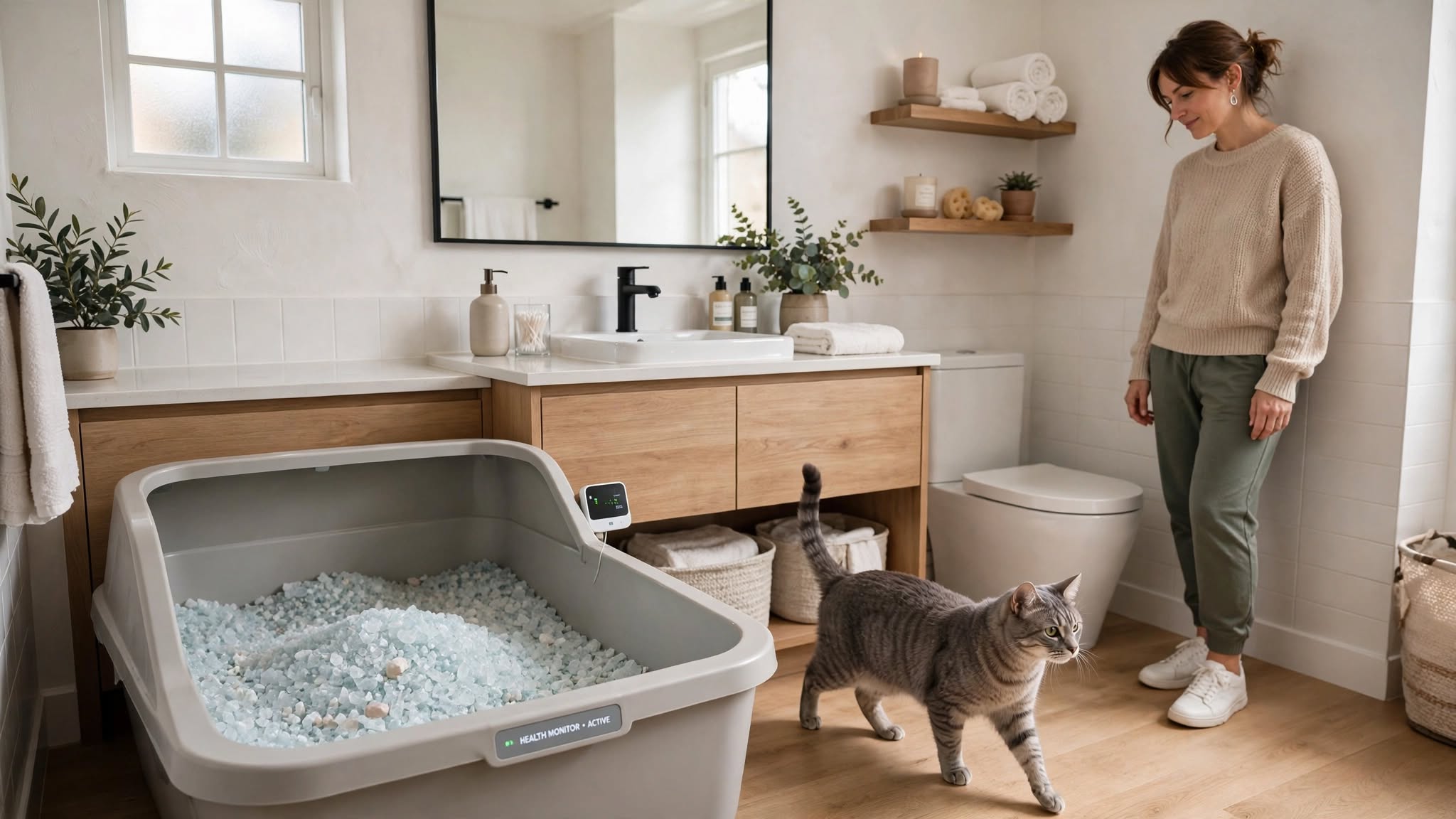
Health-monitoring cat litter can add one more clue to what is happening in the litter box, but it cannot tell you whether your cat has a specific disease. Products in this category usually react to urine chemistry or make changes such as blood easier to notice. That can be useful because cats often hide illness and urinary changes may be subtle at first. The mistake is treating a color as a diagnosis. Urine pH shifts for many reasons, and the same color can fit several very different problems. The most useful way to use monitoring litter is as a trend detector alongside urine volume, frequency, straining, appetite, thirst, weight, and behavior.
What Health-Monitoring Cat Litter Is Actually Measuring
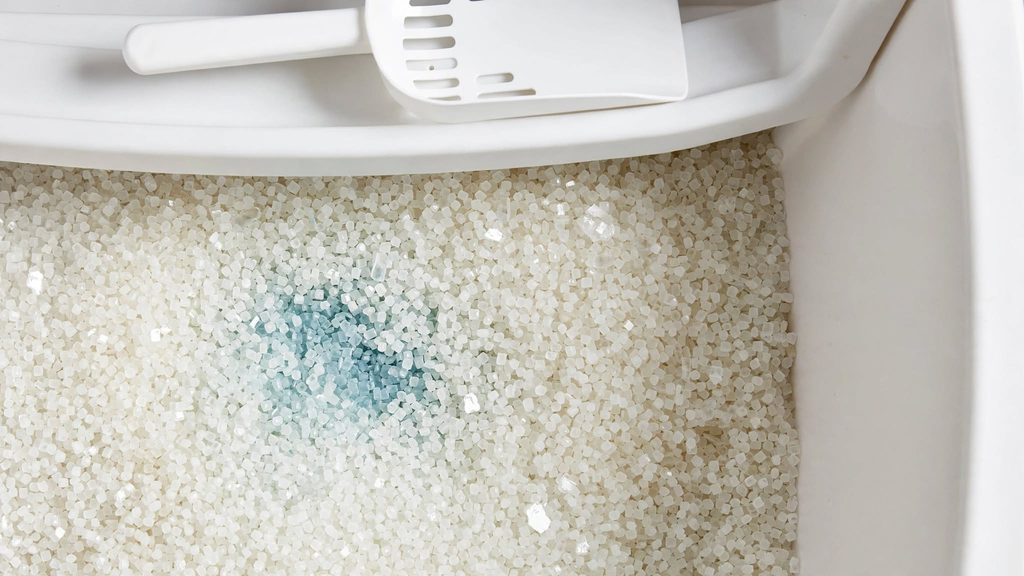
The term sounds broader than the technology really is. A common design uses silica crystals with indicators that react to urine acidity or alkalinity. PrettyLitter, for example, says its crystals can change color based on pH and can make visible blood easier to spot against the white litter. That means the litter is responding to a limited set of urine-related features. It is not running a full urinalysis, measuring kidney function, culturing bacteria, or identifying the mineral content of urinary stones.
This distinction matters because owners can easily read too much into a color chart. A blue or orange patch does not identify one disease. Urine pH can be influenced by diet, timing, stress, hydration, and disease. Blood can come from several lower urinary tract problems. Think of the litter as a smoke alarm, not a laboratory report. It may tell you that something changed and deserves attention. The next step is still observation and, when appropriate, veterinary testing.
A laboratory urinalysis can assess far more than a home litter indicator. Depending on the case, it may include urine concentration, protein, glucose, sediment, cells, crystals, and other findings, while a culture can look for bacterial growth. That difference explains why a color-changing litter should never be treated as a cheaper substitute for testing. Its advantage is frequency: it sits in the box every day. Its weakness is specificity. The clinic test is less frequent but far richer in diagnostic information.
What a Color Change Can Tell You
The strongest value is pattern recognition. If the litter has looked consistent for weeks and suddenly begins showing a different color repeatedly, that is useful information. PrettyLitter currently describes green or yellow-green as its typical range, blue as more alkaline, orange as more acidic, and red as visible blood. The company also states that the product cannot diagnose disease. That limitation should stay front and center when you interpret any result.
- A repeated pH-related color shift tells you that urine chemistry may have changed.
- Red staining can alert you to possible visible blood that deserves prompt attention.
- A change that appears once and disappears may be less meaningful than a persistent pattern.
- Any color becomes more important when it appears with straining, frequent trips, crying, licking, or reduced urine output.
Use the litter to sharpen the question you bring to your veterinarian, not to answer the question yourself.
Color charts also tempt people to search for one-to-one meanings: blue equals infection, orange equals stones, red equals one specific bladder disease. Feline urinary medicine does not work that way. Cornell lists several causes of lower urinary tract signs, including inflammation, stones, plugs, and infection, and the same cat can show similar outward signs across different causes. Treat the color as a reason to ask a better question, not as the answer printed in the box.
What It Cannot Tell You About Urinary Disease
A color-changing litter cannot distinguish feline idiopathic cystitis from a bacterial infection, stones, crystals, kidney disease, diabetes, or urethral obstruction. Those conditions can overlap in the signs they produce. Cornell notes that lower urinary tract disease is a group of disorders rather than one diagnosis, and that evaluation commonly involves a physical exam and urinalysis, with culture or imaging added when needed.
It also cannot tell you whether a male cat is blocked. A cat that strains repeatedly and passes little or no urine may have a urethral obstruction, which is an emergency. Waiting for the litter to turn a certain color would be unsafe. The same applies to a cat that is distressed, vomiting, collapsing, or repeatedly entering the box without producing urine. Monitoring technology is most useful before a crisis, when it helps you notice that a baseline has changed. It should never be used to downgrade an obvious emergency.
Why One Odd Reading Is Not the Same as a Trend
Urine is not chemically identical every time a cat urinates. Food, water intake, time since the last meal, stress, medications, and the condition of the litter itself can affect what you see. PrettyLitter’s own 2026 support guidance notes that temporary color changes can occur after diet changes, stress, moves, or routine changes. Saturated litter can also behave differently as it reaches the end of its useful life.
That makes context essential. Before reacting to a single patch, ask whether the box was freshly changed, whether food changed recently, whether the cat had an unusually stressful day, and whether the same color appears again. Photographing the litter under similar lighting can help because warm bathroom bulbs and phone-camera processing can distort color. A repeated change over multiple urinations is more informative than one ambiguous spot. But symptoms always outrank the color chart. A sick-looking cat does not need a two-day home experiment.
Lighting is an underrated source of confusion. Bathroom LEDs, warm lamps, daylight, and phone-camera white balance can make pale green, yellow, blue, and orange look different from one inspection to the next. If you are tracking a concern, check the litter under the same neutral light and photograph it from a similar distance. That simple control will not make the result diagnostic, but it reduces avoidable noise and makes a trend easier to discuss with a veterinarian.
Multi-Cat Homes Make the Data Much Harder to Interpret
Health-monitoring litter becomes less precise when several cats share a box. You may see a color shift without knowing which cat produced it. Even if one cat tends to favor a certain box, that is not the same as proof. Multi-cat households also make urine-volume changes harder to judge because clumps or wet areas represent several individuals. This is one reason litter-box monitoring works best when you already understand each cat’s normal habits.
If a concerning pattern appears, temporary separation may help only if it can be done without causing major stress and without restricting resources. Give each cat a comfortable room with food, water, resting space, and a box rather than simply shutting one cat in a bathroom. Another option is to observe box visits more closely or use a camera aimed at the approach area rather than inside the box. The goal is identification without making toileting feel unsafe. If symptoms are obvious, skip the detective work and call the veterinarian.
Automatic litter boxes and smart scales create a similar attribution problem. A device may record weight or visit frequency accurately while still misidentifying which cat entered. If you combine technologies, verify identity instead of assuming the app is correct. In a multi-cat home, the most useful monitoring system is often the simplest one you can confidently link to an individual cat: known box preference, direct observation, a temporary dedicated box, or a short video of the approach and exit.
Pair the Litter With the Clues It Cannot Measure

A strong monitoring routine includes information the litter cannot provide. Note whether urine spots are becoming much larger or smaller, whether the cat visits more often, and whether posture looks tense. Watch water intake, appetite, body weight, grooming, hiding, and energy. These details help separate a chemical change from a broader pattern of illness. They also give your veterinarian a more useful timeline.
This is where changes in an indoor cat’s normal health baseline matter more than any single gadget reading. A cat that is drinking more, losing weight, and producing larger urine spots needs a different conversation from a cat that has normal behavior but one brief pH color shift after a food change. The litter cannot make that distinction. You can, by combining the signal with everyday observation.
Urine volume deserves particular attention because color-changing products are usually designed around chemistry, not exact output. Larger urine spots together with increased thirst may fit a very different pattern from frequent tiny spots with straining. The first can occur with diseases that increase urine production; the second raises more concern for lower urinary tract discomfort or obstruction. You do not need to measure milliliters. You need to notice when the size and frequency of the wet areas depart from that cat’s usual pattern.
A Better Way to Use Monitoring Litter for Seven Days
If you want useful information instead of constant anxiety, run a short baseline week when your cat is well. Start with fresh litter and the correct depth. At roughly the same time each day, note the dominant color, approximate number of urine events, whether the wet areas look typical, and whether anything changed in food or routine. You do not need a spreadsheet with twenty variables. A small note on your phone is enough.
At the end of the week, you should know what “boring normal” looks like for that cat and that box. Later, a true departure is easier to spot. This method also reduces the urge to interpret every slight shade difference. If your product advises a particular response window for persistent color changes, follow that guidance, but combine it with symptoms. A cat showing pain or inability to urinate should be seen urgently even if the litter color looks ordinary.
A baseline week is especially useful before changing diets or litter products. If you start a urinary diet, move house, and switch monitoring litter on the same weekend, every new color becomes hard to interpret. When possible, establish the litter’s ordinary appearance first. Then document the date of later changes in food, medication, or routine. This turns the box into a timeline rather than a collection of isolated color moments.
When the Litter Is Helpful—and When It Is Just Extra Noise
Health-monitoring litter is most useful for an owner who will notice trends without treating them as diagnoses. It may provide an early nudge to look closer, document a change, or call the vet sooner. It is less useful if color shifts trigger repeated panic, if several cats make attribution impossible, or if the cat dislikes the litter texture and starts avoiding the box. Litter-box acceptance still comes first.
The best outcome is not catching a disease by color. It is having one more low-effort signal inside a larger care routine. Keep the box clean, watch your cat, and treat persistent urinary changes as information worth investigating. Technology can improve awareness. It cannot replace examination, urinalysis, imaging, or clinical judgment.
References
- PrettyLitter — Health Monitoring Cat Litter — Explains current color-change indicators and clearly states that the litter is not diagnostic.
- Cornell Feline Health Center — Feline Lower Urinary Tract Disease — Reviews urinary signs, causes, diagnostic testing, and urethral obstruction as an emergency.
- Cornell Feline Health Center — Chronic Kidney Disease — Shows why clinical urine testing provides information a home litter indicator cannot replace.
