

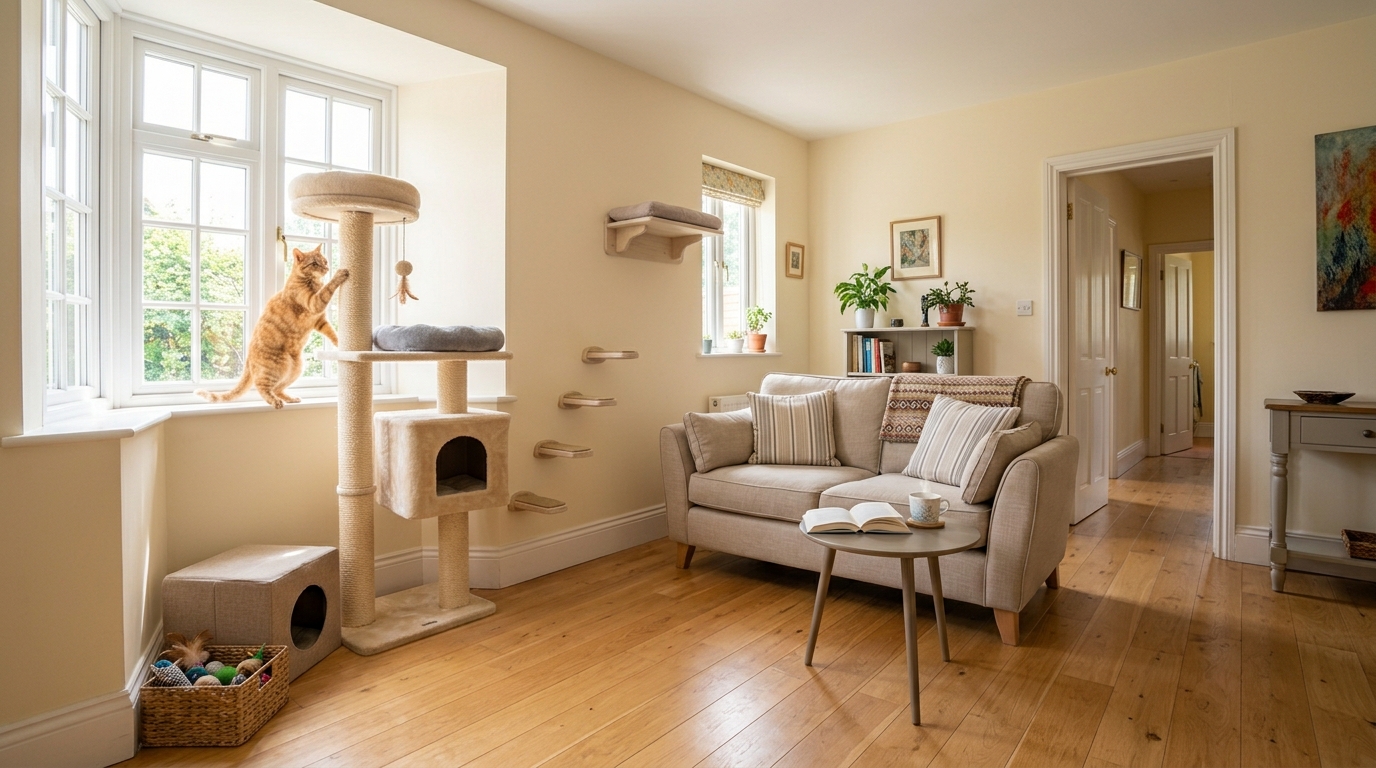
A cat corner in a small home works best as a compact activity and resting zone, not as a place where every feline resource is piled together. The corner can hold a scratcher, bed or hide, perch, toy storage, and part of a climbing route. Food, water, and litter may belong elsewhere because cats often benefit from key resources being separated. The design goal is to use one small footprint efficiently while keeping the rest of the home functional and giving the cat more than one kind of choice.
Decide What the Cat Corner Is Supposed to Do
Start with function. Is this a resting corner beside a window? A scratching and climbing zone beside the sofa? A play-storage area near the room where you spend evenings? Trying to make one square meter handle litter, food, water, sleep, play, grooming, and scratching usually creates clutter and puts resources too close together.
Choose two or three compatible functions. Resting, scratching, and climbing work well together. Play storage and a puzzle feeder can fit nearby. Litter does not need to be part of the corner simply because it is a “cat area.” A cat-friendly home is a network of usable resources, not one themed station.
Measure the footprint before shopping. A corner that is 70 centimeters wide may fit one tall scratcher and a narrow cabinet but not a broad cat tree. Knowing the real dimensions keeps the design honest. Leave enough clearance for a full-body stretch and for the cat to turn on any platform. Compact should describe the floor area, not the cat’s body space.
A Cat Corner in a Small Home Should Grow Upward
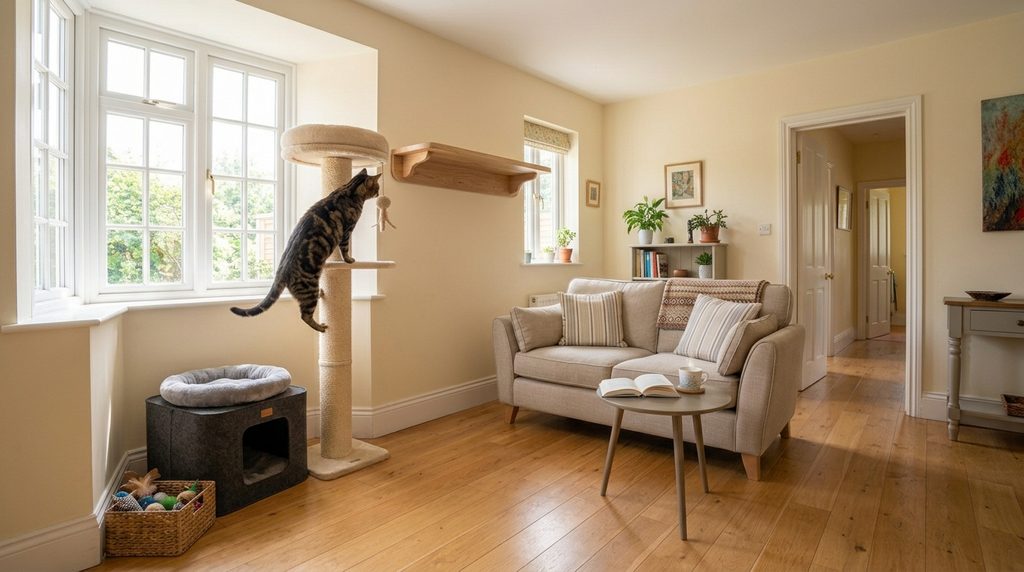
Vertical space lets the corner provide more territory without taking more floor area. A tall stable scratcher, wall perch, window ledge, or secure shelf can create several levels over the same footprint. Keep landings broad enough for the cat to pause. Build an easy route rather than one difficult leap to the highest point.
The corner can also connect to existing furniture. A low cabinet may become the first step to a perch. A sofa arm can lead toward a windowsill. The rest of the home can distribute safe places, scratching, feeding, water, toileting, and routes without forcing them into one station. That keeps the corner useful rather than overloaded.
Observe the room at different times. Morning sun may make one corner attractive, while afternoon heat makes it empty. Evening family activity may draw the cat closer to the sofa. A cat corner can work better when it supports the time of day the cat already uses that zone. One beautiful location may not serve every routine.
Put the Corner Where the Cat Already Wants to Be
A quiet unused corner may appeal to the person because it is empty, but the cat may have no reason to go there. Watch existing behavior. If your cat scratches the sofa after waking, a scratcher beside that sofa is more useful than one in a spare hallway. If the cat watches the street every afternoon, a corner near that window has built-in value.
Consider human traffic too. A resting corner should not sit where feet constantly pass or doors swing open. A play corner can be in a more active room. Match placement to function. The best cat corner often sits at the edge of normal family life, where the cat can observe without being in the middle of movement.
Protect nearby human furniture during the test period. A washable throw on the sofa arm or a temporary barrier can reduce damage while the new scratcher earns use. Reward the cat for choosing the permitted surface with calm attention or play. Avoid punishment near the corner. The area should become predictable and safe, not a place associated with being corrected.
Keep one easy route into the corner and one easy route out. A compact design should never make the cat squeeze behind furniture to leave.
Use One Strong Scratching Surface Instead of Several Tiny Ones
Small homes often accumulate multiple undersized scratchers because each purchase seems compact. A single sturdy scratcher matched to the cat’s preferred orientation can be more useful. If your cat stretches vertically, provide enough height for a full stretch and a base that does not wobble. If the cat prefers horizontal cardboard, use a low scratcher that can slide under furniture when not in use.
Place the scratcher where scratching already makes behavioral sense: near a sleeping spot, room entrance, or furniture the cat targets. The corner should make the permitted option easier than the sofa edge. If the cat ignores the scratcher, test placement and orientation before buying another product.
Do not permanently mount the resting surface on day one if you are unsure of height. Test with a stable piece of furniture first. If the cat consistently chooses the higher option, a wall perch may be worth installing. If the cat prefers the protected space underneath, invest in a better hide instead. Let behavior choose the upgrade.
Choose a Resting Feature That Matches the Cat’s Actual Preference
Not every cat wants a plush bed. Some prefer a folded blanket, cardboard box, open carrier, cool shelf, or firm chair. Copy the features of places your cat already chooses. A cat that sleeps under a chair may value overhead cover. A cat that stretches on a windowsill may prefer an open flat surface.
Use washable materials and keep the resting spot away from anything that vibrates or makes sudden noise. In a sunny corner, make sure the cat can leave the heat easily. A small hide can fit under a perch so the same footprint offers both visibility and privacy.
| If your cat prefers… | Try… | Skip… |
|---|---|---|
| High open naps | Wide perch or shelf | Deep enclosed bed only |
| Covered hiding | Box or cubby with easy exit | Exposed floor cushion |
| Cool hard surfaces | Firm washable platform | Thick warm bedding everywhere |
| Stretching after sleep | Scratcher beside resting spot | Scratcher across the room |
Leave some empty floor in front of the corner. Cats need space to stalk, chase, pounce, and turn. Filling the entire zone with beds and baskets can remove the movement area that makes play possible. Think of negative space as part of the design. The cat corner needs usable air and floor around its objects.
Keep Toy Storage Small Enough That Rotation Is Easy
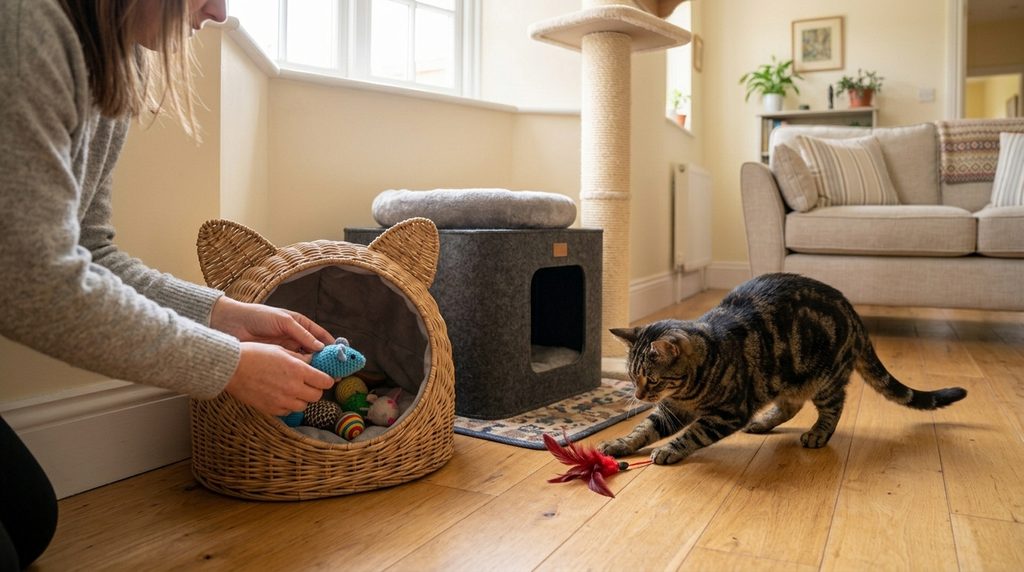
A basket overflowing with toys can become visual clutter without adding much enrichment. Keep a few safe solo toys available and store the rest. Rotate them every few days or when interest drops. Interactive wand toys should be stored safely when not supervised so strings are not left accessible.
- Keep one small container for rotating toys.
- Store wand toys where the cat cannot pull out the string.
- Use part of the normal ration in a puzzle feeder when appropriate.
- Remove damaged toys promptly.
- Leave floor space open enough for actual play.
The corner should not become a product display. Enrichment comes from what the cat can do there: scratch, climb, hide, watch, play, and rest.
Separate cat supplies from unsafe household items. Do not store cleaning chemicals, medications, string, or small swallowable objects in an open cubby under the perch. Closed drawers can hold human items while the visible surfaces stay cat-safe. Review storage after each household reorganization because new objects can quietly change landing space.
Hide Human Storage Under or Beside the Cat Zone
Small homes benefit when furniture serves more than one species. A bench can hold household storage while acting as an intermediate step. A cabinet can store grooming tools and toys while supporting a stable perch. Choose closed storage for items the cat should not access. Avoid drawers or lids that can trap paws or tails.
Keep the cat-facing surfaces clear. If a cabinet top is meant to be a perch, do not cover it with décor that makes landing difficult. A cat corner is more successful when the intended routes remain obvious. Human storage should support the system rather than competing with it.
Small-home layouts benefit from diagonal separation. Food may sit near one wall, water near another, and litter in the bathroom or opposite corner. The distances do not have to be large to create distinct zones. Even a bookcase edge, doorway, or change in flooring can help resources feel less clustered. Use the architecture you already have.
Do Not Put Litter, Food, and Water There Just to Make It Look Complete
One of the easiest small-home mistakes is making a single “pet station” with food above the litter box, water beside it, and a bed squeezed between them. It saves human steps but removes meaningful separation. Even in a compact home, resources can be spaced across different edges of the room, bathroom, hallway, or kitchen.
If the corner is beside the main resting area, keep it focused on rest, scratching, and play. Water can sit in another quiet location. Food can be served where you can monitor eating. Litter should have privacy, easy access, and enough room for a proper box. Small square footage requires thoughtful distribution, not total consolidation.
Take one photo before the cat starts using the corner and another two weeks later. The comparison can reveal where blankets migrate, which shelf collects fur, and which scratcher surface shows wear. Those signs show real use better than memory. Keep the successful pieces and simplify the rest. A small home benefits when every object earns its footprint.
Review cleaning effort too. If every toy must be moved before vacuuming or the perch fabric is difficult to wash, simplify the setup. Good design survives ordinary maintenance. The cat corner should make daily care easier, not create a miniature room that takes longer to clean than the rest of the apartment.
Seasonal changes can justify a small redesign. A sunny perch may be perfect in winter and too hot in summer. A drafty corner may become less appealing when air conditioning changes. Keep the core functions stable while adjusting bedding, shade, or perch location. The corner should follow the cat’s comfort through the year.
Keep the layout easy to reset after cleaning.
Review the Corner After Two Weeks of Real Use
Watch what your cat actually uses. Maybe the top perch is ignored while the lower shelf becomes a favorite bed. Perhaps the scratcher works only after it is moved closer to the sofa. A toy basket may block the landing route. These observations are more valuable than the original design plan.
Change one feature at a time. Move the scratcher before replacing it. Add traction before changing the shelf. Remove clutter before buying a larger cat tree. The corner should evolve around behavior. A compact setup that the cat uses every day is better than a highly styled corner that exists mainly for photographs.
References
- Client Education: What Your Cat Needs to Feel Secure — FelineVMA — Summarizes safe places, separated key resources, scratching, play, sleeping areas, and elevated territory for indoor cats.
- Setting Up the Environment for Success — FelineVMA — Explains why location, climbing options, scratching preferences, hiding places, and dispersed resources affect how cats use indoor environments.
- 2025 Indoor Cats Position Statement — FelineVMA — Highlights the five pillars of a healthy feline environment, including safe places, separated resources, play, predictable interaction, and sensory needs.
