

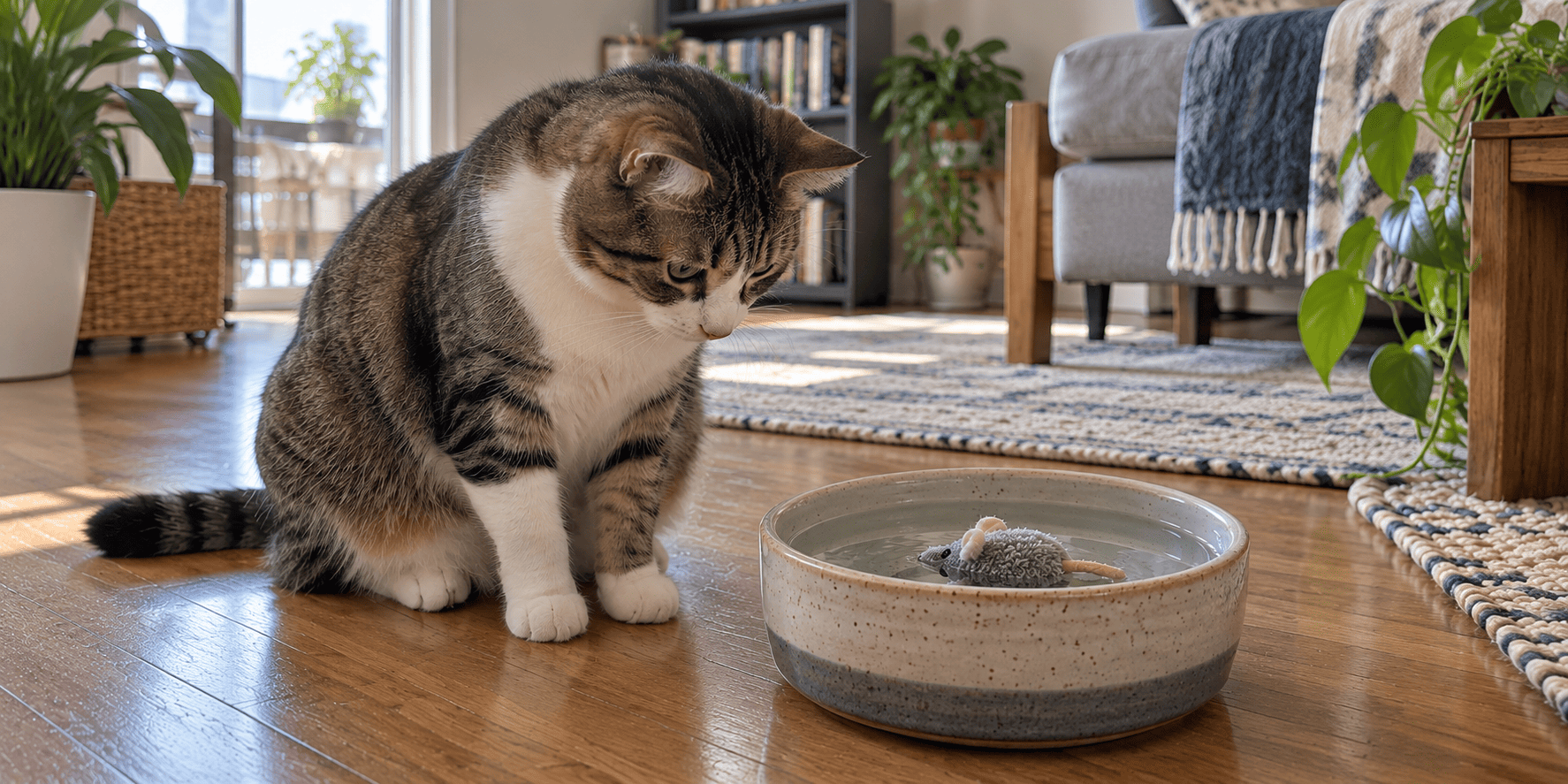
Finding a toy mouse, spring, or ball soaking in the water dish is strange but not automatically a problem. When a cat puts toys in water bowl, there is no well-established scientific rule that says the cat is “washing prey,” storing a catch, or saving it for later. Those explanations are popular online, but they go beyond what evidence can confidently show. A more grounded interpretation is that cats manipulate objects during play, some cats also play with water, and repeated routines can become self-reinforcing when an interesting toy and an interesting water surface meet.
Toys in Water Bowl: There Is No Single Proven Meaning
Object play in cats includes batting, carrying, pouncing, biting, clawing, and manipulating items. FelineVMA describes this as normal play that mimics parts of hunting behavior. A toy can therefore travel around the home as part of a play sequence. If a water bowl sits along that route, the toy may be dropped there intentionally or accidentally. Once wet, it moves, smells, and feels different, which may make the interaction interesting enough to repeat.
It is tempting to assign a detailed story to the behavior. Claims that the bowl represents a food cache, that the cat is drowning prey, or that water is a special “safe storage” site are difficult to support as universal explanations. Treat those as speculation, not fact. The most useful clues are what the cat does immediately before and after dropping the toy, which toys are chosen, and whether the behavior happens only at one water station.
Check whether the toy reaches the bowl by carrying or batting. Those are different sequences. Carrying shows the object stayed in the mouth. Batting can push a toy across the floor by chance. Watch from the side. Do not interrupt immediately. A few seconds of observation can answer more than the wet toy alone.
Water Itself Can Be Part of the Play
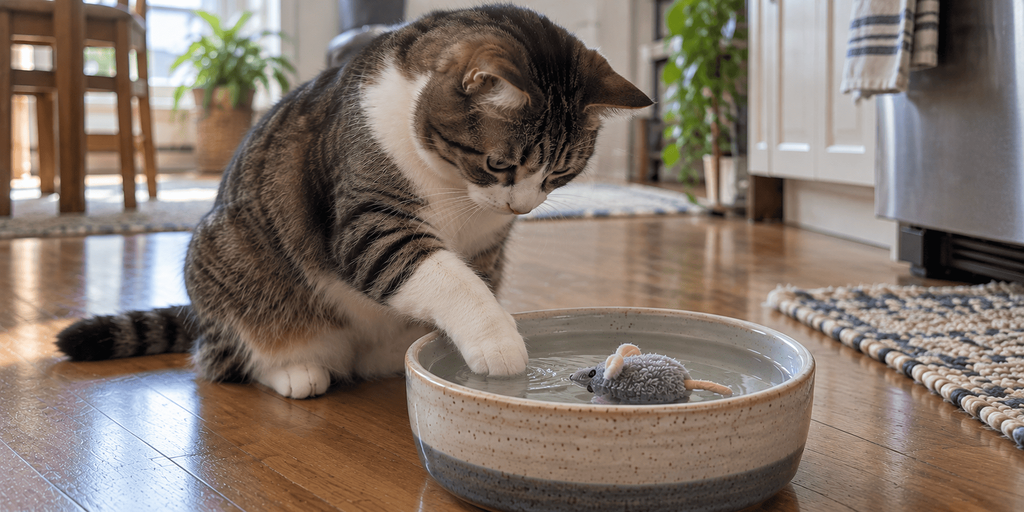
Some cats paw, splash, or play with water. In a small study comparing water sources, owners reported water play with both bowls and fountains in a subset of cats. That does not prove why toys are dropped into water, but it shows that the drinking station can also function as an interesting sensory location for some individuals. A floating toy changes the surface and may move when touched, creating another object to bat.
Watch whether the cat drops the toy and walks away or immediately begins fishing it out. Repeated pawing, scooping, and chasing the wet toy suggests the water interaction itself may be rewarding. If the cat simply carries a toy through the room and releases it over the bowl, the behavior may be part of object carrying with no special interest in water. Different cats can reach the same puddle by different routes.
The Bowl May Be on a Favorite Carrying Route
Map where play starts and ends. A cat may carry a toy from the living room toward a feeding area because that is where people spend time, where the cat pauses after play, or simply where the route narrows. If the water bowl is at the edge of the kitchen, toys may accumulate there because many daily paths cross that point. Moving the bowl a few feet can be a useful test.
Keep a second water source available while experimenting. The wider hydration setup should provide reliable access to fresh water alongside the moisture the cat already receives from food. Do not move every bowl repeatedly in an attempt to stop toy dropping. Cats benefit from predictable resources. Test one alternate location and observe for several days.
Some Toys Are More Likely to End Up Wet
Notice the type of toy. Lightweight fabric mice, foam balls, springs, and toys that are easy to carry may travel farther than large or heavy objects. A cat may also prefer toys that feel prey-like in the mouth. If only one particular toy repeatedly ends up in water, the behavior may be tied more to that object than to the bowl.
Discard toys that become unsafe when soaked. Glued decorations can loosen, stuffing can remain damp, dyes can run, and metal parts can rust. Wash washable toys and allow them to dry fully. Do not leave string, yarn, ribbon, or small pieces in the bowl where they can become a swallowing hazard. Water-safe does not mean chew-safe, and cat-safe does not mean safe after repeated saturation.
Your Reaction Can Become Part of the Routine
A wet toy often gets an immediate human response. You notice the bowl, talk to the cat, retrieve the toy, refill the water, or begin a game. Even if attention did not cause the first incident, predictable consequences can make a behavior more likely to recur. Keep cleanup neutral. Remove the toy, refresh dirty water, and return to your normal routine.
Give attention and interactive play at planned times that are not triggered by the bowl. A cat with strong object-play drive may benefit from several short sessions in which chasing and catching are allowed. Rotate toys so the same wet-mouse routine is not the only interesting event. Punishment is unnecessary and can make the drinking area stressful. The goal is not to prove whether attention is involved; it is to avoid accidentally making a messy behavior the fastest route to a big household reaction.
Use washable toys for any cat that repeats the routine. Avoid absorbent objects that stay damp for hours. Smell the toy after drying. Discard anything musty. Check seams. Remove loose eyes or bells. Water can weaken glue and fabric, so inspect favorite dunking toys more often than dry toys.
Protect Water Quality Even If the Behavior Is Harmless
The main practical problem is hygiene. Fabric toys can carry dust, litter particles, saliva, and floor debris into the water. If a toy has been soaking, remove it and replace the water rather than leaving the bowl dirty for the rest of the day. Wash the bowl regularly. If the cat drops toys frequently while you are away, offer another water station in a separate area so clean water remains available.
A fountain may or may not help. Some cats are less likely to drop objects into a fountain design, while others become even more interested in moving water. If you use one, keep the internal pump and channels clean. A covered reservoir is not automatically cleaner if toys, paws, or debris still contact the drinking surface. The best setup is one you can maintain consistently.
- Remove soaked toys and refresh visibly dirty water.
- Provide another clean water source elsewhere.
- Wash fabric toys and dry them completely.
- Discard damaged toys or loose parts.
- Keep string-type toys away from unsupervised water play.
- Use a stable bowl and waterproof mat if fishing creates spills.
Try a Simple Two-Week Pattern Test
If you are curious about what maintains the behavior, keep the test simple. For the first several days, note which toy ends up in which water source and roughly when. Then change one variable. Move the favorite carry toy out of rotation, or place one water bowl in a different quiet location while leaving another familiar station unchanged. Do not change toy type, water bowl, feeding schedule, and room layout all at once.
Look for a pattern rather than a perfect experiment. When only soft mice are dropped, toy preference matters. A pattern involving one bowl but not the second points more toward location or bowl characteristics. Behavior that clusters after energetic play may be part of the play sequence. No consistent pattern may simply mean variable play rather than a problem needing a precise explanation.
Keep at least one water source outside the main play route. This gives the cat a cleaner option. It also helps you see whether toy dropping is tied to one location. Do not hide all water to protect the floor. Reliable access matters more than stopping a harmless quirk.
Check the bowl before bed. Remove soaked objects. Refill fresh water. Look again in the morning. This simple routine protects overnight access. It also shows how often the behavior occurs when nobody is reacting to it.
Do Not Confuse Toy Dropping With a Change in Thirst
A cat spending more time around water may be noticed first because the bowl becomes messier. If the cat also drinks much more, empties bowls faster, produces larger urine clumps, loses weight, or changes appetite, the health change matters more than the toy behavior. Increased thirst and urination can occur with conditions such as kidney disease, diabetes, and hyperthyroidism.
Likewise, a cat that stops drinking normally because the bowl is constantly dirty needs another clean source. Do not restrict water to stop the toy routine. If thirst has clearly changed or the cat seems unwell, contact your veterinarian. The toy in the dish is not a diagnostic sign, but it can draw your attention to a water station where other changes are occurring.
Try ending interactive play several feet from the water station. Let the cat catch the toy there. Pause. Offer a box or tunnel nearby. Then put the wand away. This changes the end of the play sequence without punishment. It may reduce trips toward the bowl for some cats.
Keep a dry spare of the favorite toy when possible. Rotate it after washing. This prevents a damp toy from becoming the only available play object. It also lets you compare whether the cat seeks that toy specifically or simply carries whatever object is nearby.
Give Object Play Better Places to Happen
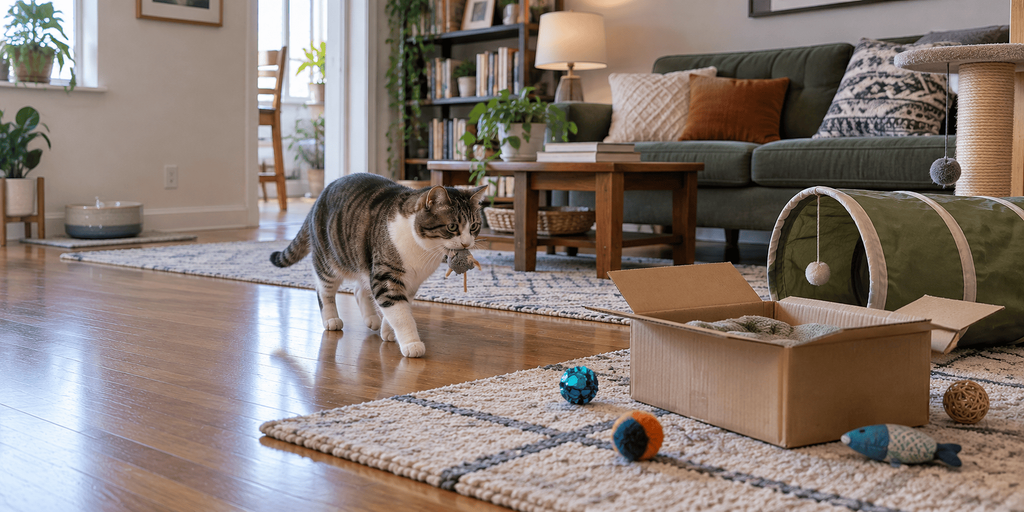
Normal feline play benefits from opportunities to chase, pounce, carry, and capture. Offer a few safe toys in areas where energetic play does not collide with food and water. Use a wand toy under supervision, toss lightweight cat-safe objects down a clear hallway, or provide a cardboard box for stalking and pouncing. End play with a successful catch instead of keeping the toy permanently out of reach.
Some cats enjoy carrying objects after play. You do not need to stop carrying. If the water bowl is the only dramatic destination, create other interesting endpoints: a box, tunnel, or open toy basket in the normal play area. This is not guaranteed to redirect the behavior, but it gives object manipulation somewhere else to continue. Enrichment should expand options rather than punish one harmless choice.
Read the Bigger Picture
There is no strong evidence for one symbolic meaning when cats put toys in water bowl. The behavior fits comfortably within normal object manipulation, and some cats also find water interesting to paw and play with. Your cat may be repeating a sensory game, carrying toys along a familiar route, or simply discovering that a wet toy is different.
Keep the response practical: protect clean water, dry or replace soaked toys, provide another station if needed, and offer normal play elsewhere. If the behavior appears alongside a clear change in thirst, urination, weight, appetite, or general health, pay attention to that larger pattern rather than trying to decode the toy.
References
- Setting Up the Environment for Success — FelineVMA — Describes normal feline object play, including manipulating toys with paws, and the importance of play opportunities and well-placed resources.
- Effect of Water Source on Intake and Urine Concentration in Healthy Cats — Journal of Feline Medicine and Surgery/PMC — A small water-source study that documented owner-reported play with bowls and fountains in some cats, supporting individual variation in water interaction.
- Hydration — Cornell Feline Health Center — Covers fresh-water access, food moisture, fountain preferences, dehydration, and medical or household factors that can alter drinking.
