

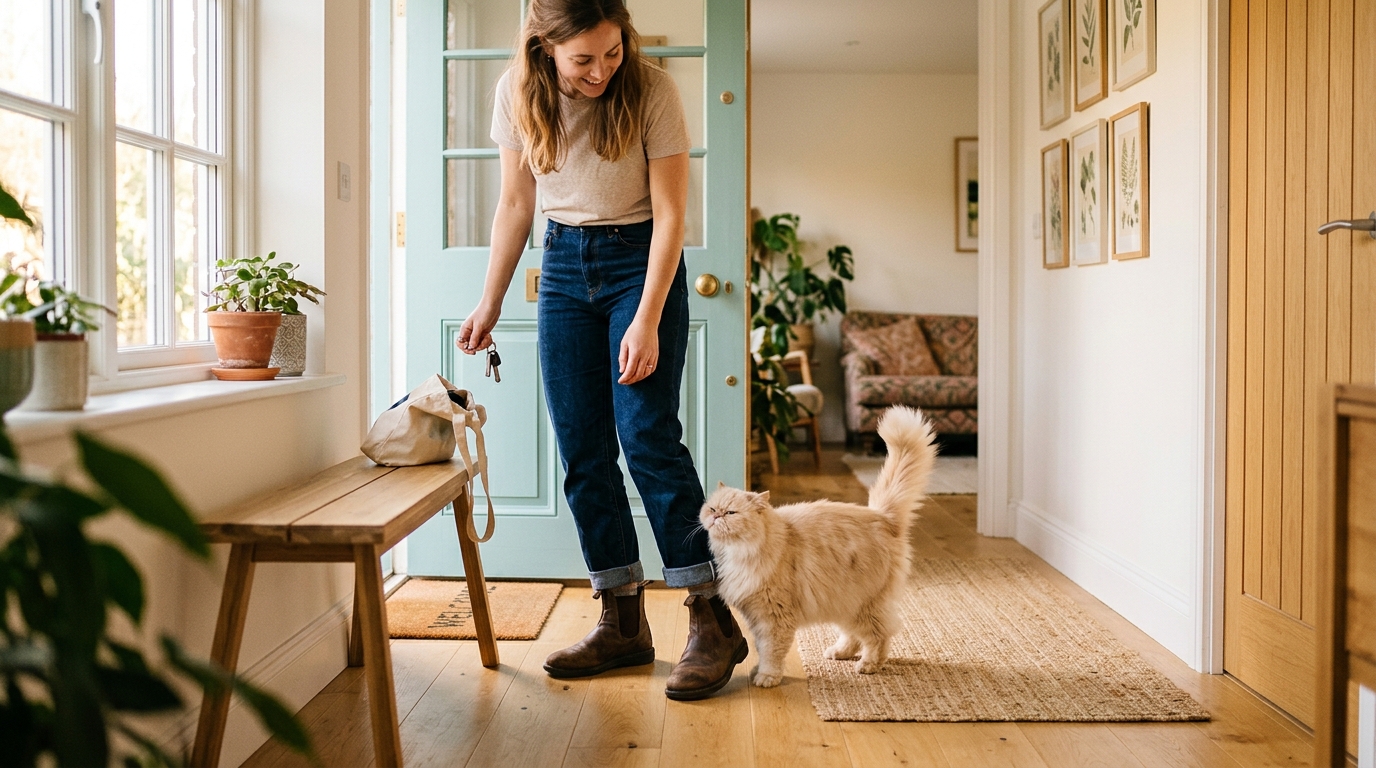
If you are asking why does my cat rub against me, the behavior is usually part greeting, part scent communication, and part social routine. Cats commonly rub the cheeks, forehead, sides of the body, or tail base against familiar people and objects. The motion can deposit familiar scent while also creating physical contact. Context tells you what the rub means in that moment: a tail-up cheek rub when you come home is different from frantic rubbing around your legs while you prepare dinner, and both are different from sudden rubbing paired with skin irritation or unusual agitation.
Look at Which Part of the Cat Makes Contact
Face rubbing and full-body rubbing can look similar from a distance but may happen in different sequences. A cat may press the cheek or forehead first, then slide the shoulder and flank along your leg. Another may wrap the tail around you after a brief head bump. Watch the whole movement instead of interpreting one touch in isolation.
Facial areas are important in feline scent communication, and rubbing helps make people and objects part of a familiar environment. Full-body contact can also be social and tactile. The important point is that the cat is choosing proximity. A loose cat that approaches, rubs, pauses, and remains nearby is giving a different message from a tense cat that brushes past while trying to escape a crowded space.
Notice whether the cat rubs everyone the same way. Some cats greet one person with cheek contact and another with a tail wrap or vocalization. Familiar relationships can have their own routines. That variation is normal. It also reminds you not to force a greeting style. A cat that approaches one person but keeps more distance from another should be allowed to control that difference.
Why Does My Cat Rub Against Me When I Come Home?
Homecoming creates a predictable social event. Your scent may have changed after hours outside the home, and the cat may greet you with rubbing, tail-up posture, vocalization, or following. The behavior can restore familiar contact while also functioning as a routine greeting. Some cats perform the same sequence every day: approach the door, rub one leg, circle, then walk toward another part of the home.
Do not assume the rub always means “pick me up.” Many cats enjoy contact while keeping four paws on the floor. Let the cat decide whether the interaction continues. Offer a hand near cheek level rather than reaching over the head. If the cat rubs again or stays close, that is a clearer invitation than the first pass alone.
After cleaning, you may see rubbing increase on edges the cat uses often. That does not mean the home was cleaned incorrectly. Familiar scent cues have simply changed. Use unscented or mild products where appropriate and avoid repeatedly wiping the cat’s preferred rubbing points with strong fragrance. The home should smell clean to people without becoming an unfamiliar scent environment for the cat.
Rubbing Helps Build a Familiar Scent Landscape

Cats experience the home partly through scent. They rub on furniture, doorways, corners, people, and sometimes other cats. This repeated contact helps create a familiar sensory environment. A household can feel different after deep cleaning, new furniture, visitors, or a move because familiar scent cues have changed.
This fits with the broader way indoor cat behavior uses scent, scratching, hiding, climbing, vocalizing, and routine to manage the environment. Rubbing is not a mystical ownership claim. It is one of several normal ways cats interact with spaces and social partners. If a cat immediately rubs on a new chair, it may be investigating and adding familiar scent rather than “claiming” it in a human sense.
Test the food connection by changing your own sequence, not the cat’s meal amount. If you normally feed immediately after the first ankle rub, pause and complete one neutral task before serving the planned meal. Over several days, you may see whether the rubbing is tied to your arrival, the kitchen routine, or the actual food cue. Keep the meal time predictable while you observe.
Some cats also rub during other predictable events, such as bedtime or when you sit at a desk. Repetition can turn ordinary social contact into a shared household ritual.
Food Routines Can Turn Rubbing Into a Learned Request
If rubbing consistently happens before meals, the behavior may be reinforced by what happens next. The cat rubs your ankles, you walk to the kitchen, and food appears. Over time, rubbing can become part of the cue sequence. That does not make the behavior manipulative. It means the cat has learned that a familiar action predicts a valued event.
Watch timing. If the cat rubs only when you approach the food cabinet, the immediate function may be different from relaxed cheek rubbing on the sofa. Avoid adding extra food every time the behavior appears if the daily ration is already appropriate. You can respond with attention, a short interaction, or simply follow the normal meal schedule.
Observe what the cat does after the rub. Staying close, sitting beside you, or returning for another cheek contact supports a social interaction. Walking directly to the food area may show that the greeting is linked to a routine. Moving to a window and settling there suggests the contact was brief and complete. The next action helps define the current purpose.
Rubbing Can Be Affectionate Without Being a Simple “I Love You” Translation
People often want one-word translations for cat behavior. Rubbing is more useful when read as a cluster of social and sensory signals. A cat that approaches voluntarily, holds the tail upright, rubs, slow blinks, and settles nearby appears comfortable with the interaction. The same rub after you stop petting may be a request for continued contact.
However, affection is not the only possible explanation. Familiarity, scent transfer, greeting, anticipation, and attention seeking can all occur together. That complexity does not make the behavior less positive. It simply keeps you from forcing every rub into one emotional label.
| Context | Likely useful interpretation | Good response |
|---|---|---|
| You just came home | Greeting and familiar scent contact | Pause and let the cat approach |
| Before a normal meal | Anticipation and learned routine | Keep the feeding schedule consistent |
| During relaxed petting | Continued social contact | Pet briefly if the cat stays loose |
| After new furniture arrives | Investigation and scent familiarity | Let the cat explore safely |
| With skin irritation or frantic behavior | May not be ordinary social rubbing | Check for other signs and seek advice if persistent |
The same idea applies when the cat rubs an object beside you. It may be comfortable sharing the space without requesting human contact. Sit nearby and let the cat choose whether to close the distance. This low-pressure response is useful with shy cats because it makes approaching and leaving equally safe.
Your Cat May Rub and Then Walk Away
A rub does not create an obligation to continue touching. Cats often make brief contact and then move on. If your cat rubs your leg and walks to a window, it may have completed the social exchange it wanted. Following and picking the cat up can turn a positive moment into pressure.
Let short interactions stay short. This is especially useful with cats that become overstimulated during petting. A cat may enjoy greeting contact but not long body strokes. Respecting the cat’s exit makes future approaches more predictable and gives the cat control over distance.
Some cats prefer cheek and head contact but dislike strokes along the back. If the rub begins with the face, try matching that location rather than automatically petting the whole body. Stop after a few seconds. If the cat presses the cheek back into your hand, continue briefly. This simple pause helps separate “I want contact” from “I want a long petting session.”
Watch for Overstimulation When Rubbing Turns Into Petting

Rubbing can encourage people to start petting, but tolerance may change quickly. Watch the tail, ears, skin movement, body tension, and whether the cat leans away. If the cat begins flicking the tail more strongly, turns sharply toward your hand, or leaves, stop. Early signals are more useful than waiting for a swat or bite.
- Keep initial petting brief after a greeting rub.
- Favor areas the cat regularly seeks, such as cheeks or head.
- Pause and let the cat reinitiate.
- Do not restrain a cat that is trying to move away.
- Teach children to let the cat approach first.
A cat can want proximity without wanting continuous touch. Rubbing itself may be the preferred interaction.
Also look for environmental triggers. New furniture, a recently cleaned room, another animal’s scent on your clothes, or a move can increase investigation and rubbing. If the cat otherwise eats, plays, grooms, and rests normally, watch the pattern for a short period. If physical signs appear or the behavior stays unusually intense, veterinary advice becomes more appropriate.
Sudden Excessive Rubbing Deserves Context
A cat that has always rubbed on people may simply become more social at certain times. But a sudden major increase, especially with scratching, hair loss, ear irritation, skin redness, agitation, or repeated rubbing of one body area, deserves closer attention. Physical discomfort can change how a cat contacts surfaces.
Do not assume every intense rub is behavioral. Check the skin and coat gently if the cat allows it. Persistent head shaking, ear debris, bald areas, sores, or obvious sensitivity should be discussed with a veterinarian. Behavior and medical problems can overlap, so the newness of the pattern matters.
Keep changes in perspective. A cat that rubs more after you return from travel may simply be re-establishing a familiar routine. A cat that suddenly rubs the face against hard surfaces for long periods while shaking the head or scratching the ears may need a medical check. The action can look similar while the surrounding clues point in different directions.
If the rubbing is welcome but inconvenient around your feet, redirect rather than punish. Pause walking, invite the cat toward a nearby mat or perch, and reward calm contact there. This can reduce tripping without making social approach unsafe. The behavior is normal; the household simply needs a safer place for it to happen.
Read Rubbing as One Part of the Relationship
Most rubbing against a familiar person is normal social and scent-related behavior. The best interpretation comes from timing, posture, sequence, and what happens afterward. A relaxed greeting rub, a meal-time ankle weave, and a cheek press during petting can all be normal while serving slightly different purposes.
Respond to the cat in front of you. Let the cat approach, keep interactions predictable, and stop when the cat creates distance. When the behavior changes sharply or appears with physical signs, treat the change as useful information rather than assuming the cat has simply become “more affectionate.”
References
- Are You a Cat Champion? — Cat Friendly Homes — Explains that cats rub their face and body on people and objects as part of scent communication and creating a familiar, secure environment.
- Setting Up the Environment for Success — FelineVMA — Provides context for feline scent, social behavior, predictable interactions, and how cats use environmental cues.
- AAFP/ISFM Environmental Needs Guidelines — FelineVMA — Describes the sensory and social needs that shape normal feline interaction with people and the home.
