

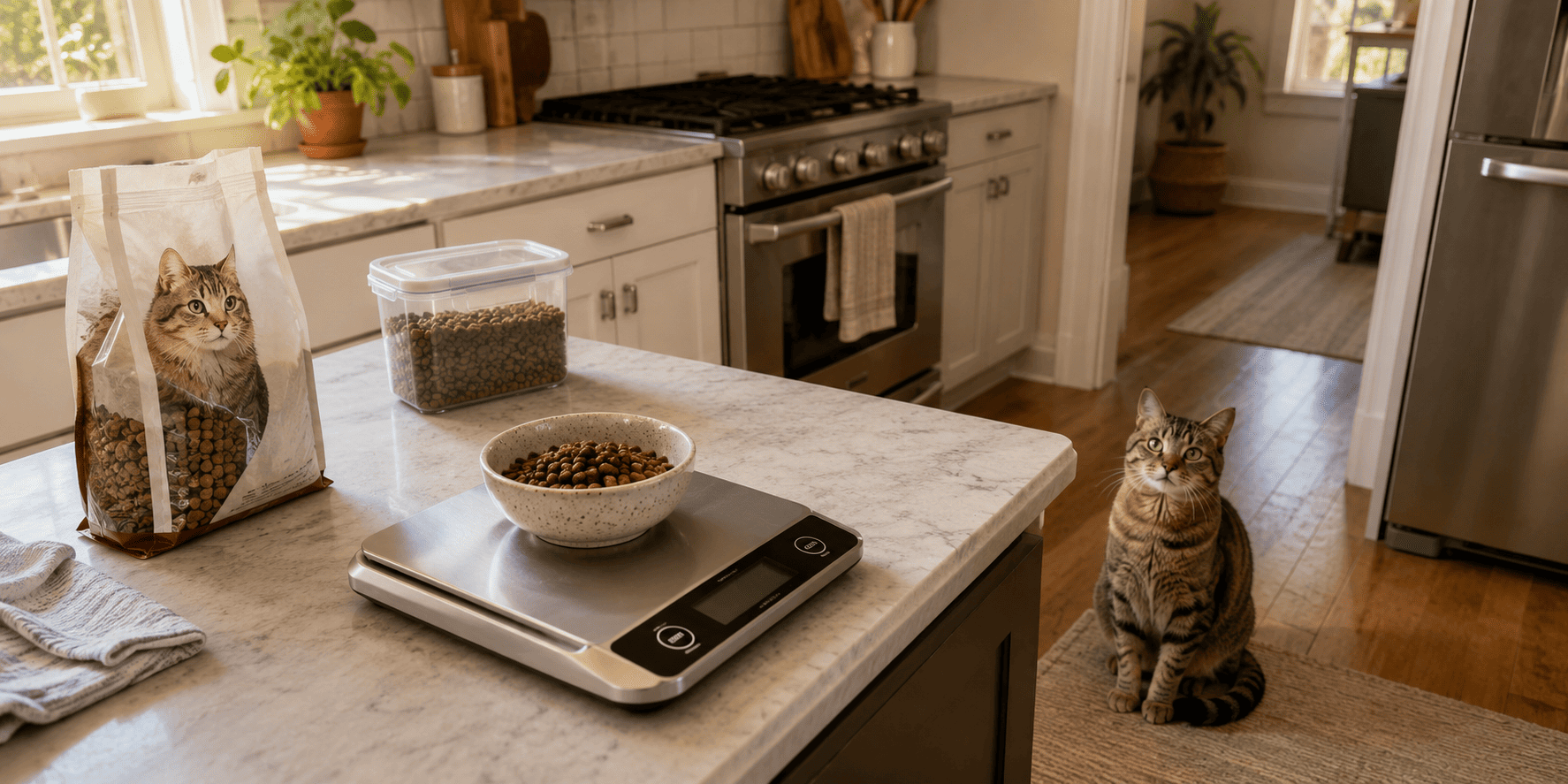
Learning how to measure cat food portions removes one of the biggest sources of feeding drift: the scoop that looks “about right.” Cat foods vary widely in calorie density, and a small volume error can matter when the whole daily ration is compact. The practical method is to identify the calories in the exact food, decide on an appropriate daily target with your veterinarian when needed, convert that target into grams or cans, and then serve repeatable portions. A kitchen scale is usually more consistent than a cup for dry food, while wet food can be divided by package calories or weight. The final check is the cat’s body condition and weight trend, not the math alone.
Find the Calorie Statement Before You Measure Anything
Look for kcal per can, pouch, cup, kilogram, or serving on the package or manufacturer information. You cannot accurately compare portions by volume until you know how much energy that volume contains. Two dry foods can look nearly identical in a scoop while providing different calories. Wet foods also vary by recipe and can size. Record the number for the exact product and flavor you feed rather than borrowing a value from a similar food online.
If the label lists only kcal per kilogram, the manufacturer may provide a per-cup or per-can value on its website or through customer support. Keep the calorie information with your feeding notes so a food change does not quietly inherit the old portion. A new bag is a good time to verify the number again, especially if the formula or package size changed.
Take a photo of the calorie statement when you open a new food. Packaging can be discarded while the bag is stored in a container, and the number is easy to forget. Keeping the label information with your feeding record prevents future calculations from relying on memory.
Measure Cat Food Portions in Grams for Better Repeatability
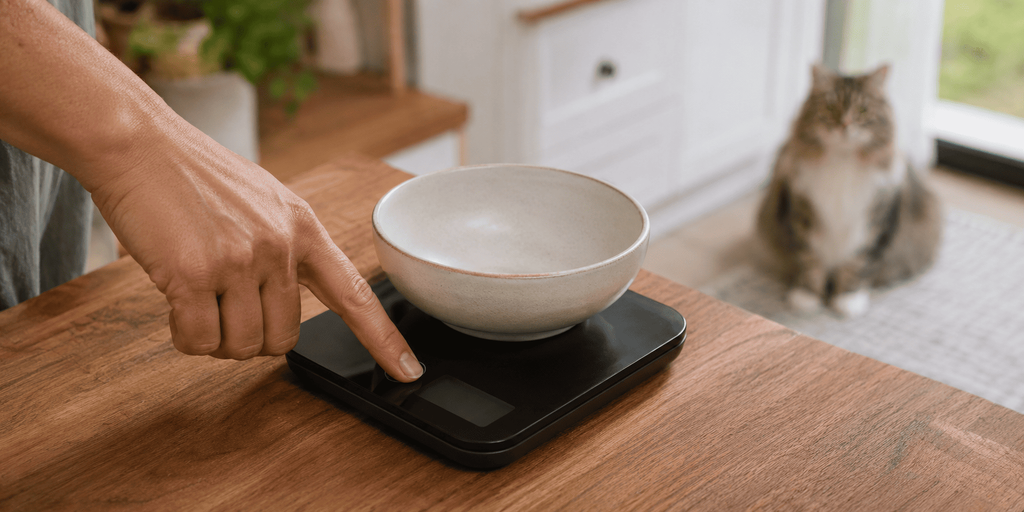
For dry food, grams are usually easier to repeat than cups. Place the empty bowl on a digital kitchen scale, press tare to return the display to zero, then add the planned amount. Do this for several meals until the motion becomes automatic. A level measuring cup can still be useful for travel, but a cup is vulnerable to packing, rounding, and different scoop shapes. The scale removes most of that variation.
If another person feeds the cat, write the gram amount where food is stored. “45 g for the day” is clearer than “a little under half a cup.” You can also pre-weigh the whole day into one container, then divide it into meals. That method prevents accidental double feeding and makes it obvious how much remains for later.
Kitchen scales are most useful when they display single grams clearly and have a tare function. You do not need a specialty pet scale for food. Check that the bowl fits without covering the display, and place the scale on a hard level surface rather than a soft mat.
Convert Calories Into a Daily Portion
Once you have a daily calorie target and the food’s calorie density, the conversion is simple division. If a food provides 4 kcal per gram and the planned food calories are 200 kcal, the daily amount would be 50 g. If a can provides 90 kcal and the plan allows 180 kcal from that food, two cans supply the target. These examples show the method, not a prescription for your cat. Individual energy needs vary, so the target itself may need veterinary input.
| Example | Food information | Portion math |
|---|---|---|
| Dry food | 4 kcal/g; 200 kcal planned | 200 ÷ 4 = 50 g |
| Wet food | 90 kcal/can; 180 kcal planned | 180 ÷ 90 = 2 cans |
| Mixed feeding | 90 kcal wet + 110 kcal dry | Subtract wet calories, then weigh the dry remainder |
Use the exact calorie value on your product. The arithmetic is only as accurate as the number you put into it.
When using a veterinarian-provided calorie target, ask whether that number includes treats and toppers. A misunderstanding here can add a second calorie budget by accident. Write down the target and the food calorie density together so anyone can repeat the conversion later.
Wet Food Can Be Split by Calories or Weight
If one can equals one meal, portioning is easy. When a can contains multiple meals, weigh the full contents in a clean container and divide by the number of planned servings. For example, if the food weighs 150 g and you want three equal meals, each portion is about 50 g. This does not change the calories in the can; it simply makes the split consistent. Refrigerate unused food safely and serve it according to product guidance.
Some cats dislike food straight from the refrigerator. Warming it slightly to a comfortable temperature or allowing a portion to lose the chill can improve acceptance, but do not use heat as an excuse to leave wet food out for long periods. If the cat regularly leaves part of a weighed portion, record what is actually eaten. A measured serving is useful only if you distinguish food offered from food consumed.
If the cat leaves food, weigh leftovers only when that information is genuinely useful. For most healthy cats, consistent offered portions and body-weight trends are enough. More detailed intake measurement becomes valuable when appetite is changing or a veterinarian specifically wants consumption data.
Mixed Feeding Requires One Combined Calculation
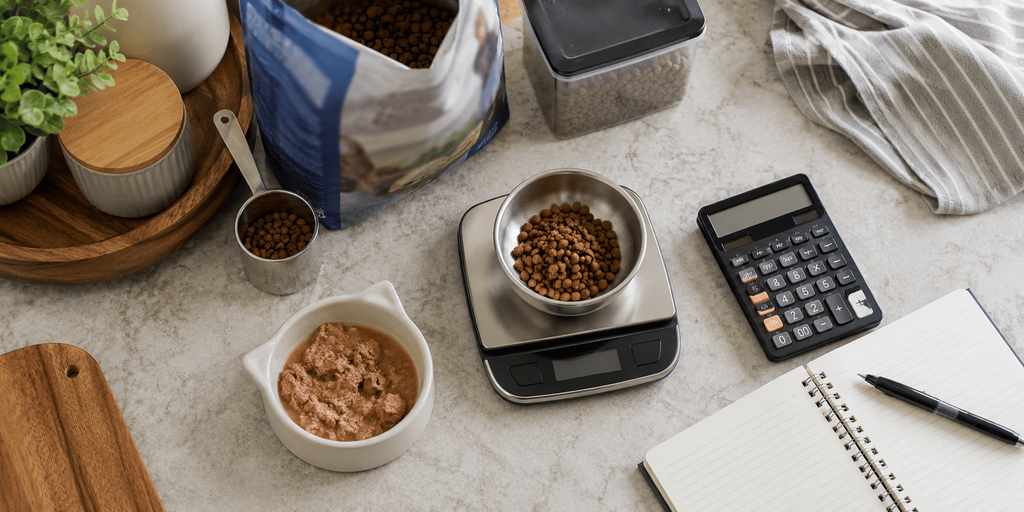
The common mixed-feeding mistake is serving a full dry ration and then adding wet food because the can looks small. Instead, decide how many calories each format contributes. If the day allows 220 kcal and one wet meal provides 90 kcal, the remaining 130 kcal can come from dry food. Convert that remainder using the dry food’s kcal per gram. This keeps the total stable while allowing both formats.
This calculation is easier after you have settled which food formats fit your cat and how the full daily diet is structured. Once the wet-to-dry balance is chosen, save the gram amounts so you do not recalculate every meal. Recheck only when the food, calorie target, or feeding plan changes.
Mixed feeding is also easier when each food has a fixed role. For example, keep wet breakfast and dinner constant, then adjust only the weighed dry portion if calories need to change. This avoids recalculating every component whenever a small adjustment is made.
Recheck the math after any product change, even within the same brand. Different recipes can have different calorie density. The gram amount that maintained weight on one formula is not automatically transferable to another, so treat a food switch as a new calculation.
Treats and Toppers Need Their Own Line in the Math
Treats, lickable snacks, dental chews, table tastes, and calorie-dense toppers can turn a careful food portion into an accidental surplus. Count them within the day rather than treating them as nutritionally invisible. If you train with treats, break them into tiny pieces or reserve part of the normal kibble ration for rewards. In multi-person homes, decide who gives extras or pre-measure a daily treat allowance.
- Check calories per treat or serving when the package provides them.
- Use small pieces for training rather than full-sized rewards every time.
- Include calorie-dense toppers in the daily total.
- Do not compensate for treats by making extreme cuts to complete food.
- Keep the nutritionally complete diet as the foundation.
If your veterinarian has prescribed a therapeutic diet, ask whether non-diet treats or toppers are compatible with the treatment goal.
Treat calories can be surprisingly difficult to remember because they arrive in small moments. A jar containing the entire day’s treat allowance creates a visible limit. Everyone takes rewards from that jar, and any leftovers remain part of the next meal rather than becoming bonus calories.
Use a Feeding Station That Prevents Portion Drift
Measurement fails when the household system is confusing. Store the scale beside the food, use one labeled scoop only if you need a transfer tool, and keep a note with daily grams and meal splits. If two people may feed breakfast, use a simple marker, container, or checklist to show that the meal has already happened. For timed feeders, weigh what each compartment actually holds rather than trusting a volume mark. Small organizational changes prevent more errors than repeatedly recalculating calories.
Do not let convenience create a second unmeasured source. A bowl that is topped up “just in case” defeats the point of weighed meals. If your cat grazes, measure the entire day’s allowance in the morning and offer only from that amount. Leftovers at the end of the day then become useful appetite information.
Pre-portioned containers are especially helpful for pet sitters. Label the day and meal rather than asking someone unfamiliar with the cat to interpret a scoop. Clear instructions reduce both overfeeding and the risk that a cautious sitter underfeeds because they are unsure.
A small dry-erase note on the food container can make the system easier to maintain: daily grams, meals per day, and treat allowance. Update it only when the food or plan changes. Clear routine reduces the chance that precise measuring turns into a complicated task nobody follows.
If you switch between multiple foods, keep a small note for each product with kcal per gram, normal meal amount, and date opened. This prevents mental math from becoming the weakest part of an otherwise precise routine. It also helps a pet sitter or family member follow the same plan without guessing.
Body Condition and Weight Decide Whether the Number Is Working
A calculated portion is a starting point. Cats differ in energy needs, and package feeding guides describe averages rather than guarantees. Weigh your cat periodically under similar conditions and learn basic body-condition assessment. Ribs should be palpable under a light covering, and a waist should be visible from above in a cat at ideal condition. Muscle condition matters separately, especially in seniors, because an older cat can lose muscle even if body weight changes little.
Use trends rather than one scale reading. Hydration, a recent meal, and scale variation can move the number slightly. If weight consistently rises or falls, review portion accuracy, treats, activity, and health before making large changes. Veterinary guidance is important for kittens, seniors with muscle loss, underweight cats, obesity treatment, pregnancy, nursing, or medical diets.
If weight changes unexpectedly despite accurate portions, do not keep cutting or adding food without considering health. Increased appetite with weight loss, reduced appetite, vomiting, diarrhea, or muscle loss may need medical evaluation. Measurement helps reveal that the ration did not explain the change.
The useful habit is therefore not obsessive weighing forever; it is repeatability. Once you know that a certain gram amount maintains healthy body condition, the scale takes seconds. It also gives you a clear baseline when appetite, weight, food type, or health changes. Measuring turns “I think she eats about this much” into information you can actually use.
Adjust Portions in Small Steps and Keep the Measurement Method
When a portion needs correction, change the amount in a measured way rather than returning to visual guessing. Keep the same scale, food, and meal system while you adjust so you can see the effect. If your veterinarian recommends a new calorie target, convert it into grams using the current food’s energy density and update every feeder, note, and household instruction. A precise plan is only precise if all feeding points use the same number.
References
- Feeding Your Cat — Cornell Feline Health Center — Current guidance on complete diets, calories, body condition, treats, appetite, and adjusting intake to maintain healthy weight.
- Global Nutrition Guidelines and Toolkit — WSAVA — Provides body-condition tools, calorie guidance, nutrition assessment resources, and feeding-monitoring materials for dogs and cats.
- Calorie Needs for Healthy Adult Cats — WSAVA — Offers calorie starting ranges for healthy adult cats while emphasizing that individual requirements vary.
