

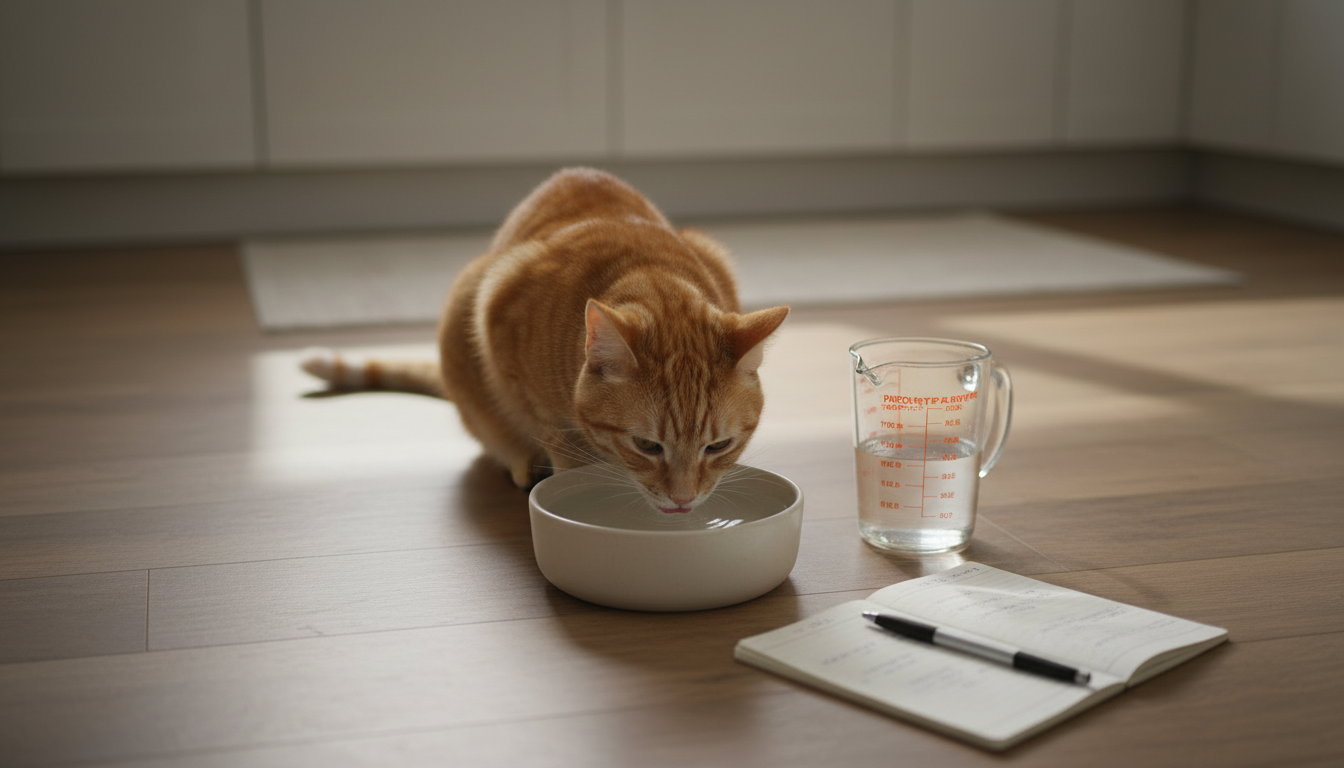
To track your cat’s daily water intake at home, you need a method that separates actual drinking from evaporation, spills, shared bowls, and water already contained in food. A measured bowl can give a useful estimate in a one-cat home, but the number is never perfect. The most valuable result is usually a trend: how today compares with the cat’s normal intake under similar conditions. If your veterinarian needs a specific measurement, follow the method they recommend because medical conditions can change what information matters.
Decide What You Are Actually Trying to Measure
There are two different goals. One is measuring visible drinking from bowls or fountains. The other is estimating total water intake, which includes moisture from food. If your cat eats wet food, bowl measurements alone can make hydration look much lower than it really is. If your goal is to detect a change in drinking behavior, bowl intake may still be the right number to track.
Write the goal at the top of your log. “Track bowl drinking for seven days” is clear. “Measure total hydration perfectly” is not realistic at home. The more specific the question, the more useful the data becomes.
Choose a starting amount that is comfortably more than the cat normally drinks so the bowl never runs low. If the cat typically leaves plenty of water, 300 or 400 milliliters may be convenient in a standard bowl. The exact starting amount is not important. Consistency and uninterrupted access are. Record any refill immediately if more water is added during the window.
Track Cat Daily Water Intake With a Measured Starting Volume
Use a clean bowl and a kitchen measuring jug or scale. Add a known amount of water at the same time each day. After 24 hours, measure what remains. The difference is the amount removed from the bowl, but it is not automatically the amount the cat drank because some water may have evaporated or spilled.
Keep the bowl in its normal location if possible. Changing the station just to make measurement easier can change the cat’s drinking behavior. Use the same bowl, water source, starting volume, and time window across several days. Consistency makes the trend more interpretable.
- Record the starting volume.
- Record the remaining volume after the same interval.
- Note obvious spills.
- Keep the water freely available throughout the test.
- Repeat for several ordinary days rather than relying on one day.
Weighing can be easier than reading a jug for some households. One gram of water is approximately one milliliter, so a kitchen scale can compare the bowl at the beginning and end. Only use this method if the bowl can be moved without spilling and the cat is not disturbed by the routine. Keep the method consistent from day to day.
Use an Evaporation Control if You Need a Better Estimate
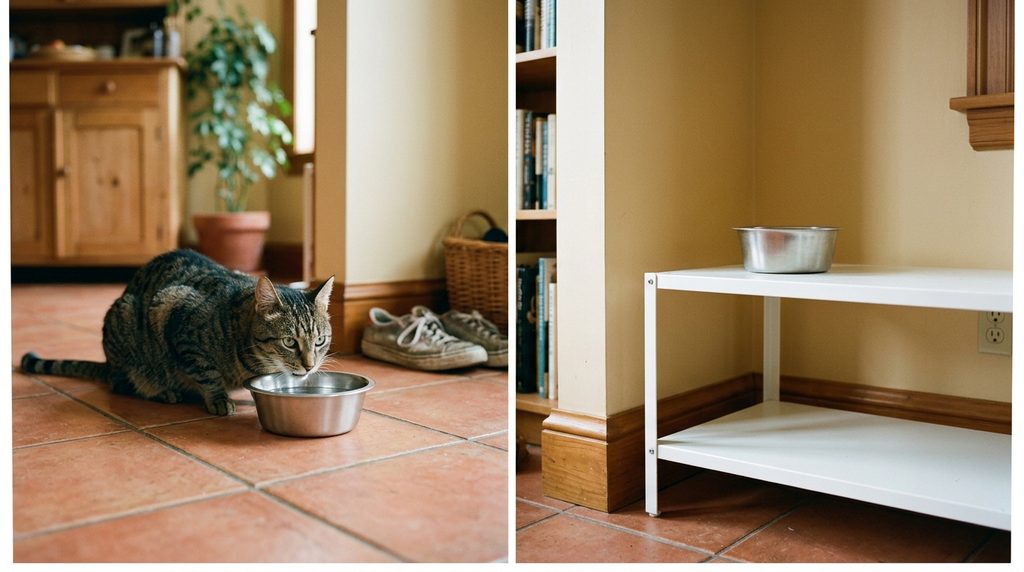
Place an identical or similar bowl with the same starting amount of water in a location the cat cannot access but that has similar temperature and airflow. After the same period, measure how much disappeared from the control bowl. That gives you a rough estimate of evaporation that can be subtracted from the drinking-bowl loss.
The control is still imperfect. Sunlight, airflow, bowl shape, and temperature can differ between locations. Match conditions as closely as practical. The purpose is not laboratory precision. It is to remove one obvious source of error when you need a cleaner home estimate.
| Example | Amount |
|---|---|
| Drinking bowl starts | 300 mL |
| Drinking bowl ends | 220 mL |
| Control bowl loses | 10 mL |
| Estimated visible drinking | About 70 mL |
This is only an example of the calculation. Do not use the number as a universal target for your cat.
Clean the fountain before the measurement period rather than midway through it. Filter changes, reservoir rinsing, and pump cleaning all remove or add water. Mark those days separately if maintenance cannot wait. A maintenance day can still be useful for care, but it should not be compared directly with an untouched 24-hour measurement.
Fountains Need a Different Tracking Method
Fountains contain water in reservoirs, pumps, channels, and filters, so a simple bowl measurement is harder. If you need to track fountain use, fill the fountain to a known mark or weigh the full unit if that can be done safely and consistently. Follow the manufacturer’s operating limits and never let measurement push the water below the minimum level needed for the pump.
Photographs of the fill line can help as a backup, but measured volume is better than visual memory. Keep a plain water bowl available if your cat normally has one. Do not remove preferred water sources simply to create cleaner data unless your veterinarian has specifically asked for a controlled test.
If you want a rough food-moisture estimate, the manufacturer may provide moisture percentage on the label. You do not need to convert it unless your veterinarian asks. For routine tracking, recording “two full wet meals” is often enough to explain why bowl drinking is lower than on a dry-food day. Keep the log practical enough that you will actually complete it.
Wet Food Belongs in the Log Even When You Are Tracking the Bowl
Record whether the cat ate wet, dry, or mixed meals each day. Wet food can reduce visible drinking because part of the fluid requirement is being met through food. If the diet changes during your tracking week, the bowl trend becomes harder to compare.
The relationship between water from food and water from drinking is what makes total daily hydration different from bowl intake alone. You do not need to calculate every gram of food moisture for a basic home log. You do need to note major changes such as “switched from dry breakfast to wet breakfast” or “ate only half the wet meal.”
Use a tray or washable mat under the bowl if your cat frequently splashes. The mat does not recover an exact volume, but it tells you whether a large loss was probably a spill. If the cat tips the bowl, mark the day invalid. Do not estimate drinking from a puddle. Restart the next day with the normal setup.
Spills Can Make a Good Measurement Look Like Heavy Drinking
Some cats paw at water, move bowls, or splash fountains. A dog may bump the station. Cleaning staff or another household member may refill it without recording the amount. These events can make the calculated intake meaningless for that day.
Do not force the math. Mark the day as unreliable and continue. A stable heavy bowl or non-slip mat can reduce accidental spills, but do not change to a bowl the cat dislikes solely for data quality. The drinking setup still needs to work for the cat.
If individual measurement is impossible, household-level data can still show a change. Keep the same number of cats, water stations, and diet conditions during the short tracking period. A sudden large household increase or decrease may justify closer observation. It still cannot identify which cat changed, so use it as a signal to investigate rather than as an individual measurement.
Multi-Cat Homes Need Individual Access if the Number Must Be Individual
A shared bowl tells you household consumption, not which cat drank. If one cat has a medical reason for individual monitoring, ask your veterinarian how they want you to separate the data. Temporary separation with individual food, water, and litter resources may be useful in some cases, but it can also change normal behavior if the cat is stressed by confinement.
Technology such as camera observation can tell you who visits a station, but visit count is not the same as volume consumed. A cat may take one long drink or several brief drinks. Use video to add context, not to convert visits into milliliters without evidence.
Summarize the week in one line after the final day. For example: “Visible intake was stable for four days, then rose for three days while urine clumps also became larger.” That sentence is more useful than seven isolated numbers. Attach the detailed log only as backup. Trends help the clinic understand why you noticed the change.
Keep a Log That a Veterinarian Can Read Quickly
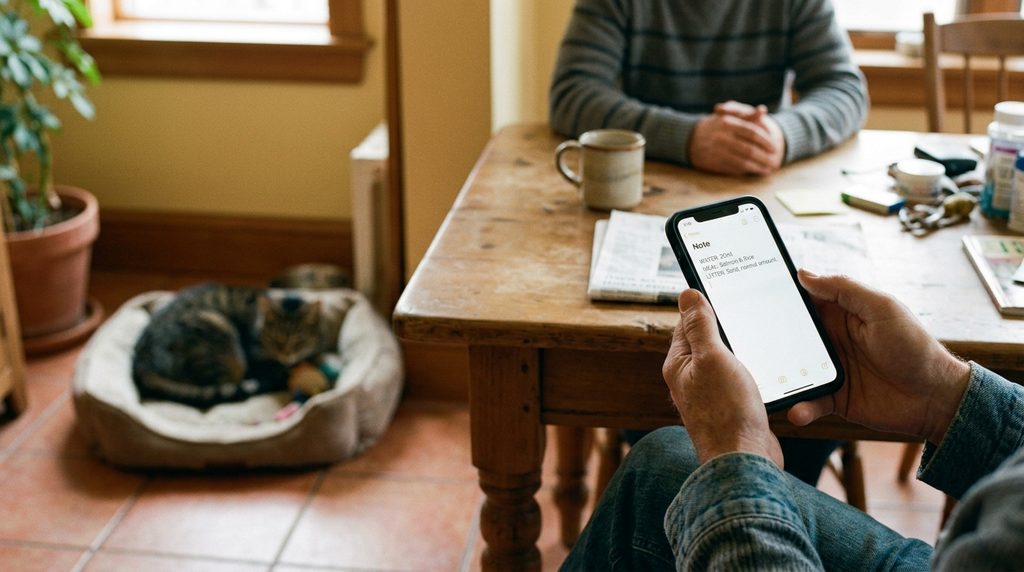
A useful log is simple enough to maintain. Include date, starting water, estimated bowl intake, food format, appetite, urine pattern, and any vomiting or diarrhea. Add notes for spills, unusual heat, a new fountain, visitors, or medication changes. Those details can explain why one day differs from another.
- Date and 24-hour time window
- Estimated visible drinking
- Wet, dry, or mixed food
- Whether normal meals were finished
- Approximate urine-clump pattern
- Vomiting, diarrhea, constipation, or other losses
- Medication or household changes
You do not need an elaborate spreadsheet unless you enjoy using one. A phone note or paper table is enough if the entries are consistent.
Stop the measurement early if the process changes the cat’s behavior. A cat that is frightened by repeated bowl handling may drink differently because of the monitoring itself. Return to the familiar setup and tell your veterinarian that the home measurement was not reliable. Bad data created by stress is less useful than an honest note that measurement was not possible.
Choose a normal week for baseline tracking when possible. Travel, visitors, very hot weather, a new pet, or a food transition can make the numbers less representative. Those periods can still be measured if they are the reason for concern. Label the context clearly so you do not compare an unusual week with ordinary days as if conditions were identical.
Do Not Turn Water Tracking Into Water Restriction
Never withhold water to make thirst easier to measure. Fresh water should remain available. Do not delay refilling a bowl because the 24-hour period is almost finished. If the bowl is low, refill it and record what you added. The cat’s access matters more than a clean dataset.
Also avoid forcing water by syringe unless your veterinarian has specifically instructed you. Monitoring should observe normal intake, not create a new drinking method. If you are concerned about dehydration or the cat seems unwell, contact your veterinarian instead of extending the home test.
Use the Trend to Answer a Question, Then Stop Measuring
Daily tracking is most useful for a defined period or medical reason. After several consistent days, you may have enough baseline information. If visible drinking changes sharply, the log can show when the shift began and whether diet, urine, appetite, or behavior changed at the same time.
Contact your veterinarian if drinking changes markedly or appears with poor appetite, vomiting, diarrhea, weakness, abnormal urination, weight loss, or other health changes. Increased drinking can also be medically important. The purpose of a home water log is not to diagnose the cause. It is to turn a vague impression into a clearer timeline that helps you and your veterinary team make better decisions.
References
- Hydration — Cornell Feline Health Center — Explains feline water intake, food moisture, dehydration clues, water access, and reasons drinking can change.
- Enhancing Water Intake for Your Cat — Cat Friendly Homes — Provides practical advice on water bowls, fountains, food moisture, and individual preferences that affect visible drinking.
- What Is Normal for Your Cat? — Cat Friendly Homes — Supports using an individual cat’s baseline for drinking, urination, appetite, and behavior to recognize meaningful changes.
