
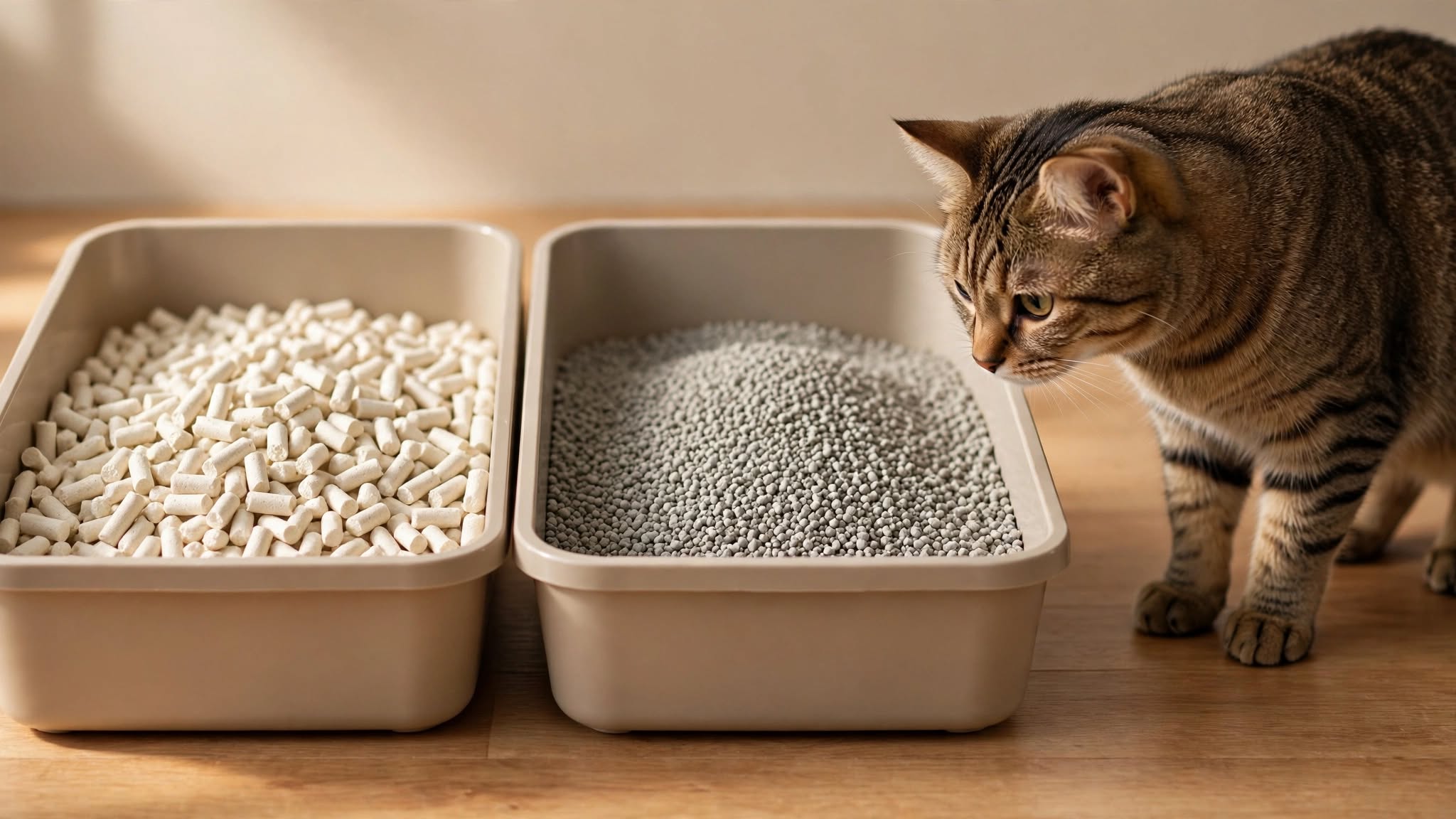
Tofu vs clay cat litter is not a contest with one universal winner. Clay remains popular because fine-grained clumping formulas are familiar to many cats and easy to scoop. Tofu litter is a plant-fiber alternative that is lighter and often marketed as low dust, fast clumping, and biodegradable. Those differences matter. The deciding factor is whether your cat uses the box comfortably and whether you can maintain it well. A litter that looks eco-friendly on the bag is a poor choice if the cat avoids its texture. A cheap clay litter is also a poor bargain if dust, tracking, or weak clumps make the box difficult to keep clean.
Tofu vs Clay Litter Starts With Very Different Materials
Clumping clay litter commonly relies on bentonite, a clay that swells and binds when wet. That is why urine can be removed as a discrete clump while most of the remaining litter stays in the box. Tofu litter is usually made from plant fibers or food-industry byproducts, often pea or soybean fiber. Starches and binders such as guar gum help it clump. The pellets or granules absorb liquid and form scoopable clumps through a different mechanism.
The ingredient list matters because “tofu litter” is not one standardized formula. Some products use pea fiber, corn starch, soybean material, baking soda, fragrance, or additives. Clay products also vary widely in grain size, dust control, scent, and clumping strength. Compare the actual bag rather than assuming every product in a category behaves the same way.
Clay has decades of familiarity behind it, while tofu is a newer category whose formulas vary substantially by manufacturer. One tofu litter may be thin pea-fiber pellets; another may use thicker soybean-based pieces with fragrance. The same is true of clay: unscented fine bentonite behaves differently from heavily scented coarse granules. When comparing them, name the exact products in your notes. Otherwise you may mistake a brand-level difference for a material-level rule.
Texture May Matter More to the Cat Than the Ingredient Story
Many cats prefer a soft, unscented, medium-to-fine clumping substrate. Cat Friendly Homes and the ASPCA both emphasize that texture and scent can affect box acceptance. This gives fine clay an advantage for cats already accustomed to it. Tofu litter is often formed into small cylindrical pellets. Some cats accept that immediately, while others dislike the larger pieces under their paws.
For a cat with a strong preference, avoid an abrupt full-box switch. Marketing does not override substrate preference. Offer a side-by-side choice if you can. Keep box size, location, and cleanliness equal while changing only the substrate. Your cat’s behavior is data. Digging normally, covering waste, entering without hesitation, and returning consistently matter more than whether the package says “natural.”
Paw sensitivity becomes more important with age and pain. An older cat with arthritis may step gingerly or avoid deep digging. Hard pellets that once felt fine may become uncomfortable. Cats recovering from paw injuries or declawing may also have special substrate needs that should be discussed with a veterinarian. A litter comparison should therefore include how the cat enters, turns, digs, and exits—not only whether urine ends up inside the box.
Dust, Tracking, and Floor Mess Are Different Problems
Tofu litter is often chosen because many formulas produce less airborne dust than traditional clay. That can make pouring and scooping more pleasant, especially in a small apartment. Clay quality varies, though. Modern low-dust formulas can perform much better than older dusty products. If anyone in the home has respiratory sensitivity, watch the actual dust cloud during pouring and scooping. Do not rely only on a label claim.
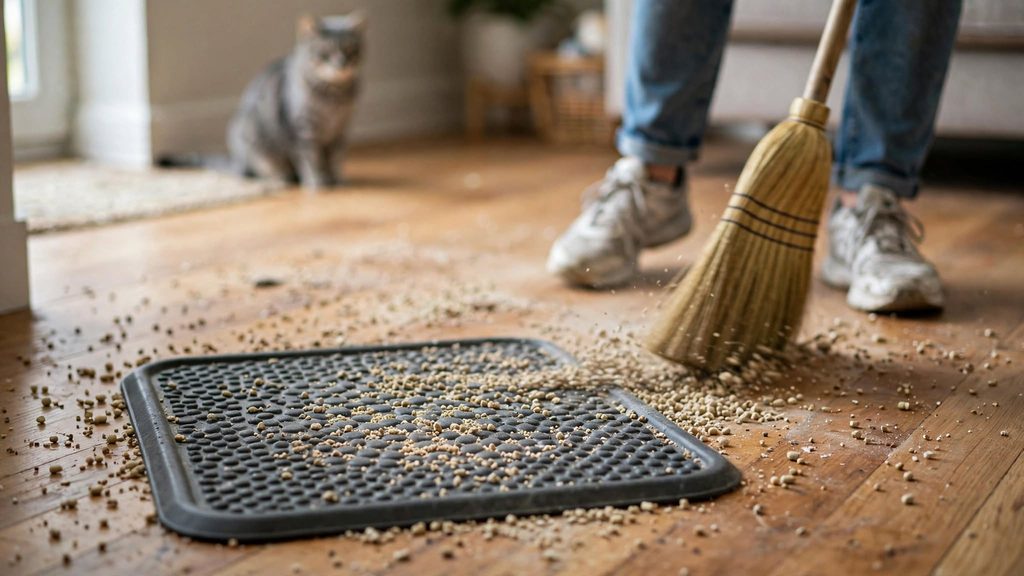
Tracking is separate. Lightweight pellets may roll or scatter differently from fine clay grains. Clay can stick to damp paws and travel farther through the home, while some tofu pellets fall off closer to the box. A large litter mat and enough space around the exit often matter as much as substrate. Compare the floor two meters from the box, not just the mat directly underneath it.
Tracking can be measured rather than guessed. After cleaning the floor, use the litter for three days and photograph the same two-meter zone outside the box before sweeping. Then repeat with the alternative product. This turns ‘tofu tracks less’ or ‘clay is messier’ into a home-specific result. Box exit direction, paw fur, mat design, and litter depth can change tracking enough that internet reviews do not predict your floor very well.
Clumping Performance Changes How Much Clean Litter You Throw Away
A strong clump lets you remove urine without sacrificing a large halo of clean litter. Bentonite clay is very good at this when the formula forms firm clumps and you give them enough time to set. Tofu can also clump quickly, but formulas differ. Some make compact clumps; others become soft if the scoop goes in too soon. That changes both maintenance and cost.
| Question | Tofu litter | Clumping clay |
|---|---|---|
| Typical feel | Pellets or granules | Fine to medium grains |
| Weight | Usually lighter | Usually heavier |
| Dust | Often low, formula-dependent | Ranges from dusty to low-dust |
| Clumps | Can be fast but softer | Often firm with bentonite |
| Cat familiarity | Varies | Often high |
Scoop performance in your actual box is more useful than category stereotypes.
Clump quality also changes over time. Fresh litter may create tidy scoops while an older, humid box produces softer clumps. Tofu products can absorb moisture from the room during storage, and clay can become less pleasant if dust accumulates at the bottom of the bag. Seal opened litter as directed and judge performance halfway through the bag as well as on day one. A product that starts beautifully but degrades fast may cost more in discarded material.
Odor Control Depends on Removal, Not Just Absorbency
Both categories can control odor when urine is captured effectively and waste is removed daily. Clay may use activated charcoal, baking soda, or fragrance. Tofu formulas may use plant fiber, starch, baking soda, or added odor-control ingredients. Strong fragrance is not automatically an advantage because many cats prefer unscented litter and some people or cats are sensitive to perfume.
Maintenance matters more than promises of “30-day freshness.” Scoop at least daily and keep enough clean litter in the box for normal digging. Wash the box on an appropriate schedule using mild, unscented soap. The best odor-control system is removing the source. If a litter only smells acceptable because a heavy fragrance masks urine, you may miss the point at which the box needs attention.
Scented versions deserve their own test because tofu products are often sold in dessert-like fragrances while clay is also available with strong perfumes. The human impression of ‘clean’ can be very different from a cat’s preference. Start unscented when possible, especially for a cat with previous box avoidance. If odor control is poor, improve scooping and box hygiene before assuming fragrance is the missing ingredient.
Disposal Claims Need More Skepticism Than the Packaging Suggests
Some tofu litters are marketed as flushable because plant-based clumps can break down in water. That does not mean flushing cat waste is appropriate for every plumbing system or municipality. Local wastewater rules, septic systems, pipe design, and environmental concerns all matter. “Flushable” is a product claim, not universal permission. Bagging used litter is the safer default when you are unsure.
Clay is generally disposed of with household waste rather than flushed. It is heavier, which can make carrying bags unpleasant, especially in apartments without elevators. Tofu’s lighter weight may be a genuine daily-life advantage. But evaluate the whole disposal routine: bag strength, odor containment, local rules, and how far you carry waste. Convenience is part of sustainability because a product you cannot maintain consistently will not work well.
Biodegradable does not mean environmentally consequence-free. Plant fibers still require manufacturing, packaging, transport, and disposal. Clay is mined and heavy to ship. If sustainability matters to you, compare the entire routine. Look at bag size, shipping frequency, discarded volume, and what local waste systems can actually handle. A lightweight product used efficiently may reduce transport burden, but broad environmental claims are difficult to verify from packaging alone.
Price Per Bag Is a Poor Way to Compare Real Cost
Tofu litter often costs more per kilogram than basic clay, but weight makes that comparison misleading. A lighter material may cover the same box depth with fewer kilograms. Clump size also affects how quickly clean litter disappears. The useful number is cost per month for your actual box, not shelf price alone.
Track one full bag from opening to replacement. Note how many days it lasts, how often you top up, and whether clumps break and force you to discard extra clean litter. This connects directly to the depth and maintenance of a comfortable litter box. A litter that performs beautifully at the wrong depth can still be wasteful or uncomfortable.
For a fair monthly-cost test, begin with a clean box filled to your chosen depth and weigh or estimate how much litter you add. Record every top-up for four weeks. Divide the total product cost by days of use. Repeat with the other litter if your cat accepts it. That calculation captures clump waste and refill rate, which shelf price misses. It can also reveal that a premium litter is cheaper per month—or that the cheaper bag truly is the better value.
How to Switch Without Creating a Litter-Box Problem
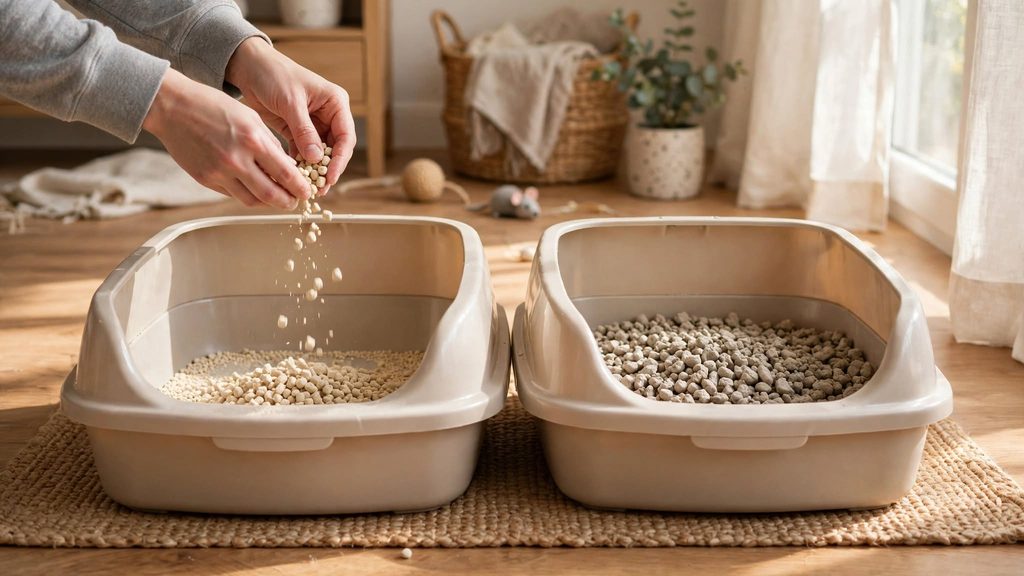
If your cat has used clay for years, the safest transition is usually gradual or choice-based. Put the new litter in a second comparable box rather than changing every box in the house. If space prevents that, mix a small amount into the old substrate and increase it slowly while watching behavior. Keep the location and cleaning routine stable during the test. A slow switch also protects your ability to tell whether the new texture is genuinely acceptable.
- Stop the transition if the cat begins hesitating, perching on the box edge, or eliminating elsewhere.
- Choose unscented formulas first when possible.
- Give older cats and cats with tender paws extra attention to texture.
- Do not change box style, location, and litter at the same time.
A successful switch is one the cat barely notices.
Which One Is Better for Your Home?
Choose tofu when lighter bags, lower dust, and plant-based materials solve real problems in your home and your cat accepts the texture. Choose clay when your cat strongly prefers fine-grained substrate and you want firm clumps. Then decide whether its weight and dust are manageable in your home. Neither category guarantees better litter-box behavior.
If you are undecided, test them as two actual products rather than two abstract materials. Use equal box sizes, equal depth, and the same cleaning schedule. The winner is the litter your cat uses reliably and you can keep clean without resentment. That practical fit matters more than the label on the bag.
References
- Cat Friendly Homes — Everything You Should Know About Litter Boxes — Notes that most cats prefer soft, unscented clumping litter and that texture matters.
- ASPCA — Litter Box Problems — Explains litter texture, scent, depth, and side-by-side preference testing.
- PetMD — What Is in Cat Litter? — Provides background on clay, silica, and biodegradable litter materials and clumping behavior.
