

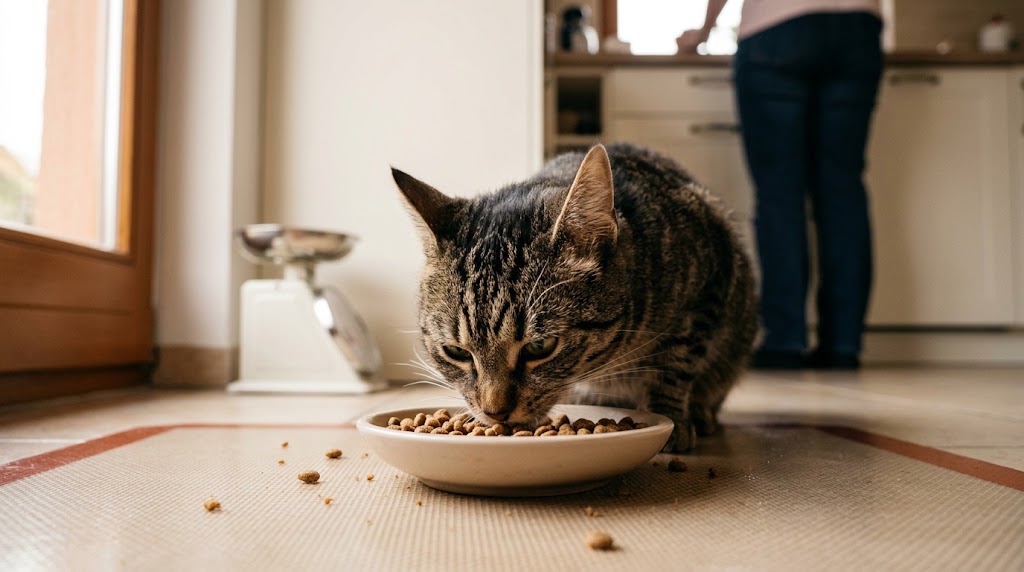
If your cat eats too fast, the problem may be as simple as excitement at mealtime, but the pattern can also reflect competition, an overly long gap between meals, food insecurity from earlier life, or a medical change in appetite. Fast eating is worth solving when it regularly leads to regurgitation, food stealing, stress, or weight gain. The best fix is not automatically a maze bowl. First identify what is pushing the speed. A cat racing another pet needs a different solution from a cat that bolts one oversized meal after twelve hours without food.
How to Tell Whether Your Cat Eats Too Fast
Some cats finish a small meal quickly and remain perfectly comfortable. Speed becomes more meaningful when the cat barely pauses to chew, swallows large mouthfuls, leaves the bowl and immediately regurgitates, pushes another cat away, or acts frantic before every meal. Time the meal once or twice instead of relying on impression. A measured portion disappearing in under a minute is very different from a modest serving eaten steadily over five minutes.
Also distinguish vomiting from regurgitation. Regurgitated food often comes back up soon after eating and may look relatively undigested. Vomiting usually involves more abdominal effort and can occur for many reasons unrelated to speed. Repeated episodes deserve veterinary attention rather than endless experimentation with bowls. A video of the episode can be useful because owners understandably struggle to describe the difference after the fact.
Meal video is surprisingly helpful here. Set a phone a few feet away and record one ordinary feeding without changing your behavior. You can see whether the cat pauses to breathe, chews, guards the bowl with an elbow, scans for another animal, or lifts the head between mouthfuls. The recording also reveals whether the ‘fast’ part is the entire meal or only the first few bites. That distinction helps you choose a smaller intervention instead of assuming the whole feeding system is wrong.
Long Gaps Between Meals Can Create a Mealtime Sprint
A cat fed two very large meals may approach each one much hungrier than a cat receiving the same daily calories in several smaller portions. That does not mean every cat needs six meals. It means meal timing can change behavior even when the daily calorie total stays identical. If your cat attacks breakfast after a long overnight gap, shift a small portion of the daily ration to a late-evening meal or an early automatic-feeder meal.
Do the math before adding food. The goal is to redistribute the existing daily amount, not create an extra snack budget. For example, a 200-calorie day might become four 50-calorie meals rather than two 100-calorie meals. This is also why the full-day portion and food type should be settled before you troubleshoot speed. A slower schedule that quietly adds twenty percent more calories can solve one problem while creating another.
Timing can also interact with sleep and household routine. A cat that receives dinner at 6 p.m. and breakfast at 8 a.m. has a long overnight interval even if calories are adequate. Moving five or ten percent of the daily ration to a timed feeder at 4 or 5 a.m. may reduce the breakfast sprint without increasing intake. The useful experiment is to change distribution for a week while keeping total calories stable, then compare meal speed and morning behavior.
Competition Can Make a Calm Cat Eat Like Food Is Disappearing
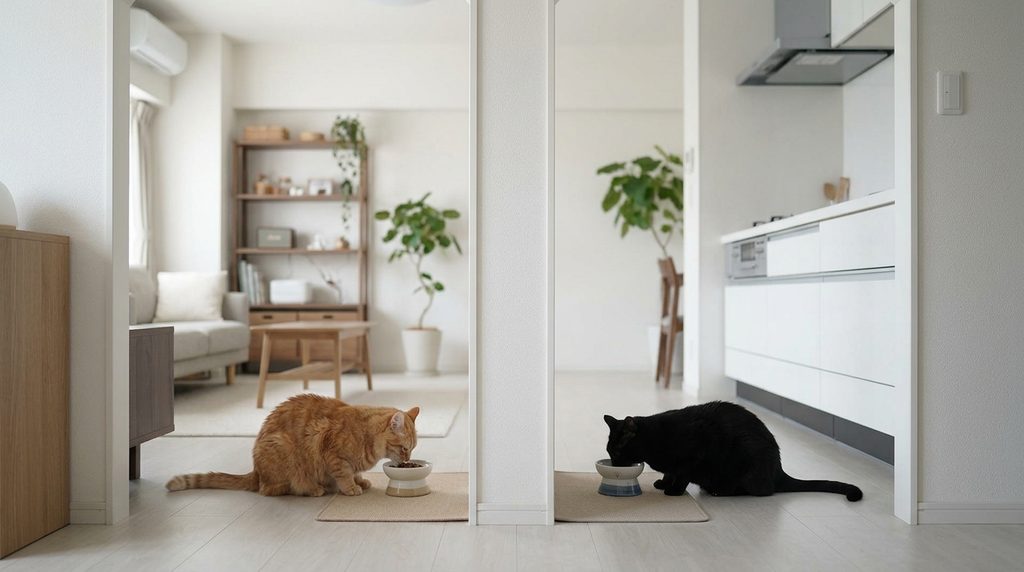
Two bowls placed side by side may look fair to a person but still feel competitive to cats. One cat may eat rapidly because the other watches, approaches, or finishes first and moves over. The pressure can be subtle. You may never see a fight. Watch body position: hunched shoulders, repeated glances sideways, blocking, swallowing without pausing, or immediately checking the other bowl are clues that social pressure is part of the meal.
Separate feeding stations usually work better than trying to train both cats to “be polite.” Use different rooms, opposite sides of a barrier, or microchip feeders if one cat needs protected access. Give each cat enough time to finish without being observed closely. If the fast eater slows down when fed alone, you have learned something important. The issue was not lack of self-control. It was resource security.
In a multi-cat home, ‘separate’ needs to mean visually and physically separate enough that the slower cat can finish. Bowls at opposite ends of one kitchen may still create pressure because both cats can watch each other. A closed door, tall visual barrier, or microchip feeder changes the social equation much more. If the fast cat suddenly takes twice as long when the other cat is out of sight, competition was probably contributing even without obvious aggression.
Slow the Food Without Turning Dinner Into Frustration
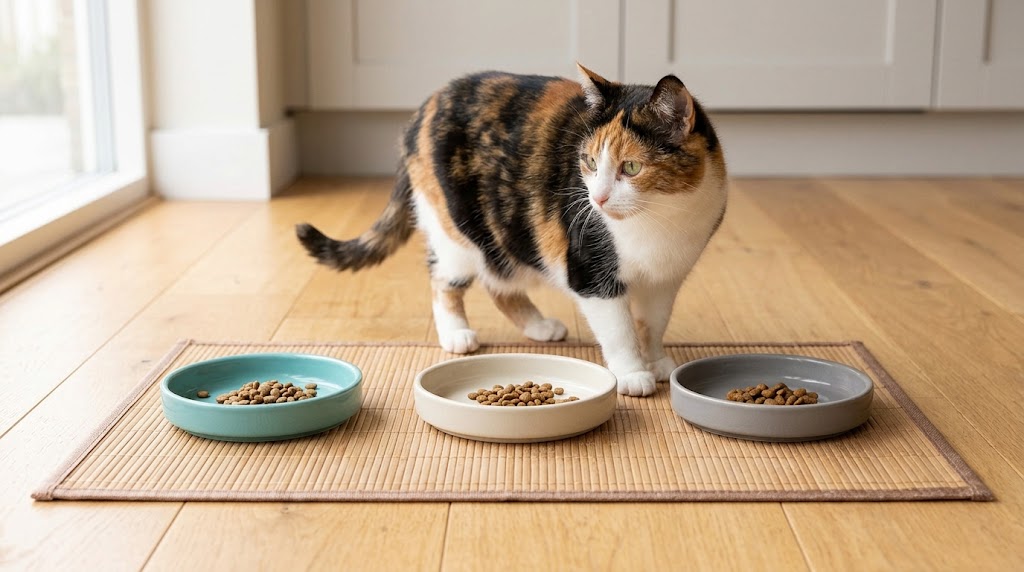
Slow-feeding tools should add small pauses, not create an impossible puzzle. For dry food, a wide maze bowl, muffin tin, scatter feeding on a clean mat, or several small dishes can spread the meal out. For wet food, smear a thin layer across a broad plate, use a lick mat designed for pets, or place several spoonfuls in separate shallow dishes. The cat should still be able to access the food comfortably without scraping the face or becoming agitated.
- Start with an easy pattern and increase difficulty only if the cat stays relaxed.
- Use part of the meal in a puzzle rather than forcing the whole ration through it on day one.
- Avoid deep crevices that are difficult to wash thoroughly.
- Stop if the cat gives up, bites the feeder aggressively, or begins guarding it.
Slower is useful only when the cat still eats enough.
Puzzle difficulty should match the cat’s experience. A beginner feeder that releases one kibble with a light paw tap is very different from a complex device requiring several steps. If the feeder is too difficult, the cat may walk away, tip it violently, or become more aroused around food. Start with enough visible, easy food that success is immediate. The goal is natural pauses and searching, not making the cat earn dinner through frustration.
Wet Food and Dry Food Need Different Speed-Control Strategies
Dry kibble is easy to roll, scatter, or place in puzzle toys, so the environment can create natural pauses. Wet food needs a different approach. A broad plate can reduce the ability to scoop a large mouthful. Dividing one serving among three small plates makes the cat move between bites. Chilling a portion slightly may change pace for some cats, although palatability matters more than speed, especially for a cat with a marginal appetite.
Texture can matter too. Some cats lap gravy quickly and then chew chunks later; others gulp soft pâté. Do not assume one texture is universally slower. Observe your own cat. If changing texture decreases total intake or creates food refusal, return to the food the cat reliably eats and change the presentation instead. Speed control should support nutrition, not compete with it.
For wet food, surface area can do most of the work. Spreading the portion into a thin layer across a dinner plate forces smaller licks without adding equipment. Three small plates placed a few feet apart create movement between portions. For a cat that tends to regurgitate after gulping, this can be easier to clean and easier to adjust than a textured lick mat. Always use a food-safe surface and wash it promptly because wet food residue supports bacterial growth.
Food Insecurity Can Persist After the Cat Is Safe
Former strays, cats from crowded homes, and cats that experienced unpredictable feeding may continue to eat rapidly long after food becomes reliable. The behavior can be learned. In that situation, consistency often matters more than gadget complexity. Meals arriving at predictable times, in the same safe location, with no other animal hovering nearby can gradually reduce urgency. Some cats improve over weeks rather than days.
Avoid taking the bowl away mid-meal as a speed-control tactic. Repeated interruption can make food feel less secure and may increase frantic eating. Instead, pre-divide the meal into smaller portions and deliver them calmly. If the cat is maintaining a healthy weight and has no medical signs, improvement can be gradual. You are teaching the environment to feel predictable, not correcting bad manners.
If the cat has a history of food scarcity, avoid making the feeding area unpredictable in the name of enrichment. Keep at least some meals simple and dependable. Novel puzzle feeders can be introduced outside the most emotionally charged meal, using a small portion of familiar food. That lets the cat learn the object without experiencing it as a barrier between hunger and dinner. Security and enrichment can coexist, but security comes first.
When Fast Eating Points to a Bigger Appetite Change
A cat that has always eaten quickly is different from one that suddenly becomes ravenous. Increased appetite paired with weight loss, more thirst, more urination, restlessness, vomiting, or diarrhea can occur with medical problems such as hyperthyroidism or diabetes. Kittens and nursing cats also have naturally higher energy needs, so life stage changes the interpretation.
Weigh your cat regularly if appetite has changed. A cat that seems “starving” but is losing weight despite eating more should be evaluated. The same is true when the eating speed changes abruptly without any schedule or household change. Slow feeders can reduce gulping, but they should not be used to mask a new biological drive to eat.
Sudden speed can also appear when calorie needs have changed. Growth, pregnancy, lactation, and recovery from illness can increase requirements, while hyperthyroidism and diabetes can produce an abnormal drive to eat. The red flag is not simply enthusiasm; it is a mismatch between appetite and body condition. A cat eating faster and more while becoming thinner should not be managed only with a slow bowl. That pattern deserves medical assessment.
A simple body-weight check can keep this from becoming guesswork. Weigh the cat weekly for a month while you change meal presentation. Stable weight with calmer meals suggests you are changing behavior without underfeeding. Downward weight drift means the feeding plan needs review, even if the slow feeder looks successful.
A Practical Seven-Day Plan to Slow a Fast Eater
For the first two days, measure the normal daily ration and simply divide it into one extra meal. On days three and four, move meals to a quiet location and separate other pets. If speed is still extreme, add an easy slow-feeding method for only one meal. By days five through seven, compare meal duration, regurgitation, food guarding, and post-meal behavior with your starting point.
Change one variable at a time so you can tell what helped. If smaller meals solve the problem, you may not need a complicated feeder. When separation is the key, protect that space permanently. If nothing changes and your cat seems unusually hungry, loses weight, or vomits repeatedly, shift the focus from behavior to veterinary evaluation. A good solution makes meals slower and calmer without making food harder to obtain than it needs to be.
References
- Cornell Feline Health Center — Feeding Your Cat — Feeding environment, body condition, and appetite changes.
- VCA Animal Hospitals — Testing for Increased Appetite — When increased appetite may need medical investigation.
- Cornell Feline Health Center — Hyperthyroidism in Cats — Hyperthyroidism pattern of increased appetite with weight loss.
