

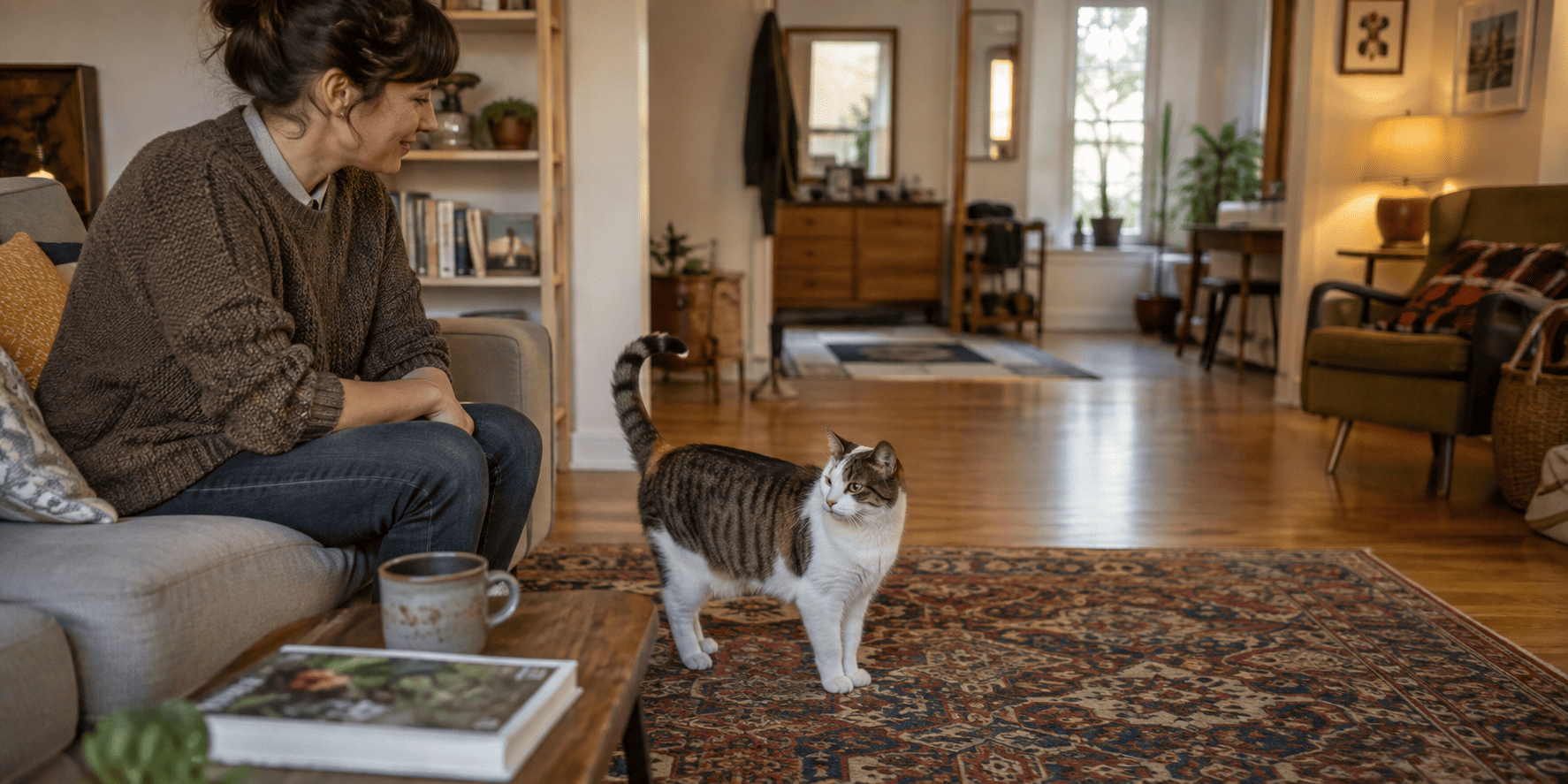
Learning how to read cat body language means noticing combinations and transitions, not assigning one fixed meaning to an ear, tail, or pupil size. A cat that stays loose, approaches voluntarily, and recovers quickly after a sound is communicating something very different from a cat that freezes, leans away, or keeps scanning for an exit. Read body shape, movement, distance, ears, eyes, tail, whiskers, and context together, then compare the moment with that cat’s normal behavior.
Read the Sequence: Posture, Direction, and Recovery
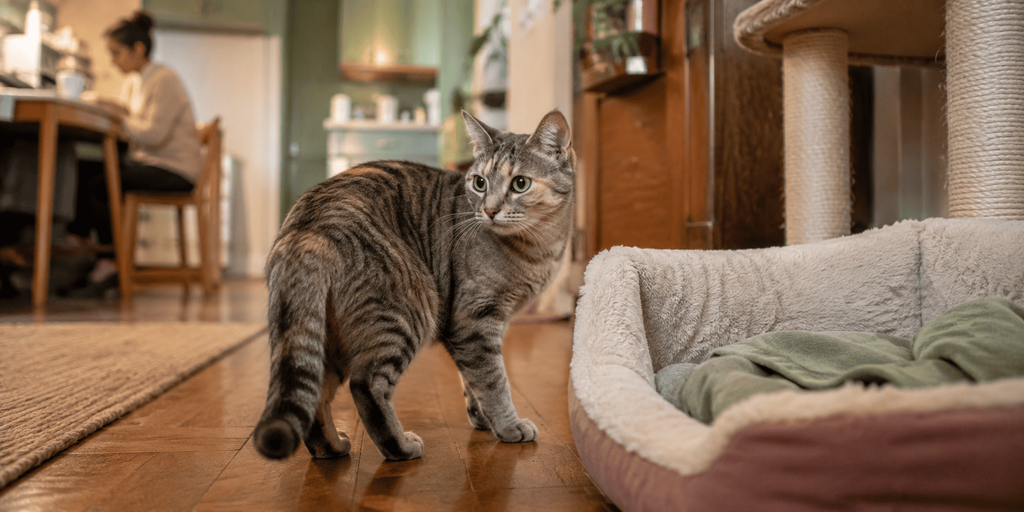
These are patterns, not rigid stages. Cats can move quickly between states, especially during play or a stressful encounter. Watch how fast the ears return to neutral. A brief turn toward a sudden sound is ordinary attention. Ears that stay pinned while the body remains tense tell a different story. Duration and recovery are often more informative than the first movement. Recovery time is another useful marker. A cat startled by a dropped object may jump, then return to normal within moments. A cat that remains hidden, tense, or hypervigilant long after the trigger has gone may need more support.
| State | Common body clues | What helps |
|---|---|---|
| Relaxed | Loose posture, soft eyes, neutral ears, normal grooming or resting | Let the interaction continue naturally |
| Alert or curious | Body oriented toward stimulus, ears tracking, focused eyes | Give space to investigate |
| Unsure | Weight shifts back, body lowers, ears turn sideways, pauses increase | Reduce pressure and offer an exit |
| Fearful | Crouching, freezing, hiding, ears flattened, body pulled away | Increase distance and stop forcing contact |
| Highly aroused | Rigid body, fast tail movement, intense staring, swatting or lunging | Do not handle; give time and space |
Notice the Small Requests for More Distance
The best response is usually to stop and let the cat decide whether to return. Respecting small signals makes communication clearer because the cat does not need to escalate. Different body areas can have different tolerance. A cat may enjoy cheek rubs but dislike long strokes over the back or belly. Start with the places your cat seeks out and treat any sudden change in touch tolerance as information.
- Turning the head away repeatedly during petting
- Skin twitching along the back
- Tail flicking that becomes faster or stronger
- Ears rotating sideways or backward
- Body leaning away from the hand
- Sudden grooming immediately after an intense interaction
- Freezing instead of participating
- Leaving, hiding, hissing, swatting, or biting when earlier signals were missed
Try a short pause when you are unsure. Stop touching, soften your posture, and give the cat a clear path away. If the cat stays loose and re-initiates contact, that choice is useful information. If it turns away, leaves, or settles at a distance, let the interaction end. This simple pause works better than testing how much more the cat will tolerate. It also teaches visitors and children to respond to early communication instead of waiting for a hiss or swat.
Small signals are valuable because they arrive early. A head turn, brief freeze, or stronger tail flick can be enough reason to pause. You do not need to wait for a dramatic reaction to justify giving space.
Petting Changes the Meaning of the Same Signals

Many cats prefer shorter interactions than people expect. Start with areas the cat commonly accepts, such as the cheeks or head, and pause after a few strokes. If the cat leans back in, rubs against you, or remains loose, interaction can continue. If the body stiffens, the tail starts whipping, or the cat turns sharply toward your hand, stop. Overstimulation is easier to prevent than to interrupt after the cat is fully aroused. Consent can change within the same session. A cat that asked for attention two minutes ago can be finished now. Walking away is useful communication, not rejection. Children and visitors benefit from this rule too: let the cat approach, keep interactions brief, and provide an easy path away. Mutual pauses are useful during play.
If both cats stop, reset, and choose to re-engage, the interaction is more likely to be comfortable. If one cat repeatedly hides or tries to leave while the other keeps pursuing, intervene by creating distance and redirecting activity. Petting sessions can change quickly because arousal builds. A cat may enjoy the first few strokes and then become overstimulated. Pausing frequently gives the cat a chance to reinitiate, which makes consent easier to read.
Ears, Whiskers, and Body Tension Matter Most Together
Ears and whiskers are useful because they can change quickly, but neither should be treated as a standalone mood label. Ears may rotate toward a sound while the rest of the cat stays loose. In a more uncertain moment, the ears can remain turned sideways or back while the body lowers and the cat leans away. Whiskers may sit neutrally during rest, move forward with focused interest, or draw back during protective emotion.
The combination is what gives the signal weight. Imagine two cats with ears angled slightly sideways. One is standing loosely, sniffing a new box, and steps forward again after a pause. The other is crouched, pupils enlarged in bright light, whiskers pulled back, and weight shifted toward an exit. The ear position is similar; the emotional picture is not. Read the change across the whole body and notice whether the cat can recover, approach, or leave by choice.
Tail Movement Needs Context
A raised tail often appears during friendly approaches, but the tail is not a universal mood meter. Look at speed, stiffness, position, and the rest of the cat. A cat stalking a toy with an active tail is different from a cat lashing its tail while being held. The situation tells you what the movement means. Whiskers add another clue. Relaxed whiskers often sit in a neutral position, while whiskers may pull back during fear or move forward during intense interest. Like pupils, they should be read with the body rather than used as a standalone emotion label.
- Upright tail: Often seen during a confident social approach.
- Loose curve around the body: Can appear during relaxed sitting or resting.
- Tucked close: May accompany fear or an attempt to make the body smaller.
- Fast lashing or strong twitching: Can signal high arousal, frustration, or overstimulation.
- Puffed tail: Often appears when the cat is startled or highly aroused.
- Tail-tip movement: May occur during focused watching or mild arousal; context matters.
Pupils Need Light and Situation
Soft, partially closed eyes often accompany relaxation. Slow blinking can occur during calm social interaction. A hard fixed stare can feel threatening between cats, especially when the body is tense and neither animal disengages. Pupil size changes with light as well as emotion. Large pupils in a dim room may be completely normal. Large pupils in bright light during a tense encounter can reflect arousal or fear. Squinting should not always be read as contentment. Persistent squinting, redness, discharge, or keeping one eye closed can be a medical sign and deserves veterinary attention. Instead of asking “What do the pupils mean?” ask whether the eyes match the rest of the posture and the lighting. Giving distance is an active response, not ignoring the cat.
Stop reaching, soften your own posture, and leave an open route away. If the cat chooses to remain nearby, that is still different from being held in place. Choice lowers pressure. Direct staring can be socially intense. When approaching a cautious cat, softer attention and turning your body slightly sideways can feel less confrontational than leaning over and maintaining eye contact.
Between Cats, Watch Who Can Move Where
Intercat tension is often quieter than a fight. One cat may stare from across a room, block a hallway, follow another cat, or consistently occupy the route to food or litter. The other cat may avoid certain rooms without ever hissing. Relaxed affiliated cats may rest near one another, greet with tails up, rub, groom each other, or take turns during play. Healthy play usually contains pauses and role changes rather than one cat always pursuing while the other tries to escape. Watch the cat that leaves. If one cat repeatedly stops eating, exits a room, or waits for the other to move, the relationship may need more space and resource distribution. Body language is about access as much as posture. Where a cat can comfortably go tells you how safe the home feels.
Role changes are especially useful during play. Healthy play often includes pauses, turns in chasing, and voluntary re-engagement. If one cat repeatedly pursues while the other hides, flattens the body, or tries to escape, the interaction deserves more distance even if there is no dramatic fight. Also watch neutral moments. A cat that consistently waits for another to leave before approaching food, litter, or a doorway may be showing social pressure through movement rather than vocalization.
Do not use a single friendly behavior as proof that the relationship is fine. Two cats may sleep near each other yet still compete around a narrow hallway or feeding station. Look at whether both animals can use important parts of the home comfortably across the day. Access patterns often reveal tension that is invisible in a snapshot.
How to Read Cat Body Language Without Turning It Into a Dictionary
Start with the body shape. A relaxed cat usually looks physically loose rather than compressed or rigid. Weight is distributed comfortably, movements are smooth, and the cat can turn attention away from whatever is happening. A tense cat may crouch, freeze, lean away, or prepare to retreat. Then add the ears, eyes, tail, whiskers, and direction of movement. A single signal can be ambiguous. Wide pupils may appear during fear, excitement, or active play. Ears turned sideways can reflect uncertainty, but the meaning changes if the body is also relaxed and curious. Signals also make more sense when you understand how indoor cats use scratching, hiding, climbing, vocalizing, and routine as part of normal behavior. Always ask what happened immediately before the body language changed. Movement quality is a major clue.
Relaxed cats move fluidly and can disengage from a stimulus. A worried cat may freeze, creep, repeatedly scan the room, or keep the body positioned for escape. Those transitions often tell you more than a single still photograph. Distance is part of the message. A cat that moves closer while staying loose is making a different choice from a cat that freezes because escape is blocked. Give special weight to whether the cat can approach, pause, or leave voluntarily.
Respond Early So the Cat Does Not Need to Escalate
Respond to the earliest useful signal instead of waiting for a hiss, swat, or bite. Looser posture, voluntary approach, and quick recovery support continued interaction. Leaning away, freezing, escalating tail movement, blocked escape, or repeated attempts to leave mean reduce pressure. If a familiar cat suddenly resists touch, stops jumping, or shows new defensive behavior during normal handling, consider pain or illness as well as emotion.
References
- 2024 AAFP Intercat Tension Guidelines — FelineVMA — Shows subtle and overt feline social signals, including staring, blocking, avoidance, posture, and movement between cats.
- 2022 AAFP/ISFM Cat Friendly Veterinary Interaction Guidelines — FelineVMA — Detailed guidance on feline emotional states, body language, distance, choice, and low-stress handling.
- Meeting the Physical and Emotional Needs of Indoor Cats — FelineVMA — Adds environmental context for interpreting behavior, control, safe places, and social interactions.
