

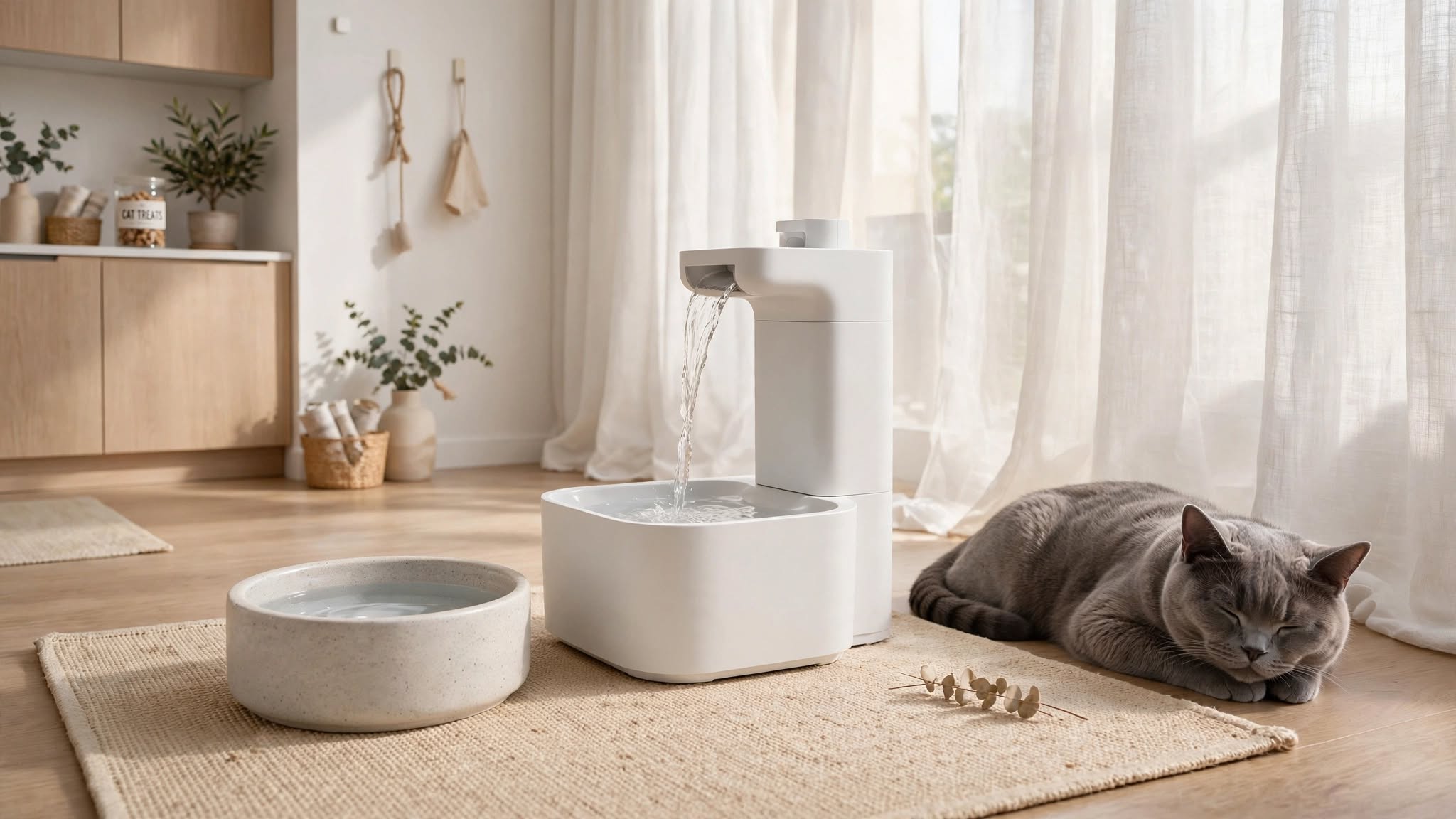
A cat hydration station is not one fancy fountain placed beside the food bowl. It is a small, intentional area where clean water is easy to reach, comfortable to drink from, and simple for you to maintain. The best station may contain a wide ceramic bowl, a fountain, or both. Its location matters as much as the container. Cats may avoid water near litter boxes, noisy appliances, doorways, or places another pet can block. Build the station around access and freshness first, then add equipment only if it solves a real preference or maintenance problem.
Start With the Route to Water, Not the Bowl
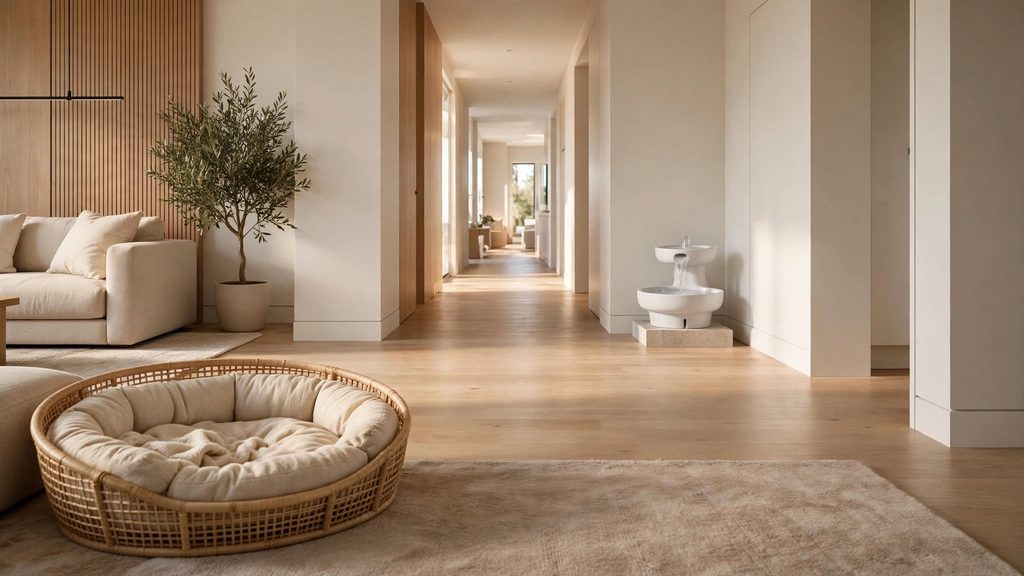
Stand where your cat usually rests and trace the path to the proposed station. Does the cat have to pass a dog bed, squeeze behind a chair, cross a busy kitchen, or drink with its back to the room? International Cat Care recommends quiet, accessible water locations and notes that access from more than one side can help cats feel less vulnerable. A beautiful water setup in a social bottleneck can therefore perform worse than a plain bowl in a calm corner.
For multi-level homes, consider at least one water source on each floor used by the cat. For older cats or cats with mobility limitations, keep water on the same level as their main resting area. A hydration station works best when drinking fits the cat’s ordinary movement through the home. The cat should not need to make a special trip to find water.
Use a Wide, Stable Bowl as the Foundation
A wide bowl gives the cat more choice about head position and keeps whiskers from constantly pressing against narrow sides. Ceramic, glass, and stainless steel are easy to clean and less likely than scratched plastic to hold odors or residue. Stability matters too. A light bowl that slides across tile can make drinking awkward. It also creates spills that tempt owners to reduce the water level too far.
Fill enough that the cat can drink without lowering the face deep into the container, but leave practical room for movement. A non-slip mat can protect flooring, although the mat itself should lie flat and be washable. If you use a raised stand, make sure the height actually improves posture for your cat rather than simply matching the décor. Most healthy cats do not require elevated water.
Add a Fountain Only If Moving Water Improves the Station
Some cats prefer running water and may drink more readily from a fountain. Others ignore the stream and use the basin, while some prefer a still bowl. A fountain is therefore an option, not an upgrade every household needs. If you add one, keep a separate bowl available so pump failure, cleaning, or a sudden preference change never removes the cat’s only water source.
Choose a fountain you can disassemble completely. Hidden pump housings and narrow channels collect hair, saliva, food debris, and biofilm. A quiet motor also matters because pumps often become louder when the water level falls. If the fountain gurgles before you notice it needs topping up, that sound can make the station less predictable. Maintenance convenience is part of hydration design.
Do not assume the kitchen is automatically the best hydration zone just because plumbing is nearby. Cats often spend long stretches in bedrooms, offices, or window areas. A small secondary bowl near a favored resting route may receive more use than the “main” bowl in a room the cat visits only to eat. Let traffic patterns decide where the station earns its place.
Separate Water From Food and Litter When the Layout Allows
Cats do not all object to water beside food. Separation still gives you more flexibility and can increase the number of useful resource locations in the home. Keep water away from the litter box because splashed litter, dust, and odors do not belong in a drinking area. Avoid placing the station where food crumbs regularly fall into the bowl, especially if your cat carries pieces away from the dish before chewing.
The larger principle is resource distribution. Total hydration depends on both drinking and food moisture, but access still affects whether the drinking part is easy. A cat eating wet food may make fewer bowl visits and still be well hydrated. That does not mean the water station can be neglected; it should remain clean and available every day.
Dogs can change station design too. Some cats happily share a dog’s large bowl. Others avoid the area because the dog approaches quickly or leaves saliva and food debris. A counter-height cat-only water source is not suitable for a cat with mobility limits. Instead, use a quiet room behind a pet gate or a strategically placed floor bowl to create separation without forcing climbing.
Give Multi-Cat Homes More Than One Hydration Station
One large bowl does not equal multiple resources. Cats can share peacefully at some times and still avoid approaching when another cat is present. Spread water sources so they are not all controlled from the same doorway or narrow corridor. International Cat Care commonly recommends one water source per cat plus an additional one, distributed through the home. The exact number can be adapted, but the principle is to create choice rather than a single point of competition.
Watch subtle timing. If one cat drinks only after another leaves the room, or approaches and then turns away, add distance between stations. In a small apartment, “spread out” may mean opposite sides of the room or one source elevated and another on the floor, provided both are safe and accessible. Visual separation can matter even when physical distance is limited.
Build the Station Around Easy Cleaning
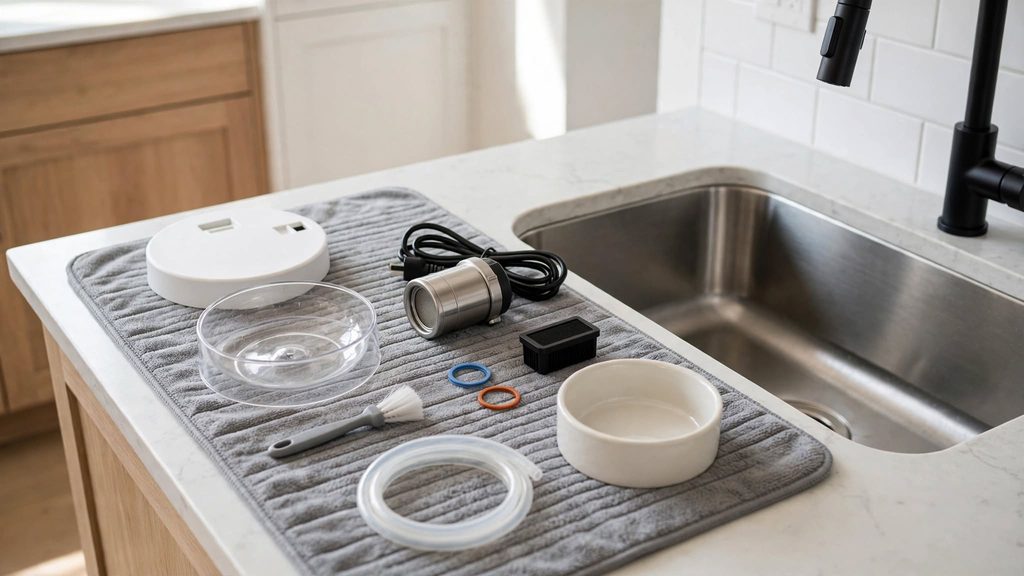
If cleaning the station requires moving six decorative objects, unplugging a power strip. And scrubbing a textured tray, maintenance will eventually slip. Keep the setup simple enough that water can be refreshed daily. Wash bowls with hot water and dishwashing detergent, rinse thoroughly, and clean fountains according to the manufacturer’s instructions. International Cat Care advises fresh water daily and regular container cleaning, daily if possible.
- one or more dishwasher-safe bowls if practical;
- a washable mat that dries quickly;
- a small jug or bottle used only for refilling;
- fountain brush tools stored nearby if you use a pump;
- replacement filters kept on hand rather than ordered after flow drops.
A station that takes two minutes to reset will stay cleaner than one designed mainly for visual impact.
Think about the surface underneath as part of the station. Wood and laminate can be damaged by repeated splashing, while a deep tray with high edges can make a timid cat feel boxed in. A flat washable mat or shallow waterproof tray usually protects the floor without changing access. If the cat paws water, choose a larger catch area rather than reducing the bowl to a tiny volume that empties quickly.
Lighting can matter more than it seems. A bowl hidden in a dark corner may be physically accessible but rarely encountered during normal movement. On the other hand, a station directly under harsh motion-activated lighting can startle a cautious cat at night. Aim for a location the cat already passes comfortably at several times of day. Hydration design works best when the water sits inside an established route.
Use the Station to Notice Changes Without Obsessive Measuring
A defined station makes patterns easier to notice. You learn how often you refill, which bowl your cat prefers, whether fountain use changes with weather, and whether a housemate affects access. You do not need to measure every milliliter unless your veterinarian asks you to. Shared bowls, evaporation, splashing, and food moisture make casual measurements imprecise.
What is useful is a meaningful change from baseline. If a cat that rarely visits the bowl begins emptying it quickly, or a cat that normally drinks visibly stops approaching water while eating less, that deserves context. Check the food, weather, fountain function, and household changes. And contact your veterinarian if the change is marked, persistent, or accompanied by illness signs.
If you want to compare two bowl types, make it a fair test. Put both in equally good locations, fill them with the same water at the same time, and avoid changing food during the trial. A ceramic bowl placed in the quiet bedroom will usually beat a stainless bowl beside the washing machine regardless of material. Switch positions halfway through if you are trying to learn container preference rather than location preference.
Fountain trials need the same discipline. Keep the old bowl available, introduce the fountain without forcing contact, and watch for actual drinking after the novelty period. Some cats only play with streams. Others drink from the basin but never from the moving flow. Either can be acceptable if water intake remains normal. Do not interpret “uses a fountain” as a single behavior.
Adjust the Hydration Station for Age and Mobility
Kittens need stable equipment that cannot be easily tipped or dismantled. Large cats need enough space to stand naturally without wedging between furniture. Senior cats may benefit from water placed close to preferred resting zones so stairs and long routes do not become barriers. Cats with arthritis may prefer a bowl position that does not require deep crouching. But avoid raising it so high that drinking requires neck extension.
Health conditions can change recommendations. Cats with kidney disease, urinary disease, diabetes, heart disease, or prescribed fluid plans may need individualized guidance. Do not add salty broths, supplements, or flavorings simply because an internet hydration tip recommends them; ingredients and sodium can matter. Ask the veterinary team what is appropriate for the specific cat.
Finally, build a failure plan. Know what happens during a power outage, when the fountain is soaking in the sink, or when you leave for a weekend with a sitter. Plain bowls are excellent backups because they have no pump, filter, or power requirement. If your station works only when one device is functioning perfectly, it is less resilient than it looks.
Keep the station visually simple enough that a sitter can understand it immediately. Clear routines reduce missed refills and make it easier to notice when one component, such as a pump, stops working.
A Good Cat Hydration Station Should Feel Almost Boring
Once established, the station should be predictable: clean water, quiet access, no blocked route, no strong odor, and equipment that works. The cat should be able to approach, drink, and leave without drama. If you are constantly changing bowls, adding flavor, moving the fountain, and testing gadgets, you make it harder to learn what the cat actually prefers.
Start with a strong basic setup and change one variable at a time. Add a fountain if running water appears attractive. Add another station if access is socially difficult. Move the bowl if the location is noisy. The best hydration station is not the one with the most features; it is the one that reliably disappears into the cat’s normal day while making fresh water easy to choose.
References
- International Cat Care — Encouraging Your Cat to Drink — Practical feline guidance on drinking and water access.
- Cat Friendly Homes — What Your Cat Needs to Feel Secure — Feline-veterinary guidance for home care and behavior.
- Cornell Feline Health Center — Feline Heat Safety — Veterinary guidance on feline health and care.
