

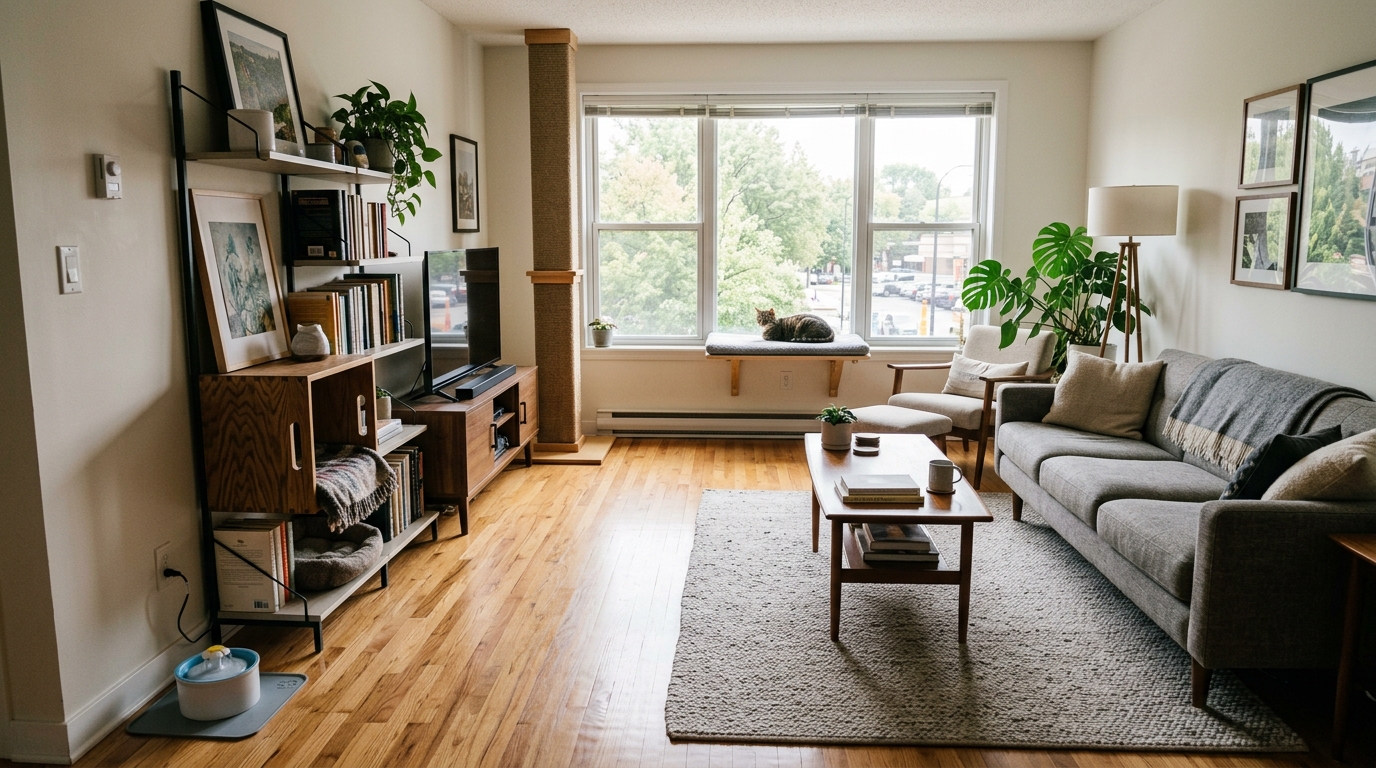
A cat friendly apartment does not need to look like a pet store or give every spare surface to the cat. It needs to make normal cat behavior easy: eating without pressure, drinking in a comfortable place, toileting in peace, scratching where scratching makes sense, climbing without unsafe improvisation, hiding without getting trapped, and moving through the home without being cornered. In an apartment, the challenge is not simply limited square footage. It is making the same square footage serve both the people and the cat without stacking every feline resource into one crowded “cat corner.”
Map the Apartment as Separate Cat Zones
Before buying anything, walk through the apartment and identify what each area already does. A quiet bedroom corner may work well for rest. The bright living-room window may suit observation. A low-traffic bathroom or hallway nook can work for a litter box if access is reliable. The kitchen is convenient for people, but that does not automatically make it the best place for every food and water resource. Treating the apartment as a set of zones prevents one common mistake: putting food, water, litter, bed, toys, and scratcher side by side because that is where there happens to be open floor.
Feline environmental guidance emphasizes multiple, separated key resources. Separation does not mean each item needs its own room. It means the cat should not have to eat beside the toilet, drink where another pet can block the route, or cross one busy bottleneck to reach everything important. In a studio, even several feet, a furniture barrier, or placement on different sides of a room can create meaningful separation. Once you think in zones instead of products, resource placement throughout the home becomes easier to plan as one connected system rather than a collection of objects.
Make a quick floor plan before moving furniture. Mark the cat’s current sleeping places. Mark the litter route. Note where people walk most often. Circle any narrow doorway used for several resources. This takes only a few minutes. It often reveals crowding that is hard to notice while standing in the room.
Build Upward Before You Add More Floor Furniture
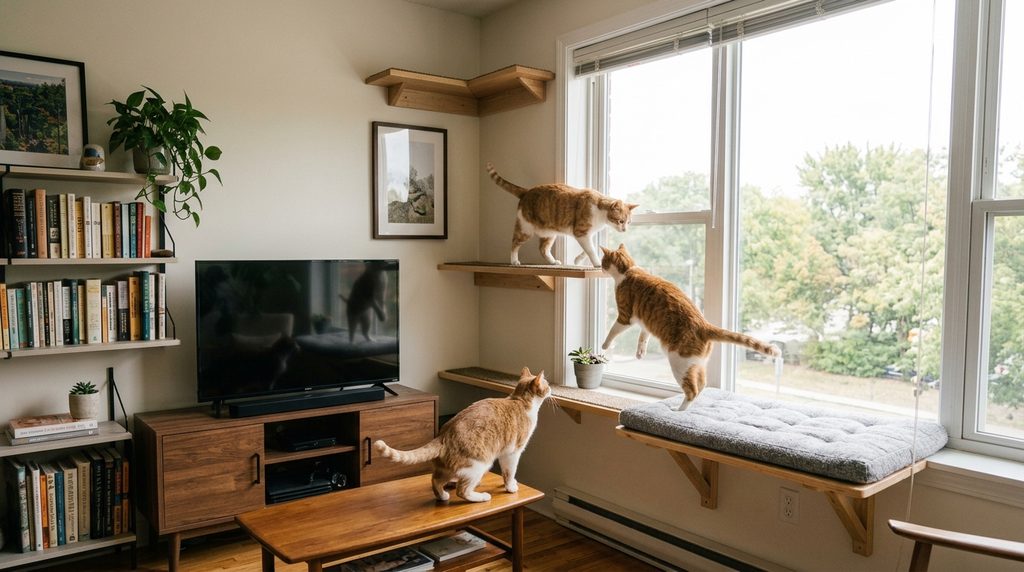
Vertical territory is especially valuable in an apartment because it increases usable space without consuming much floor area. A cat tree is one option, but it is not the only one. A sturdy bookcase with a safe top, a window perch, a stable bench, or a sequence of secure shelves can create elevated resting and observation points. The important details are stability, an easy route up and down, and enough landing space for the individual cat. A high surface that requires a risky jump is not useful simply because it is tall.
Think about the route, not only the destination. A young athletic cat may jump directly to a shelf, while a senior cat may need an intermediate stool or lower platform. In a multi-cat apartment, more than one route can reduce tension because one cat is less able to control access to a prized perch. Avoid arranging a vertical path that ends in a dead end where a cat can be trapped by another cat. If you rent, freestanding cat trees, tension-mounted systems, and furniture-based routes can add height without drilling into walls. Whatever you use, check weight limits and stability rather than assuming a product marketed for cats is automatically secure.
Give the Litter Box Privacy Without Hiding It From Yourself
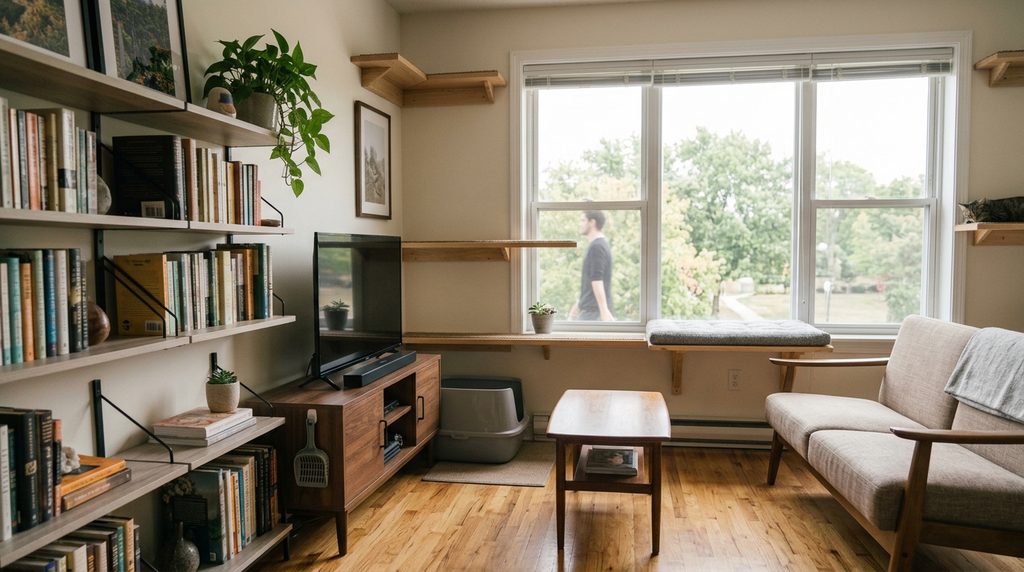
Apartment layouts tempt people to hide the litter box in the most distant or concealed spot available. That can backfire if the location is noisy, hard to reach, poorly ventilated, or easy for another pet to block. The box needs to be accessible every time the cat needs it. A laundry area may seem practical until the washer enters a loud spin cycle. Deep closets can contain odor but may create a single narrow entrance. Balcony access is unreliable if weather or a closed door can remove the toilet option.
Choose a location that is quiet enough for the cat and convenient enough that you will scoop it consistently. Large boxes often work better than decorative compact boxes, so plan the footprint before filling every corner with furniture. If the apartment has more than one cat, try not to make all boxes function as one station by lining them up together. Even in limited space, placing boxes in genuinely different areas can create safer choices. A screen or furniture placement can give visual privacy without turning the litter area into an enclosed trap.
- Keep food and water away from the litter area.
- Make sure a door cannot accidentally block access.
- Avoid loud appliances and high-traffic choke points.
- Choose an entrance height the cat can use comfortably.
- Leave enough room for the cat to turn, dig, and exit easily.
Distance can be created without another room. A shelf can block direct sight lines. A sofa can separate water from litter. Different elevations can create choice. Even a few feet can matter when the route feels open. These small layout decisions are often more useful than adding another large product.
Put Scratching Where the Behavior Already Happens
A scratcher works best when its location and orientation match what the cat wants to do. Cats often scratch after waking, near socially important routes, or beside objects that already attract scratching. If the sofa arm is the favorite target, placing a sturdy vertical post beside that arm is more logical than hiding the post across the apartment. If the cat scratches rugs, a horizontal cardboard or sisal surface may be more useful than another tall post. Stability matters: a post that wobbles during a full stretch may be rejected even if the material is appealing.
In a small home, one well-placed scratching structure can do several jobs. A stable cat tree can combine scratching, climbing, and resting. A low horizontal scratcher can tuck beside a sofa instead of occupying the center of the room. Wall-mounted scratchers save floor space when the lease and wall structure allow secure installation. Do not remove a worn scratcher simply because it looks less attractive to you; familiar scent and texture can make it valuable. Replace it when it is unstable, unsafe, or too damaged to function, not merely when it stops looking new.
Create Safe Hiding Without Creating Inaccessible Hiding
Cats need places where they can withdraw, especially when visitors arrive, appliances run, or the household becomes busy. The useful distinction is between an intentional hide and an inaccessible gap. A covered bed, cardboard box, space under a side table, or carrier left open can provide retreat while still allowing you to locate the cat in an emergency. A hole behind the refrigerator, an opening inside a sofa base, or a gap into a utility cabinet is a different kind of hiding place and should be blocked.
Place at least one safe retreat in a part of the apartment that is not constantly disturbed. Some cats prefer a low covered hide; others prefer height. Offering both gives the cat control. Do not pull a cat out of a safe place simply because you want interaction. A hiding place works partly because the cat can choose when to leave it. In small apartments, this choice is especially important because the cat cannot create distance by going to another floor or faraway wing of the home. Good hiding spaces make the available territory feel larger and more controllable.
Separate Food and Water From the Busy Parts of the Room
Apartment feeding stations often end up wherever an outlet, cabinet, or washable floor is convenient. Human convenience matters, but the cat also needs to feel comfortable stopping to eat or drink. Avoid placing bowls in a narrow passage where people repeatedly step over the cat or another animal can approach from behind. Water can be offered in more than one location, especially if the cat spends time in separate parts of the apartment. Some cats prefer a bowl; others may use a fountain. The useful setup is the one the cat actually uses and you can keep clean.
In multi-cat homes, separate feeding areas reduce the need to eat shoulder to shoulder. Visual separation can be created by a doorway, furniture, or different elevations if both cats can access them safely. If one cat eats quickly and steals from another, the feeding plan may need more structure than simply moving bowls apart. The broader principle is that resources count only when each cat can access them without pressure. A beautiful feeding station that one cat avoids is not functioning as a resource for that cat.
Check the apartment from the cat’s height once a month. Look for loose cords. Test wobbling furniture. Inspect screen edges. Notice new plants or decorations. Move swallowable objects out of reach. A safe layout changes as the household changes, so the first cat-proofing pass should not be the last.
Make Windows Interesting but Physically Safe
A window can provide light, changing sights, sounds, and a useful observation point, but apartment windows also create preventable risks. Check screens for secure fit and damage. Do not assume an insect screen can hold a cat leaning or jumping against it. Tilt-and-turn windows, balconies, and open high-rise windows need special attention because a curious cat can squeeze, fall, or become trapped. If a perch is placed at a window, make sure the mounting system is secure and that blinds or cords do not create entanglement hazards.
Visual enrichment does not require constant stimulation. A cat may spend long periods sleeping near a window and only occasionally watch birds, people, or weather. That still gives the cat choice. If outdoor animals visible through the window trigger persistent agitation, redirected aggression, or territorial marking, the view may need to be managed rather than maximized. Frosted film on the lower part of a window, moving the perch, or changing access at certain times can reduce exposure while keeping the area useful.
Use Daily Routines as Part of the Apartment Setup
Furniture alone cannot make an indoor environment satisfying. Play, predictable social interaction, and opportunities to search, chase, or work for food add activity without permanently filling the apartment with objects. Rotate a small set of toys instead of leaving every toy on the floor. Use short wand-toy sessions in open walking space, then put string-type toys away when unsupervised. A portion of the normal food allowance can be used in an easy puzzle feeder when appropriate. Cardboard boxes can appear for a few days and then be recycled rather than becoming permanent clutter.
The best apartment setup should also be easy for the human to maintain. When scooping requires moving three pieces of furniture, the design is too complicated. A fountain that is difficult to clean may be worse than a simple bowl. Cat furniture should not block the only comfortable human chair, because shared spaces need to work for both species. Good shared design lets both species use the home comfortably. Review the layout when the cat ages, gains or loses mobility, a new pet arrives, or the household routine changes. The apartment does not need to stay fixed to remain cat-friendly.
Maintenance is part of design. Keep the scoop close to the box. Store a towel near a splash-prone water station. Put grooming tools where short sessions are easy. Keep toy storage simple. Small friction points become skipped chores. Removing them makes good care more consistent.
Audit a Cat Friendly Apartment by Watching How the Cat Moves
Stand back and watch the routes your cat actually uses. Can the cat reach water without crossing the litter area? Is there a scratcher near a place where stretching naturally happens? Can the cat move from a busy room to a protected resting area? Is there a high place with a safe way down? In a multi-cat home, can one cat reach key resources without passing directly beside another? These questions reveal more than counting products.
A cat friendly apartment is successful when resources are usable, separated enough to reduce conflict, and placed where normal behavior can happen without constant correction. Start with the layout you already have, then add only what solves a real gap. Small changes in route, height, stability, privacy, and access often improve the home more than buying another large piece of cat furniture.
References
- 2025 Meeting the Physical and Emotional Needs of Indoor Cats — FelineVMA — Defines the five pillars of a healthy feline environment, including safe places, separated resources, play, predictable interaction, and sensory needs.
- Setting Up the Environment for Success — FelineVMA — Practical guidance on resource distribution, safe places, climbing, scratching, play, and reducing environmental pressure in the home.
- 2024 Indoor/Outdoor Lifestyle Position Statement — FelineVMA — Explains the environmental resources indoor-only cats need, including vertical space, toileting areas, play, food, water, and safe territory.
