

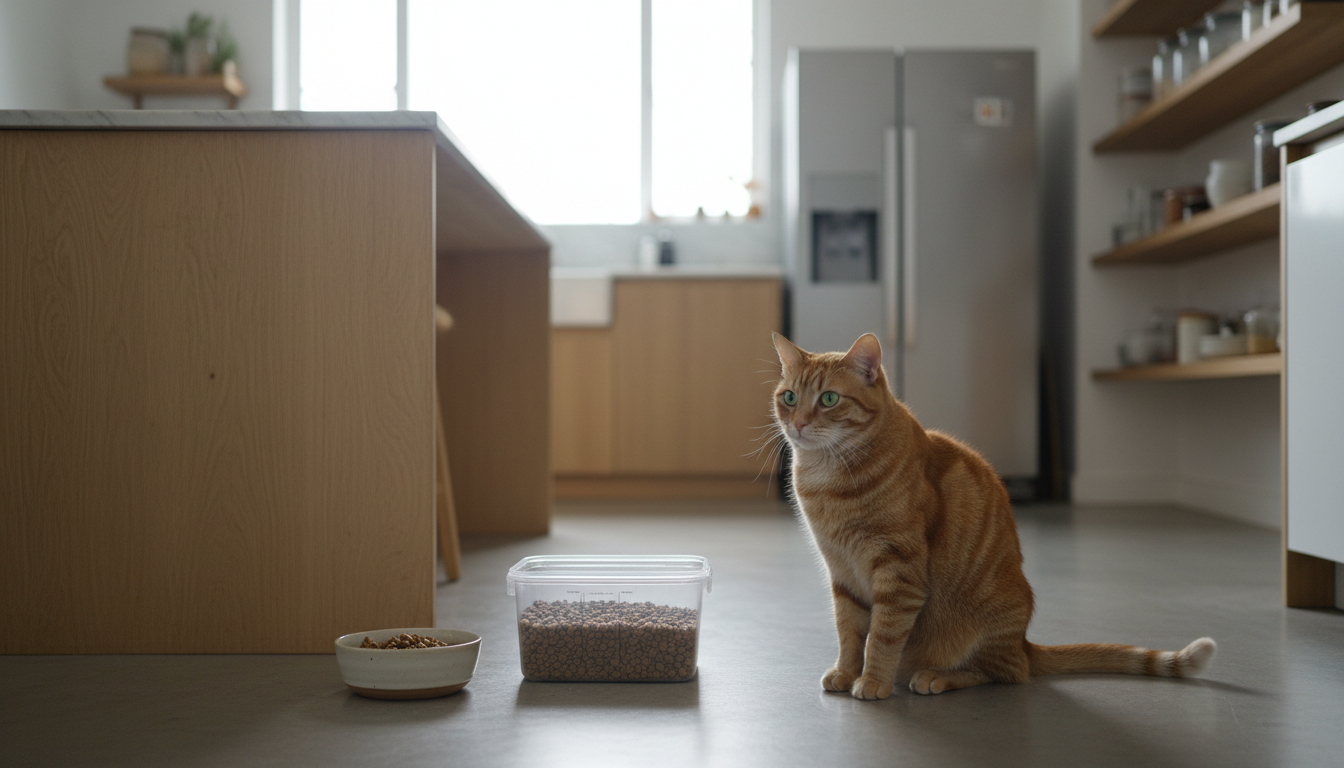
Free feeding vs scheduled feeding for indoor cats is not a contest with one correct winner. The better method is the one that delivers the right daily calories, lets you notice appetite changes, fits the food you use, and prevents one cat from quietly eating another cat’s share. Free feeding can work for a cat that self-regulates and maintains a healthy body condition. Scheduled meals make portions and appetite easier to monitor. Many homes do best with a hybrid: measured daily food divided between meals, timed feeders, and small foraging opportunities rather than an unlimited bowl.
Compare the Two Methods by What You Need to Control
Think about the problem you are actually trying to solve. Need to see appetite clearly? Scheduled meals have an advantage. A cat that eats tiny amounts comfortably and maintains ideal condition may do well with measured grazing. Food theft changes the decision: neither method works well until access is separated.
The key difference is not whether the cat eats twice or ten times. It is who controls access to the food and whether the total amount is measured. Free feeding keeps food available for grazing. Scheduled feeding offers food during defined meal periods. Either method can be managed carefully or poorly. A measured day’s ration left for a grazer is very different from topping up a bowl whenever it looks low. Likewise, scheduled meals can still cause weight gain if portions are too large.
| Question | Free feeding | Scheduled feeding |
|---|---|---|
| Portion visibility | Harder if bowl is repeatedly topped up | Easier when each meal is measured |
| Appetite changes | Can be harder to notice | Often easier to spot at a meal |
| Food stealing | Harder to control in multi-cat homes | Separate meals can protect access |
| Grazing preference | Convenient for cats that self-regulate | Can be recreated with several small meals |
| Weight control | Requires a measured daily allowance | Requires measured meal portions |
The table is a decision tool, not a rule. Your cat’s body condition and actual intake decide whether the system is working.
Free Feeding vs Scheduled Feeding for Indoor Cats: Start With the Daily Ration
Write the ration in grams or calories rather than “one bowl.” Bowl size changes, scoops get rounded, and different foods can contain very different calories in the same volume. A repeatable number lets you compare weight trends and makes any later schedule change much easier.
Before choosing a schedule, decide how much food belongs in the whole day. That number comes from the exact food’s calorie density, the cat’s body condition, life stage, activity, and health. Once the daily ration is set, the feeding method simply determines how access is distributed. This prevents the common mistake of treating extra feeding opportunities as extra calories.
The bigger nutrition decision—what your indoor cat eats and how much belongs in the full day—should stay separate from whether the food is served in two meals or made available in smaller portions. Treats, toppers, puzzle-feeder kibble, and food used for medication still count. If several people feed the cat, portion the day’s allowance in advance so nobody unknowingly adds a second breakfast or an uncounted refill.
Free Feeding Works Best When “Free” Does Not Mean Unlimited
Use a morning checkpoint. Measure the day’s food once, place only part of it in the bowl, and keep the rest in a labeled container. Refill from that container rather than the main bag. At night, what remains tells you roughly how much was offered and consumed.
Some cats graze naturally, taking a few mouthfuls and leaving the bowl. If that cat maintains a healthy body condition and you can tell how much is eaten, measured free feeding may be reasonable. Put out the planned daily ration rather than filling the bowl to an arbitrary level. Check what remains before adding more. Replace stale food according to safe handling guidance instead of leaving the same food indefinitely.
The system becomes less useful when the bowl is always full and nobody knows the day’s intake. Cornell notes that free feeding can lead to overeating and inappropriate weight gain in some cats. It can also hide reduced appetite because a slowly declining bowl may not be noticed. Free feeding is especially difficult when multiple cats share one dish, when one cat is overweight, when prescription diets differ, or when a caregiver needs accurate intake information for a medical condition.
Scheduled Meals Make Appetite Changes Easier to See
A meal window does not need to mean removing food after five minutes. Some cats eat slowly. Give enough quiet time for the cat to finish without another pet hovering. The useful structure is a known portion offered predictably, not a race that creates anxiety around the bowl.
Meal feeding gives you a natural checkpoint. If a cat that usually finishes breakfast suddenly eats one-third, you notice. That can be valuable because appetite change is an important health clue in cats. Scheduled meals also make it easier to separate cats, give different diets, prevent food stealing, and use a known amount of food for medication or weight management.
The drawback is that two very large meals may not suit every cat’s behavior or comfort. The FelineVMA feeding consensus describes normal feline feeding as involving frequent small meals and solitary feeding opportunities. You can keep the structure of scheduled feeding without creating long gaps by dividing the same daily calories into several smaller portions. Timed feeders and puzzle feeders can help when people are away from home. The schedule should organize access, not turn the entire day into waiting for two oversized meals.
Wet Food Changes the Practical Choice
Temperature can affect acceptance too. Some cats dislike food served straight from the refrigerator. Small refrigerated portions can be brought toward room temperature safely according to product guidance before serving. Avoid leaving wet food out simply to force a grazing pattern that is easier to create another way.
Wet food adds moisture and can work very well in scheduled meals, but it is not suited to sitting out indefinitely. Follow the food manufacturer’s handling directions and refrigerate unused portions promptly. If your cat prefers many small wet meals, a caregiver can serve smaller portions through the day or use a feeder designed to keep food appropriately chilled. Do not assume that “grazing” requires a bowl of dry food available around the clock.
Mixed feeding can also be structured. For example, serve measured wet meals in the morning and evening, then reserve part of the calculated dry ration for a timed feeder or puzzle toy. This creates more feeding events without increasing calories. The useful part is that each component belongs to one daily plan. Feeding a full dry ration and then adding wet meals because they look small is a common way mixed feeding drifts upward in calories.
Multi-Cat Homes Usually Need More Control Than One Shared Bowl
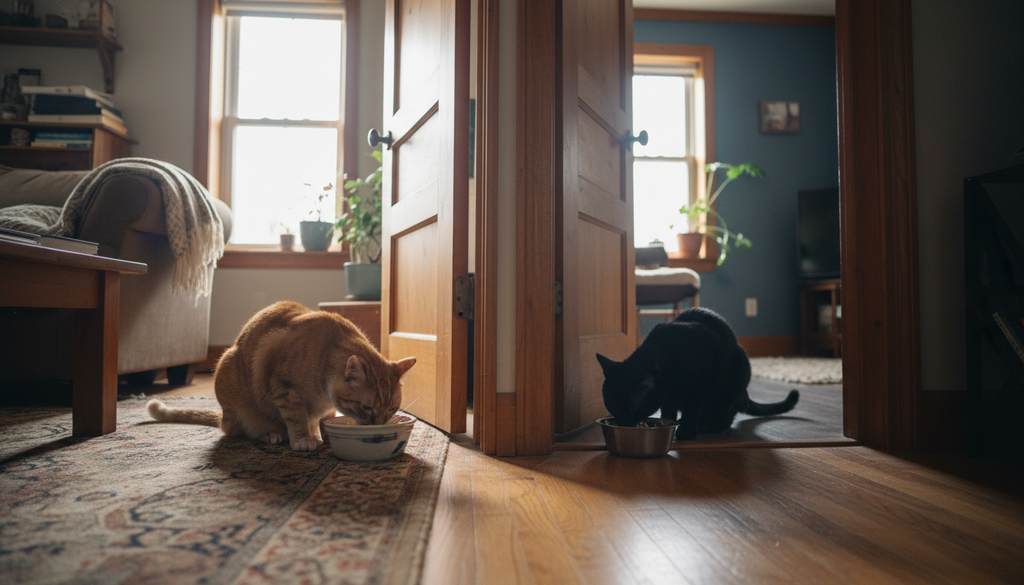
A shared free-feeding station can hide unequal access. One cat may eat quickly while another waits until the room is quiet. A confident cat can control the route without obvious fighting. The result may be weight gain in one cat and underfeeding in another, even though the household appears to provide plenty of food. Separate feeding areas or scheduled meal periods make individual intake easier to see.
- Give each cat its own bowl or feeding station.
- Separate cats visually if one watches or crowds another.
- Use different rooms when diets or eating speeds differ.
- Consider microchip feeders for cats that need individual access.
- Do not place every food resource in one narrow area.
- Track body weight and condition for each cat, not the household average.
Some socially comfortable cats can eat near each other without trouble. The point is to watch who actually gets the food, not assume sharing is fair because no one hisses.
Choose Scheduled Feeding When You Need Better Information
Scheduled meals can also show whether a cat wants food but cannot eat comfortably. Approaching the bowl, sniffing, then walking away is different from sleeping through the meal. Dropping food or chewing oddly can point toward mouth discomfort and deserves veterinary attention.
Scheduled feeding is especially useful when a cat is overweight, underweight, on a therapeutic diet, receiving medication with food, or living with another cat that steals meals. It also gives better appetite data when a veterinarian asks how much the cat is eating. A measured bowl offered at known times creates information that an always-full communal dish cannot provide.
Medical needs can override general preferences. Diabetes, gastrointestinal disease, kidney disease, dental pain, recovery from illness, and weight-loss plans may require specific foods or meal timing. Follow the veterinary plan rather than changing to free feeding because the cat seems hungry between meals. If a cat suddenly becomes ravenous, loses weight, or stops eating normally, treat that as a health change rather than only a scheduling problem.
A Hybrid System Can Preserve Grazing Without Losing Portion Control
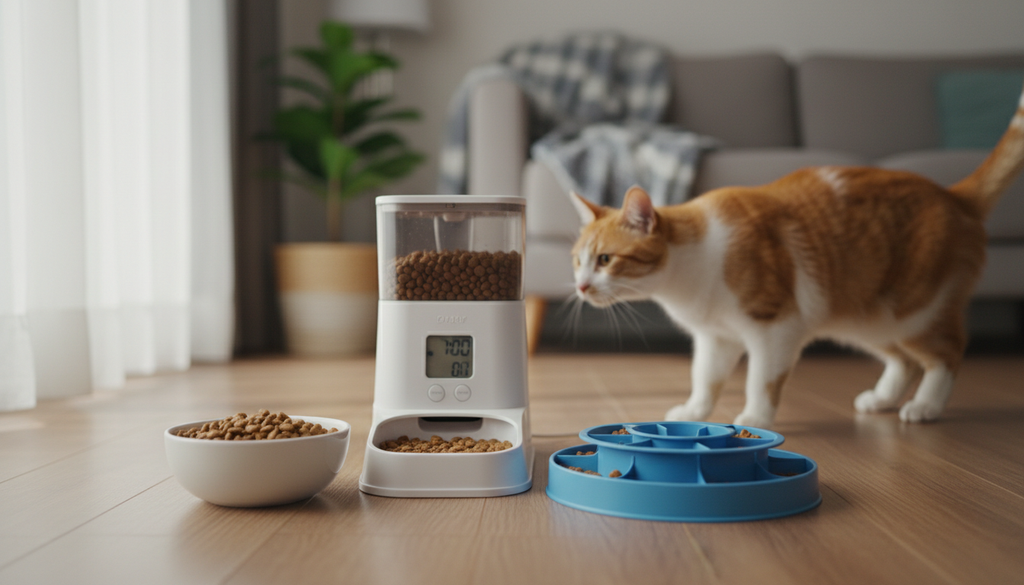
Introduce puzzle feeding at an easy level. A cat that has never used a food toy should not have the entire meal locked inside a difficult device. Let success come quickly, then increase the challenge only if the cat engages willingly and still receives the full daily ration.
You do not have to choose between an unlimited bowl and two rigid meals. Measure the full day’s ration, serve part at predictable meals, and divide the rest into timed or foraging portions. This can preserve several small eating opportunities while keeping calories visible. It also makes it easier to shift the schedule if early-morning begging or long workdays become a problem.
A simple example: prepare the day’s food in one container each morning. Serve breakfast from that container, place a measured portion in a timed feeder for midday, use another portion in a puzzle feeder, and serve the remainder at dinner. Treats come from the same plan. At the end of the day, you know what was offered and what remains. That information is more useful than arguing about whether the household technically “free feeds” or “meal feeds.”
Use Weight, Appetite, and Household Reality to Choose
Recheck the system after a few weeks rather than judging it after one day. Look at body weight, begging, leftovers, food stealing, vomiting after meals, and how easy the routine is for people to maintain. A feeding method that collapses every busy weekend is not truly practical.
The better system is the one you can maintain without losing track of intake, even on busy days when the household routine changes. If measured grazing keeps one cat lean and healthy, it may be fine. If food disappears too quickly, appetite changes are invisible, or cats compete, scheduled meals usually give more control. Reassess when life stage, health, body condition, household schedule, or the number of pets changes, because a system that once worked can stop fitting the household.
References
- How Often Should You Feed Your Cat? — Cornell Feline Health Center — Discusses free feeding, meal feeding, age, health, weight, and household schedule.
- Feline Feeding Programs — FelineVMA — Supports frequent small meals, solitary feeding, foraging, and individualized feeding programs.
- Feeding Your Cat — Cornell Feline Health Center — Covers complete diets, portions, food types, treats, and body condition.
