

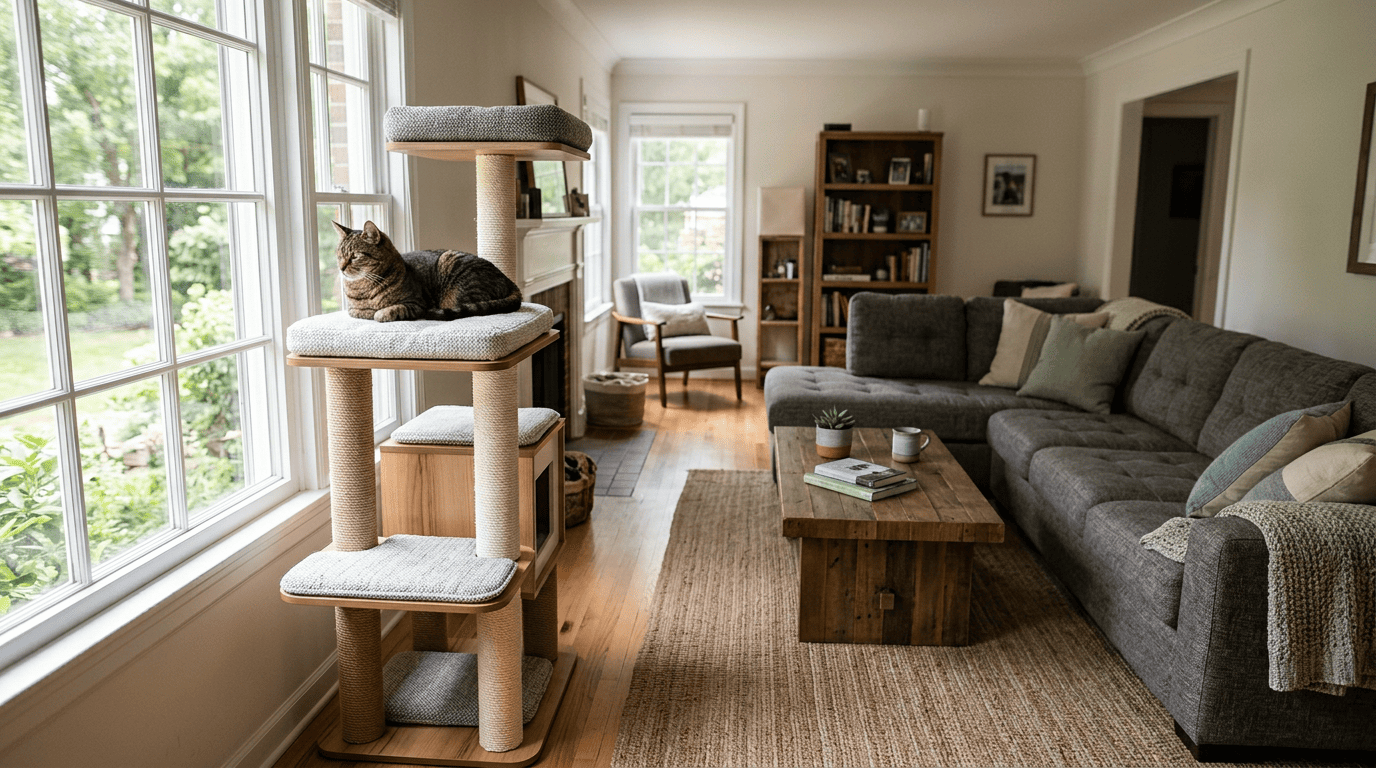
The best cat trees for indoor cats are not necessarily the tallest, most expensive, or most complicated models. A useful cat tree is stable under a full jump, gives the cat a comfortable route up and down, provides a perch or retreat in a location the cat actually values, and can survive regular scratching and cleaning. The right design also depends on age, body size, mobility, number of cats, and available floor space. Instead of starting with product photos, start with the behavior you want the tree to support.
Observe the cat for several days before choosing features. Note whether it sleeps high, scratches vertically, hides under furniture, watches windows, or uses the back of the sofa as a highway. Those behaviors reveal which tree features are likely to earn daily use. Buying from behavior first reduces the chance of paying for decorative parts the cat ignores.
Decide What Job the Cat Tree Needs to Do
A cat tree can provide height, scratching, resting, observation, hiding, or a route between furniture. Few homes need every function in one object. A cat that already has a favorite windowsill may benefit most from a stable intermediate step and scratching surface. Another cat may need a high resting place away from a dog.
Define the job before shopping. If the problem is sofa scratching, a tree with tiny decorative scratch posts may not help. If the goal is vertical territory, a short tower covered in soft beds may use floor space without adding meaningful height.
Measure the intended floor area before comparing models. A tree that blocks a walking path or forces furniture into awkward positions may be moved later to a less useful location. The best purchase is one you can place correctly from day one, not the largest tower that technically fits.
Budget can be allocated by function. If you already own a stable bench that serves as a step and a separate scratcher your cat loves, you may need only a simpler tree with one excellent perch. Combining safe existing furniture with a smaller purpose-built structure can outperform one expensive all-in-one tower.
If you are unsure whether your cat values height, test the behavior before buying big. Clear a secure shelf, add a stable stool near a window, or observe whether the cat chooses elevated furniture. That low-cost experiment can show whether vertical resting is a priority or whether scratching and hiding deserve more of the budget.
The Best Cat Trees for Indoor Cats Start With Stability
Stability is the first filter because a tree that rocks during a jump can quickly lose value. Look at the base footprint, total height, weight distribution, and how the upper platforms connect to the structure. Tall narrow towers need especially careful anchoring or wall support.
Test the display model if possible, or read assembly details closely. Push near the upper platform rather than only at the base. A large cat landing with momentum creates more force than a hand resting on the lower post. Secure wall attachments when the design provides them and the wall type allows safe installation.
Look at the center of gravity as well as the listed weight. A heavy tree can still wobble if most mass sits high above a narrow base. Conversely, a compact tree with a broad low platform can feel solid. Stability is a structural property, not simply a number on the shipping box.
Build a Route, Not Just a Tall Destination
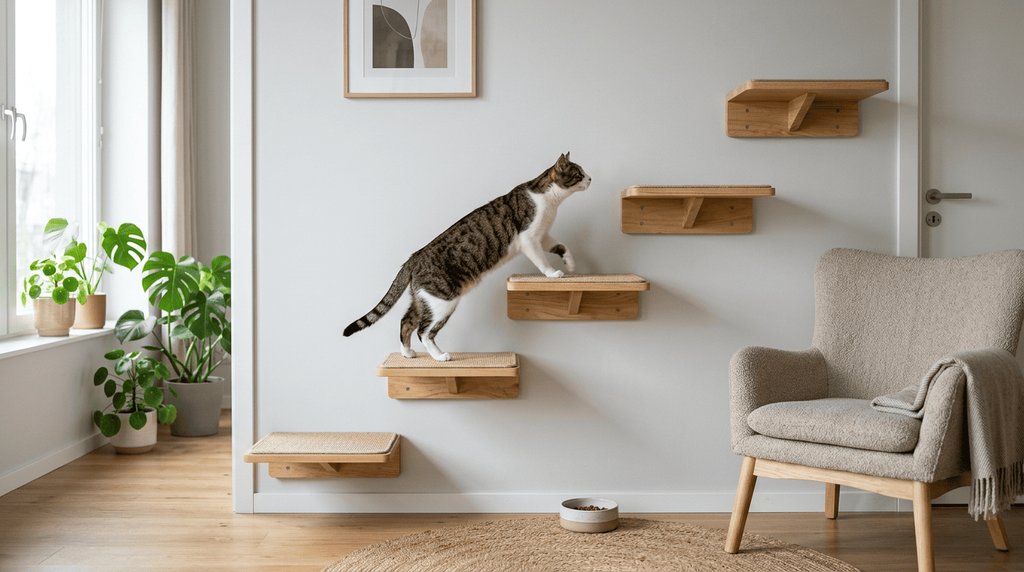
Cats need a practical way to get up and down. Young athletic cats may leap between platforms, while seniors and cats with arthritis often do better with smaller height changes and wider steps. A beautiful top perch is less useful if the only route requires one large jump.
Look for staggered platforms that create an obvious sequence. The landing areas should be large enough for the cat’s whole body rather than serving only as decorative ledges. In the broader distribution of resources around a cat-friendly home, the tree works best when it connects naturally with existing furniture, windows, and resting areas.
Routes also need a descent plan. Cats may climb confidently and then hesitate when returning to the floor because the landing below is hidden or too far away. Watch existing furniture use. If your cat always steps down through the same chair or shelf, choose a tree that offers similar intermediate landings.
For very large cats, also inspect platform attachment points. A wide perch is not enough if it is supported by one narrow post that flexes. Look for designs that distribute weight through multiple supports or use a solid central column. The cat should be able to turn around without the platform tilting beneath it.
Match Perches and Hides to the Cat’s Body
Many product photos use kittens, which can make platforms look larger than they are. Compare perch dimensions with your adult cat’s resting footprint. A large cat needs enough room to turn, curl, and lie securely without hanging over every edge.
Hammocks and enclosed cubbies also need realistic sizing. Some cats love a supported sling; others avoid fabric that shifts under their feet. Enclosed hides should have an opening large enough for comfortable entry and an interior that can be cleaned. If your cat rarely uses enclosed beds, do not pay extra for three caves it may ignore.
Perch edges matter for cats that sleep deeply or stretch while resting. Raised rims can add a sense of containment, but very narrow bolsters reduce usable lying space. Measure the flat interior area rather than the outside dimensions when deciding whether a bed will actually fit your cat.
Scratching Surfaces Need Length and Resistance
A vertical scratch post should allow a full-body stretch and should not rotate or wobble under pressure. Sisal rope, sisal fabric, cardboard, and other surfaces feel different, so existing preferences matter more than a universal material ranking.
- Choose tall scratch zones for cats that reach upward on furniture.
- Include horizontal or angled options if your cat scratches rugs or floor scratchers.
- Check whether worn rope can be replaced rather than discarding the whole tree.
- Place the scratching side where the cat approaches, not against a wall.
- Avoid decorative posts too short for the cat’s normal stretch.
A tree that cannot satisfy scratching may still be useful for climbing, but do not assume one object replaces every scratcher.
If the tree is meant to redirect scratching, place the scratch surface close to the existing target first. A new tower across the room competes poorly with a sofa arm already located on a travel route. After the cat uses the tree reliably, you can decide whether the final position still meets the climbing goal.
Do not position a tree where it creates an unintended launch point onto unsafe shelves or kitchen surfaces. Vertical enrichment should expand safe territory, not open access to breakables, hot appliances, or unsecured windows. Walk the likely jump paths from every upper platform before finalizing the location.
Placement Can Matter More Than the Model
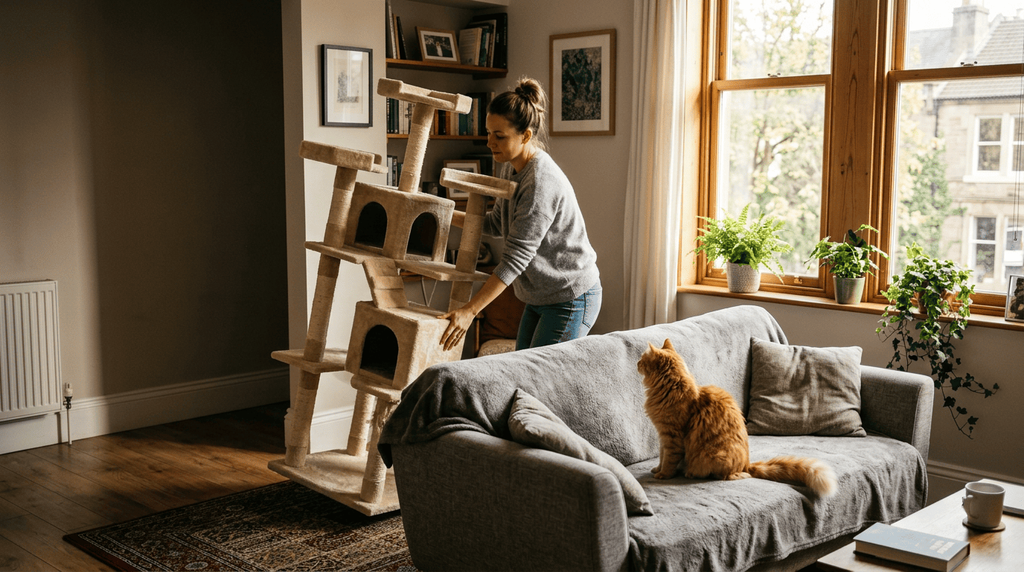
A high-quality tree hidden in a spare room may lose to the back of the sofa. Cats often value height where there is something to observe: a window, household activity, a doorway, or a social space. Place the tree where its height has a purpose.
Also consider heat, drafts, and direct sun. A window perch that becomes uncomfortably hot for part of the day may be used only briefly. Keep enough clearance from unstable shelves, cords, blinds, and breakable objects. The best placement lets the cat climb without creating a new household hazard.
Window placement can also create enrichment without adding electronics or toys. A perch that overlooks safe outdoor activity may hold attention for long periods. Just make sure the window screen is secure and the tree does not provide access to cords, blind loops, or a window opening that was previously unreachable.
Choose Differently for Seniors, Kittens, and Multi-Cat Homes
Kittens need stability and safe spacing because confidence can exceed coordination. Seniors need easier transitions, wider steps, and routes that do not depend on powerful jumps. A lower, broader tree can be more useful than a dramatic tower when mobility declines.
In multi-cat homes, think about traffic. One top perch can become a contested resource. Multiple resting levels and more than one route reduce the need for one cat to pass directly through another cat’s space. If the tree has only one ladder-like path, a confident cat may control the entire structure.
For older cats, traction becomes important. Slick laminated platforms can be harder to use than carpet, sisal, or washable non-slip pads. If the structure is otherwise suitable, adding securely fixed traction may extend its usefulness as mobility changes.
Assembly quality matters at purchase time too. Follow the manufacturer’s sequence and tighten hardware evenly rather than overtightening one side. Recheck the structure after several days of use because joints can settle. A tree that feels solid on day one can develop movement after repeated jumps if fasteners loosen.
Multi-cat trees should provide enough separation that one cat can rest without another needing to climb directly over it. Side-by-side or offset perches can be more useful than a single vertical stack. The goal is usable territory, not merely more platforms on the product specification sheet.
Cleaning and Repair Determine Whether the Tree Lasts
Check how fur, vomit, litter dust, and normal wear will be handled. Removable washable cushions are easier to maintain than deeply upholstered platforms. Replaceable scratch surfaces extend the useful life of the frame.
Inspect fasteners periodically. Screws can loosen as the structure flexes under repeated jumping. Tighten hardware and stop using the tree if a platform cracks or the frame becomes unstable. A durable tree is not one that looks perfect forever; it is one that can be maintained safely as parts wear.
Buy for the Cat You Have, Not the Product Photo
The best cat tree is the one your cat can use confidently and your home can support safely. Prioritize stability, realistic perch size, useful routes, suitable scratching surfaces, and placement before decorative features.
Measure both the cat and the available space. Then look at how your cat already climbs and rests. A modest tree beside a favorite window can outperform a huge tower in the wrong room. The product should solve a real environmental need, not simply prove that the home contains cat furniture.
When comparing final candidates, ignore feature count and score each one on stability, route, perch size, scratching usefulness, cleanability, and placement. A simple six-point comparison prevents a flashy product from winning because it has more accessories. The strongest tree is the one with fewer compromises on the features your cat will actually use.
Keep the return policy in mind when possible. Even a carefully chosen tree may fail because the cat dislikes a hammock, the platform feels unstable, or the route is awkward in practice. A realistic return or exchange option reduces pressure to keep an unsuitable structure just because it was expensive.
References
- Meeting the Physical and Emotional Needs of Indoor Cats — FelineVMA — Current framework for safe places, vertical space, scratching, separated resources, play, and environmental choice.
- AAFP/ISFM Environmental Needs Guidelines — FelineVMA — Evidence-based guidance on elevated resting areas, scratching, safe spaces, and environmental resources.
- Home Modifications for Your Cat — Cat Friendly Homes — Practical advice on ramps, steps, resting places, mobility, and adapting the home as a cat ages.
