

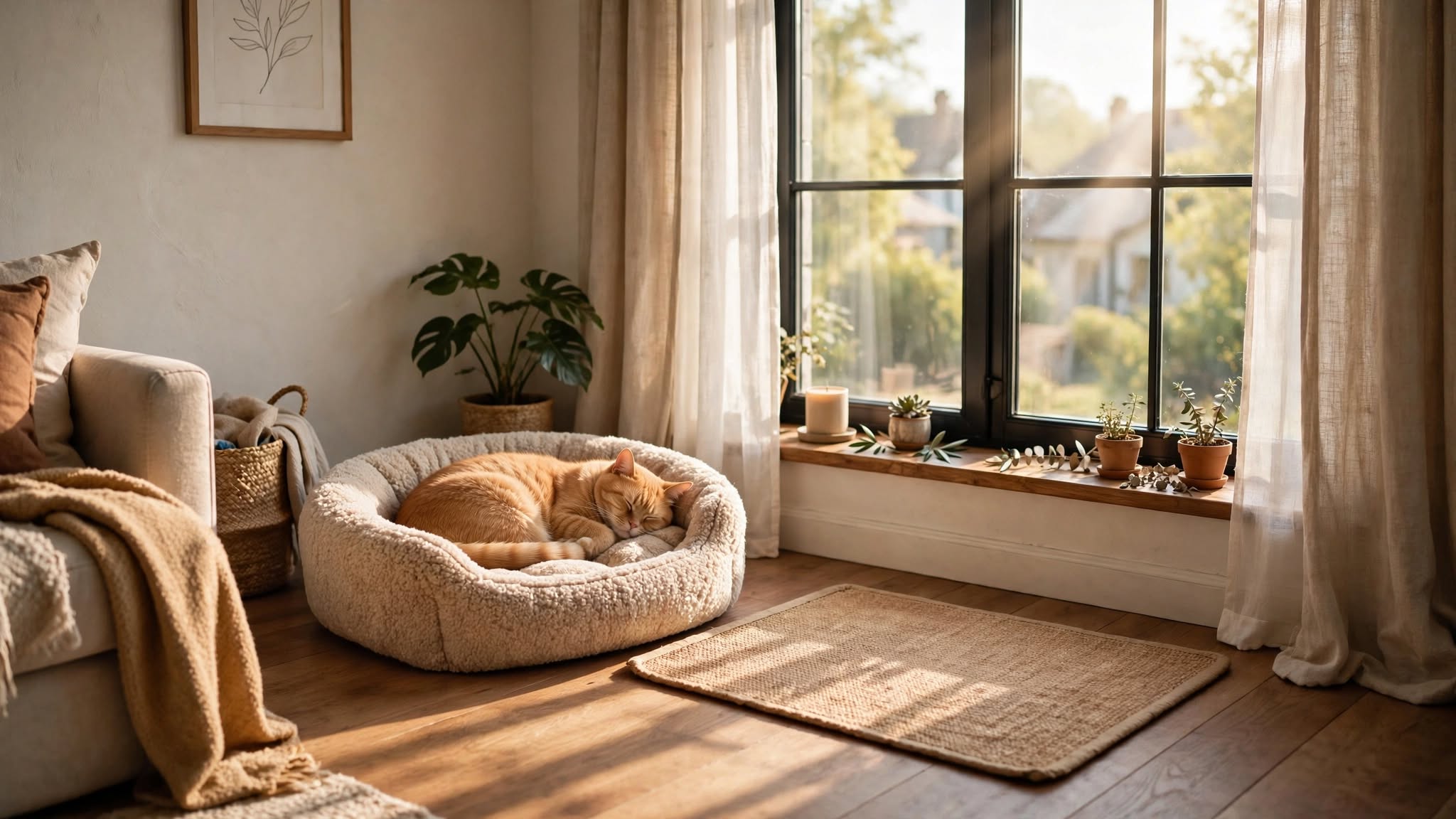
The best indoor cat beds are not necessarily the plushest beds in the catalog. Cats choose sleeping spots based on temperature, security, body position, height, scent, social distance, and what feels comfortable that day. That is why an expensive bed can sit empty beside a cardboard box. A useful bed solves a specific resting preference: warmth for a heat-seeker, raised sides for a curler, a flat washable mat for a sprawler, or a protected cave for a cat that wants cover. Current products such as the K&H Thermo-Kitty line, FurHaven ThermaNAP. And Best Friends by Sheri Donut Bed cover different parts of that spectrum.
| Bed | Best for | Main advantage |
|---|---|---|
| K&H Thermo-Kitty Bed | Heat-seeking cats | Purpose-built heated resting surface with cat-sized shape |
| K&H Thermo-Kitty Mat | Cats that dislike raised sides | Low-profile warm surface that fits existing favorite spots |
| FurHaven ThermaNAP Self-Warming Bed | Warmth without electricity | Reflective self-warming construction and light portable format |
| Best Friends by Sheri Original Calming Donut 23-inch | Curlers and burrowers | Raised rim and deep soft center |
These are not interchangeable. A senior cat that stretches flat may ignore a deep donut. A cat that sleeps on radiators may prefer a heated mat. Use your cat’s current sleeping choices as the product brief.
K&H Thermo-Kitty Bed Is the Strong Pick for Dedicated Warmth
K&H’s Thermo-Kitty range is designed around low-watt pet heating and a cat-sized sleeping surface. This type of bed makes sense for cats that consistently seek warm laptops, sun patches, heating vents, or laps. Warmth can be particularly appealing to seniors and thin-coated cats, although any heated product should be used according to the manufacturer’s instructions and placed where the cat can leave freely.
Do not treat heat as automatically therapeutic. A cat with fever, reduced mobility, sensory impairment, or a medical condition may need individualized advice. Check cords for chewing, keep the bed dry, and inspect the cover regularly. The cat should always have an unheated alternative. A heated bed is best when it expands choice, not when it becomes the only comfortable resting place.
K&H Thermo-Kitty Mat Works Better for Cats That Hate Bolsters
Some cats want warmth but dislike climbing over a rim or sinking into deep filling. A low-profile heated mat can be placed on a wide shelf, bench, sofa corner, or other stable surface the cat already uses, as long as the placement follows product safety instructions. This is often more successful than trying to persuade a cat to adopt a freestanding bed in a location they never chose.
The mat format also helps large cats that spill out of small circular beds. Measure the usable sleeping area rather than relying on “cat” in the product name. If your cat usually sleeps stretched on the side, trace the body length on the current favorite blanket and compare that footprint with the bed before buying.
FurHaven ThermaNAP Is a Good No-Cord Warmth Option
FurHaven’s ThermaNAP line uses self-warming material rather than an electrical heating element. That can be useful where an outlet is inconvenient, where cord chewing is a concern, or when you want a portable warm layer for a carrier, sofa, or floor. It does not create the same controlled heat as an electric bed. It reflects the cat’s own body heat, so the experience is gentler and depends on the cat occupying it.
This type of bed is especially versatile for figuring out placement. Move it between a sunny window area, a quiet corner. And the sofa for several days each and see where the cat chooses it most. Once you learn the preferred zone, you can decide whether a more permanent bed is worth buying.
Best Friends by Sheri Donut Bed Suits Cats That Curl and Nest
The Original Calming Donut Bed has a round shape, raised rim, soft filling, and shag-style surface. The 23-inch size is often suitable for cats and small pets, while larger sizes provide more room. Cats that sleep tightly curled or press against cushions may enjoy the supported edge. Burrowing cats may also use the deeper center more readily than a flat pad.
The same design can be wrong for a cat that overheats easily, dislikes unstable fluffy surfaces, or prefers to stretch. Deep beds also collect fur quickly, so washability matters. The current product line includes machine-washable options and removable-cover designs on some sizes. Follow the specific care instructions because bulky filling can dry slowly and retain odor if stored damp.
Surface preference matters alongside shape. Some cats love shag and fleece; others choose smooth cotton, cardboard, or bare wood even when softer options are available. If your cat repeatedly pushes blankets aside before lying down, do not buy the thickest plush bed. A removable cover lets you experiment with texture without replacing the whole bed.
Choose Bed Shape From the Cat’s Existing Sleep Positions
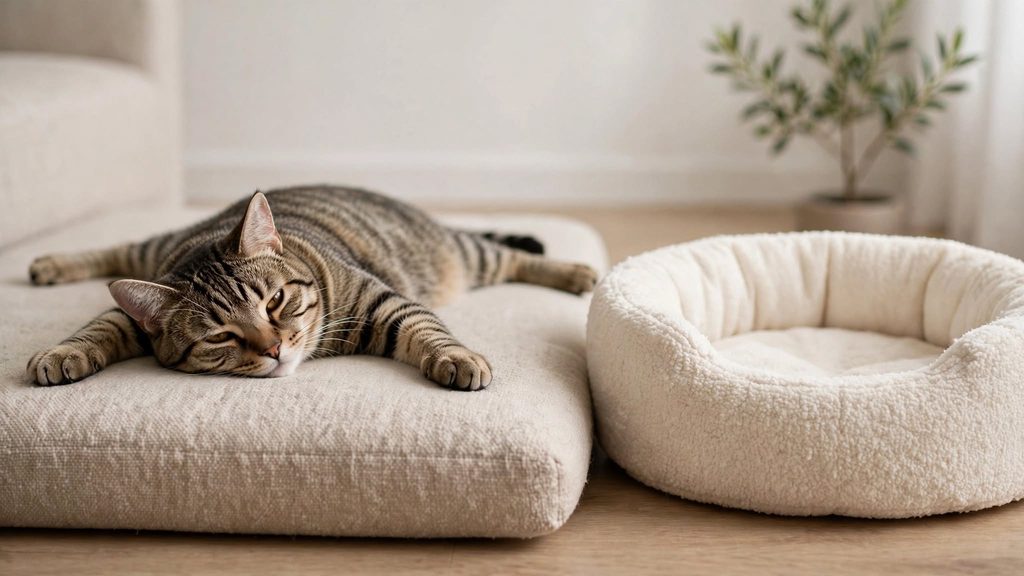
Before shopping, look at three days of naps. Does your cat curl into a tight circle, stretch long, lean against a wall, hide under furniture, or sleep exposed in the middle of the room? Those choices are free usability tests. A curler may like bolsters. Sprawlers need length. A hider may prefer a cave or high-sided bed. A cat that rotates between all of them may benefit more from two inexpensive bed types in different locations than one premium bed.
- curled tightly: donut or bolster bed;
- stretched long: flat mat or rectangular pad;
- seeking heat: heated or self-warming bed;
- hiding to sleep: cave, covered bed, or protected box;
- older or stiff cat: low entry and stable supportive surface.
This fits the broader idea of placing cat resources where they support normal movement and rest rather than treating furniture as decoration.
Temperature changes the answer across the day. A cat may use a sunny window bed in the morning, a cool tile floor in the afternoon, and a donut beside you at night. That rotation is normal. Instead of trying to find one “forever bed,” provide different thermal options and let the cat move between them. In hot climates, breathable flat surfaces can be as important as cozy winter bedding.
Vertical placement deserves care. Never put a soft bed on a shelf that is barely larger than the bed base, because the whole unit can shift when the cat jumps in. On cat trees, check whether bolsters reduce usable landing space. The bed should not turn a safe perch into a narrow platform.
Location Can Matter More Than the Bed Itself
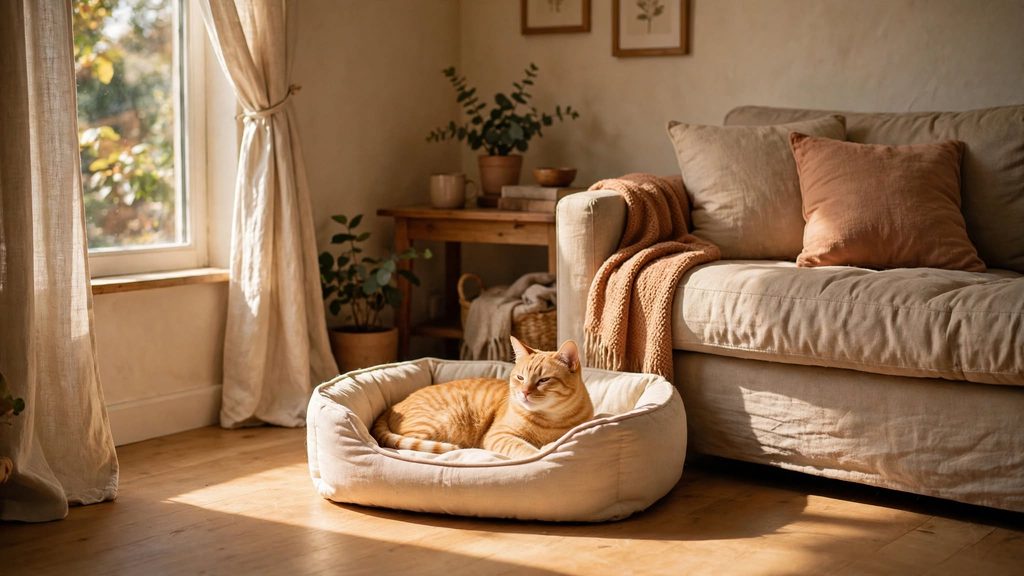
A good bed in the wrong place often loses to a folded towel in the right place. Cats may choose warmth, elevation, quiet, visibility, or closeness to people. Try the bed where the cat already sleeps before inventing a new destination. If the cat uses the bed only after you move it to the window, you learned that location—not padding—was the main requirement.
Give shy cats a resting option away from foot traffic and children. Give social cats a bed near the room where people spend time. In multi-cat homes, provide more than one desirable resting area so beds are not controlled by the most confident cat. Elevated beds need safe access and enough platform depth that the whole bed cannot slide or tip.
For cats with occasional vomiting, urine leakage, or medical recovery, waterproof layering can save the bed without changing the top texture. Place a washable absorbent pad under a familiar cover rather than replacing every resting surface with crinkly waterproof fabric. If accidents become new or frequent, treat them as health information and contact the veterinarian rather than solving only the laundry problem.
Allergies are often blamed on bedding materials, but itchy skin has many possible causes. If a cat develops redness, overgrooming, or hair loss after a new bed, remove the item and discuss persistent signs with the veterinarian. Do not assume a “hypoallergenic” marketing label identifies the cause.
Washability Is a Comfort Feature, Not Just a Human Convenience
Beds collect saliva, skin oils, litter dust, food crumbs, and loose hair. A removable washable cover or a fully machine-washable design makes long-term use easier. Check whether the filling can be washed, whether the cover shrinks, and whether the bed must air dry. For heated beds, unplug and remove electrical components exactly as instructed before cleaning.
Do not sterilize a favorite bed so aggressively that every familiar scent disappears at once. Cats use scent as part of environmental security. If you rotate two blankets or covers, one can retain familiar smell while the other is washed. Strong fragrances and heavily perfumed laundry products can be unpleasant to a cat even when they smell “clean” to you.
Body size also changes bolster comfort. A small cat can use a 23-inch donut as a deep nest, while a large cat may be forced into a tight curl. If the cat routinely hangs the head or hips over the edge, that may be a chosen pose. But it can also mean the usable sleeping diameter is smaller than the product’s outside measurement suggests.
Senior Cats Need Easier Access, Not Automatically Softer Beds
Older cats often change resting behavior because jumping, climbing, or curling tightly becomes less comfortable. A low-entry bed on the same floor as food, water. And litter may be more valuable than a luxurious bed on a high shelf. Warmth can help comfort, but stability and access come first. If the cat hesitates before stepping into a high bolster, a flat orthopedic-style pad may be easier.
Changes in sleeping location can also be health clues. A cat that suddenly abandons a favorite high perch, sleeps much more, or chooses unusual secluded spots may be dealing with pain or illness rather than shopping for a better bed. Adjust the environment, but mention persistent mobility or behavior changes to the veterinarian.
Budget-wise, buy one bed for a known preference before building a collection. A $15 flat mat used every day is better value than three premium caves the cat ignores. Once a shape proves successful, duplicate the function in another important room rather than buying a completely different style just for variety.
The Best Indoor Cat Beds Earn Repeat Use
K&H heated beds are strong choices for heat-seekers, FurHaven ThermaNAP offers simple self-warming portability. And the Best Friends by Sheri Donut suits cats that curl into soft raised sides. Yet a product becomes “best” only after the cat repeatedly chooses it. Do not judge after one hour. New fabric and unfamiliar scent can take time to become acceptable.
Place the bed in a proven sleeping zone, add a familiar blanket if needed, and leave it alone for several days. If the cat still ignores it, reconsider shape and location before buying another premium model. Indoor cats spend a large part of life resting. So the best setup often includes several different safe sleeping options rather than one designated bed that the human expects them to love.
References
- K&H Pet Products — Indoor Heated Cat Beds — Current manufacturer product specifications.
- FurHaven — All Beds — Current manufacturer product specifications.
- Best Friends by Sheri — Original Calming Donut Bed — Current manufacturer product specifications.
