

If you are dealing with cat begging for food all day, the answer is not always hunger. Cats learn routines quickly. Meowing at the kitchen may bring attention, treats, or a few extra kibbles, so the behavior can strengthen even when daily calories are adequate. Other cats are underfed because portions were guessed, bored because meals offer little activity, or genuinely hungrier because of growth, pregnancy, medication, or disease. The useful first step is to separate “asking for food” from “needing more food.” Measure what your cat actually eats, compare it with body condition and weight trend, then look at when and how the begging happens.
Separate Cat Begging for Food From True Hunger
A cat can beg ten minutes after finishing a complete meal. The behavior may be asking for interaction, predicting a treat, or responding to the sound of a cupboard. If food has followed the meow often enough, the cat has learned that persistence works. That does not mean you should ignore every vocal cat. It means begging cannot tell you whether the ration is nutritionally appropriate.
Use the scale and the food label instead. Track body weight, body condition, and the measured daily amount. A cat maintaining an ideal condition on a complete diet may not need extra calories even if the performance at 4 p.m. is convincing.
Begging location provides clues. A cat that vocalizes only beside the treat drawer has learned a very specific association. A cat that wakes you, follows everyone, raids counters, and searches bins may have broader food motivation. Note whether the behavior stops after a meal and how long the relief lasts. The pattern helps separate a cue-driven habit from persistent hunger that deserves closer evaluation.
Also note whether begging changes after a full play session. If the cat settles afterward without food, part of the drive may be interaction rather than calories.
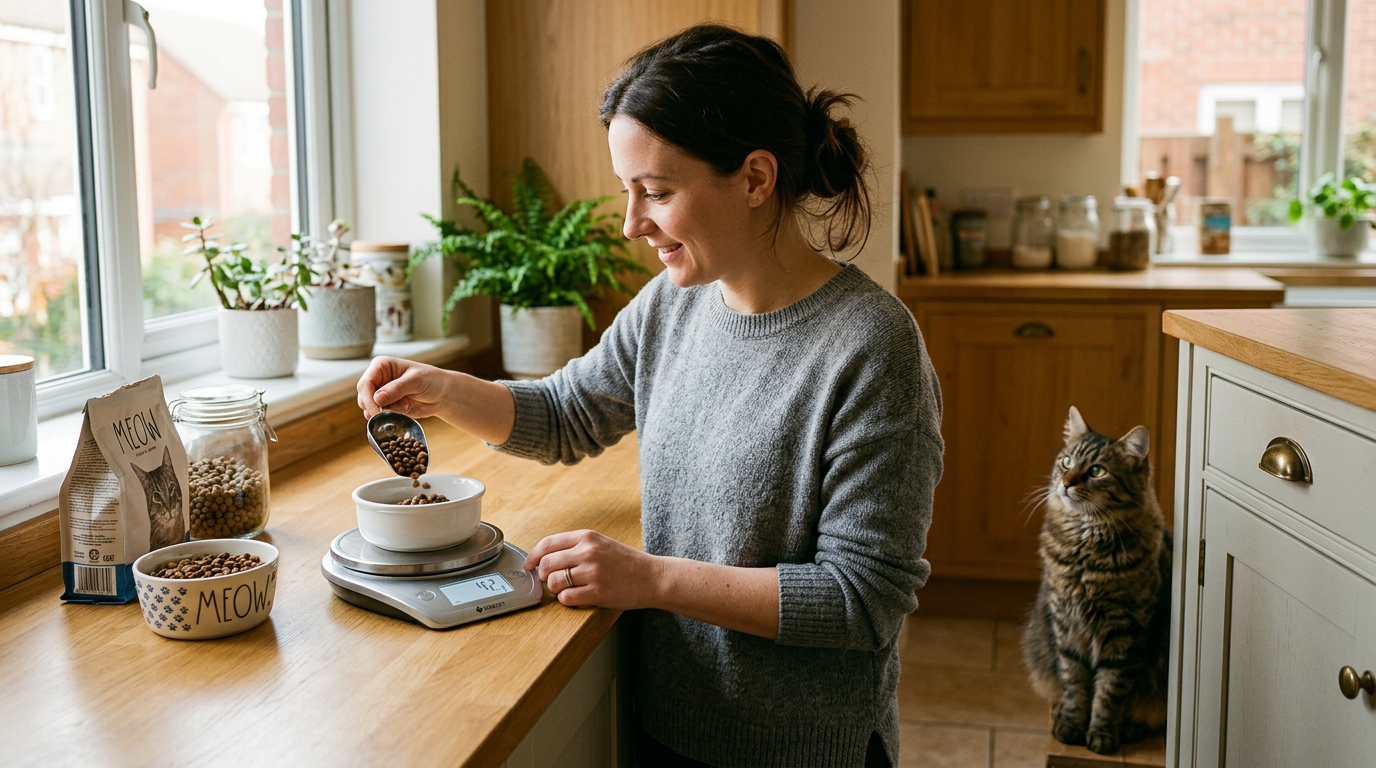
Measure the entire day’s food in grams or calories rather than counting scoops. Dry-food cups can vary dramatically depending on how they are filled, and wet-food cans differ in calorie density. Treats count too. If several family members feed the cat independently, the total can be far above what anyone realizes.
Once you know the daily amount, compare it with the cat’s full feeding plan and body condition. If weight is dropping or the cat is too thin, the ration may need professional adjustment. If weight is rising, begging is not evidence that more food is required.
Check the Daily Portion Before You Change the Schedule
Use grams when possible because volume measures are imprecise. Put the empty bowl on a kitchen scale, tare it, and weigh the portion. For wet food, record the calories per can or pouch and the fraction served. For dry food, use the manufacturer’s kcal per cup or kilogram to calculate calories. Once the number is real, your veterinarian can adjust it intelligently instead of working from ‘about half a scoop.’
Meal Timing Can Turn Normal Appetite Into All-Day Asking
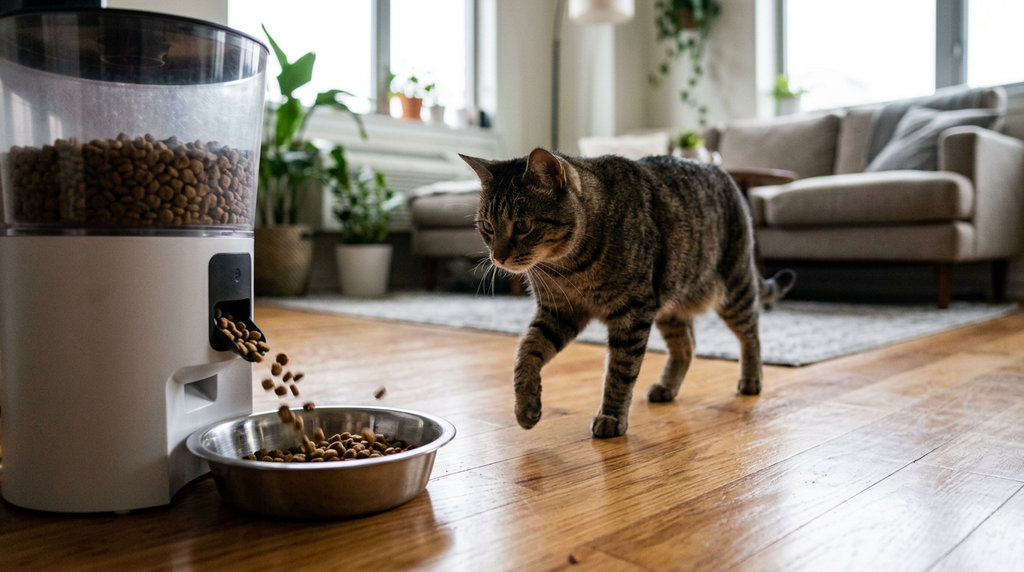
Two large meals create long periods in which some cats start anticipating the next feeding. Dividing the same calories into three or four smaller meals can reduce the sense that food only appears at rare events. An automatic feeder can separate food delivery from your arrival in the kitchen, which helps when the cat has learned to target one person.
Do not add meals without subtracting calories elsewhere. A 220-calorie daily ration remains 220 calories whether it is served twice or five times. The goal is to redistribute opportunity, not reward every request.
An automatic feeder can also reduce the emotional link between begging and a particular person. If the machine delivers a small pre-measured portion at 3 p.m., the cat has less reason to campaign at your desk at 2:45. This works best when the feeder is reliable and the cat cannot break into it. For wet food, use a model designed to keep food safe for the intended interval.
If you move to more frequent meals, give the schedule at least a week before judging it. The cat may continue asking at the old times out of habit. What matters is whether the duration and intensity of begging decline while weight and total intake stay appropriate.
Boredom Can Look Exactly Like Food Obsession
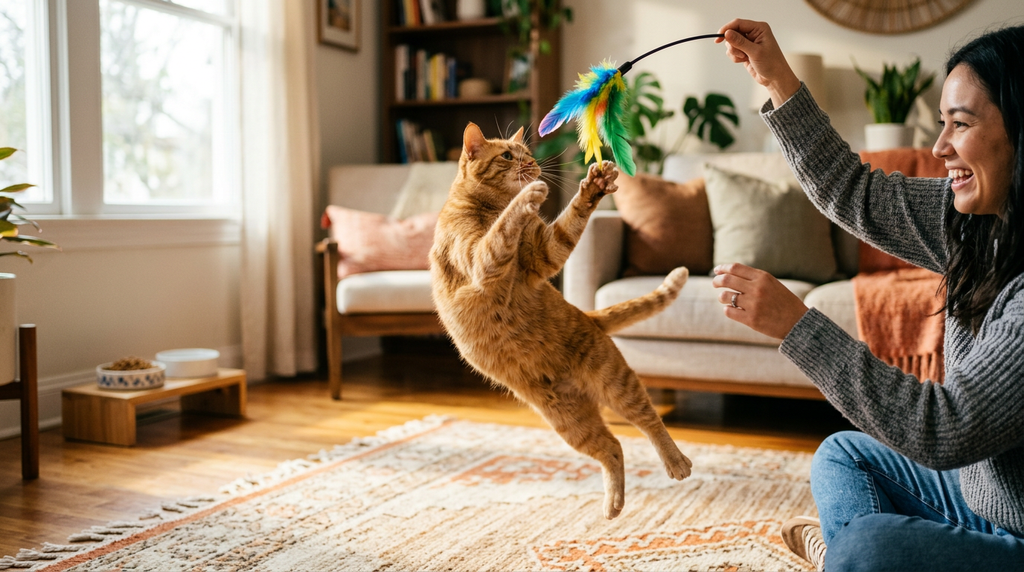
Indoor cats may discover that begging is the most reliable way to make humans stand up and interact. If the day has little hunting, climbing, watching, or play, food becomes the main event. Try giving a short wand-toy session before a scheduled meal, scattering part of a dry ration in safe searching spots, or using a simple puzzle feeder.
Watch what happens when you offer play instead of food. A cat that switches happily into stalking and chasing may have been seeking stimulation. A cat that ignores everything except the bowl may still be highly food-motivated, but the test helps you understand the pattern.
Environmental enrichment does not need to be elaborate. Rotate cardboard boxes, move a perch to a better window, hide a few pieces of the measured ration in easy locations, or schedule two short wand sessions. The key is creating events that are not snacks. If every interesting moment in the day comes from food, it is unsurprising that the cat spends time asking for food.
Some Cats Have Learned That Persistence Pays
Intermittent rewards make behavior remarkably durable. If you ignore nine begging episodes but give a treat on the tenth because you are in a meeting, the cat learns that longer effort can work. The solution is not punishment. It is making food predictable and attention available at other times.
- Feed on a schedule rather than in direct response to meowing.
- Give affection or play when the cat is calm, not only at the food cupboard.
- Ask all household members to follow the same feeding plan.
- Pre-measure treats for the day so extras are visible.
Consistency is easier for the cat to understand than repeated negotiation.
Family inconsistency is a common hidden variable. One person may measure meals carefully while another offers a spoonful whenever the cat meows. Put the daily treat allowance in one container each morning. When it is empty, the household is done. This simple system prevents accidental double feeding and makes it obvious whether begging is being rewarded outside the formal meal plan.
Food Type and Meal Volume Can Affect Satiety
Calorie density influences how physically large a meal looks. Some dry foods deliver many calories in a small volume, while wet food contains much more water. Changing diet can affect satiety for some cats, but there is no single format that makes every cat feel full. Protein, fiber, palatability, energy density, and individual preference all matter.
If you want to change food for satiety or weight management, do it deliberately rather than adding vegetables or diluting a complete diet at random. Veterinary weight-management diets are formulated to provide essential nutrients at reduced calories. Homemade volume tricks can unbalance nutrition.
Fiber and moisture changes should be made through complete diets or veterinary guidance rather than kitchen additions. Cats have specific nutrient requirements, and replacing part of a balanced ration with pumpkin, vegetables, broth, or other fillers can dilute nutrition if done routinely. If satiety is a major issue during weight loss, ask about diets formulated to provide adequate protein and micronutrients at controlled calories.
When Constant Hunger Is a Medical Sign
Increased appetite deserves more attention when it is new or paired with weight loss. Hyperthyroidism commonly causes weight loss despite increased appetite in middle-aged and older cats. Diabetes can cause increased appetite along with increased thirst, urination, and weight loss. Parasites and gastrointestinal disease are other possibilities depending on age and history.
A kitten that is growing rapidly has different needs from a twelve-year-old cat suddenly raiding every bowl. Do not assume a dramatic appetite increase is behavioral, especially when body weight is moving in the wrong direction. Your veterinarian may recommend an exam and tests based on the full pattern.
Medication can change appetite too. Corticosteroids and some other drugs may increase hunger, while many medications can reduce it. If begging began after a prescription changed, tell the veterinarian rather than altering the dose yourself. The timing can help the clinician decide whether the behavior is an expected effect, a dose issue, or a sign of the disease being treated.
Multi-Cat Homes Can Create Begging Even When Enough Food Exists
One cat may finish quickly and steal from another, leaving the slower cat genuinely short on calories. Another cat may avoid the feeding area while the dominant cat is present, then beg from humans later. Shared free-feeding bowls make individual intake hard to measure, so “everyone has food available” does not prove each cat is eating enough.
Feed separately when necessary. Microchip feeders can protect individual portions, but simple closed-door meals often work. Once you can measure each cat’s intake, begging becomes much easier to interpret.
Watch the slower cat as carefully as the beggar. In some homes, the noisy cat is actually overeating because it steals meals, while the quiet cat is losing weight. Weigh both cats and protect both portions. The most vocal animal is not always the one with the nutritional problem. Multi-cat feeding needs individual data.
For seven days, record meal times, measured calories, begging times, treats, play, and body weight if practical. Patterns often emerge quickly. Begging may peak one hour before a predictable meal, after a household member returns home, or on days without play. That points toward routine rather than nutritional deficiency.
If the cat is losing weight, drinking more, vomiting, having diarrhea, or showing a sudden appetite change, do not wait for the log to finish before calling the vet. The purpose of tracking is to make ordinary behavior clearer, not to delay care.
Add one column for what happened immediately before the begging. A person entering the kitchen, the automatic feeder clicking, a Zoom call beginning, or another cat eating can reveal learned cues. Those triggers often explain why the behavior feels ‘all day’ even though it clusters around repeatable events.
Build a Routine That Does Not Require Saying No All Day
Measure the daily ration, divide it into a schedule the cat can predict, protect each cat’s portion, and create non-food events worth anticipating. Use puzzles or hunting-style feeding when the cat enjoys them. Reward calm behavior with attention rather than making every interaction edible. Keep the plan boringly consistent.
Once the plan is consistent, give it time. A cat that has been rewarded for begging for years may continue for a while after the rewards stop. The aim is not silence. It is a cat whose weight, nutrition, and daily activity make sense even when the cat remains charmingly convinced that dinner should arrive early.
References
- Cornell Feline Health Center — Feeding Your Cat — Reviews calorie needs, body condition, feeding environment, and appetite changes.
- VCA Animal Hospitals — Testing for Increased Appetite — Explains normal and abnormal increased appetite and common diagnostic approaches.
- Cornell Feline Health Center — Hyperthyroidism in Cats — Describes increased appetite with weight loss, thirst, and other hyperthyroidism signs.
