
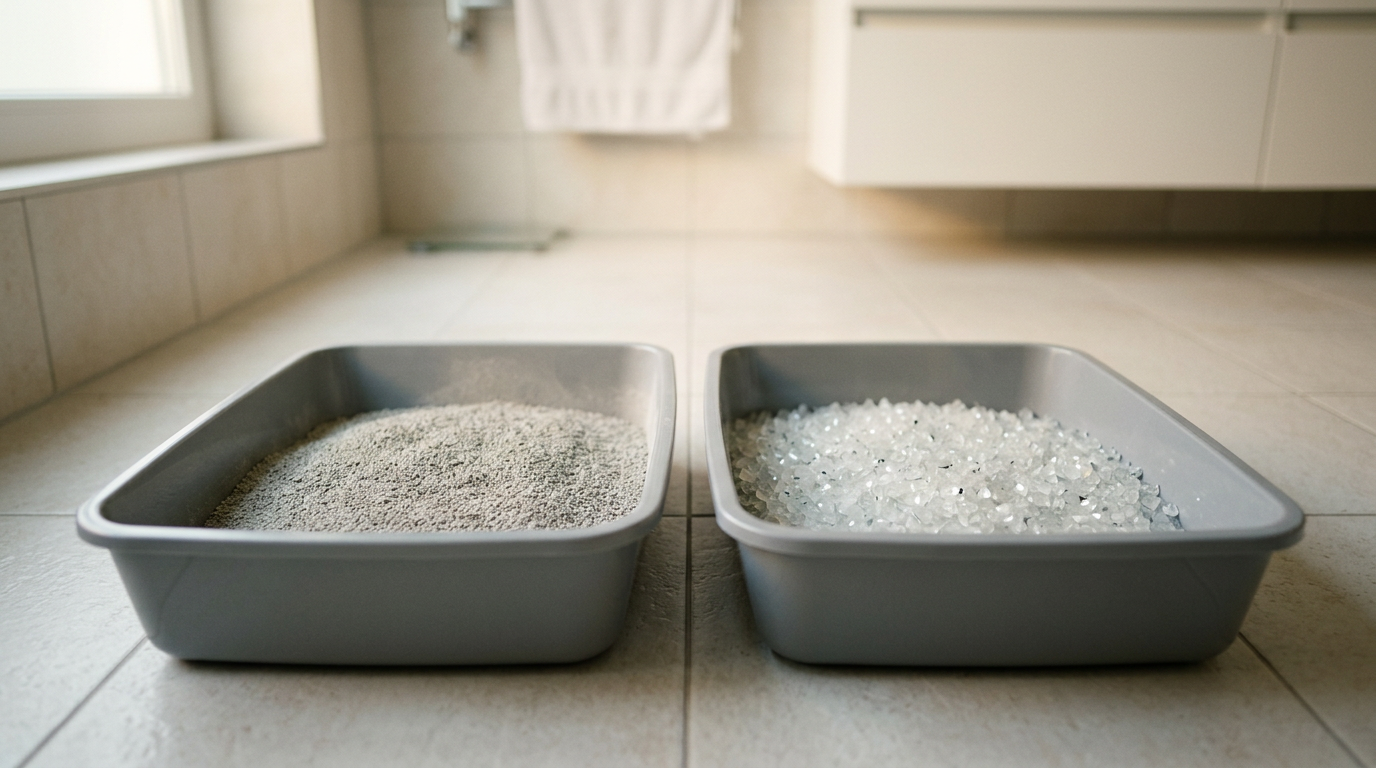
Clay vs crystal cat litter is not a simple contest between “natural” and “high tech.” Clay litter and silica crystal litter manage moisture in different ways, feel different under a cat’s paws, create different cleanup routines, and vary widely by brand. Many cats show strong substrate preferences. The best choice is one your cat uses comfortably and that you can keep clean consistently. Fine clumping clay remains a common feline preference, while crystal litter can be lighter and control moisture for longer. Compare texture, dust, tracking, urine visibility, odor control, and cost. Also consider how often you want to scoop or replace the box.
Clay and Crystal Litter Handle Urine in Different Ways
Traditional clay litter may be clumping or non-clumping. Clumping clay absorbs liquid and forms a mass that can be scooped out. You can remove urine waste daily and top up the remaining litter. Non-clumping clay absorbs urine into the substrate, so the whole box usually needs more frequent replacement. Crystal litter is generally made from silica gel granules that absorb moisture into the particles. It does not usually form the same kind of clay clump, although some products now advertise clumping behavior.
That difference changes what “clean” looks like. With clumping clay, you physically remove most urine each time you scoop. With non-clumping crystals, moisture is distributed and absorbed until the substrate reaches its useful capacity. Follow the product instructions rather than applying a clay routine to crystals or vice versa.
Texture May Decide the Clay vs Crystal Cat Litter Question for Your Cat
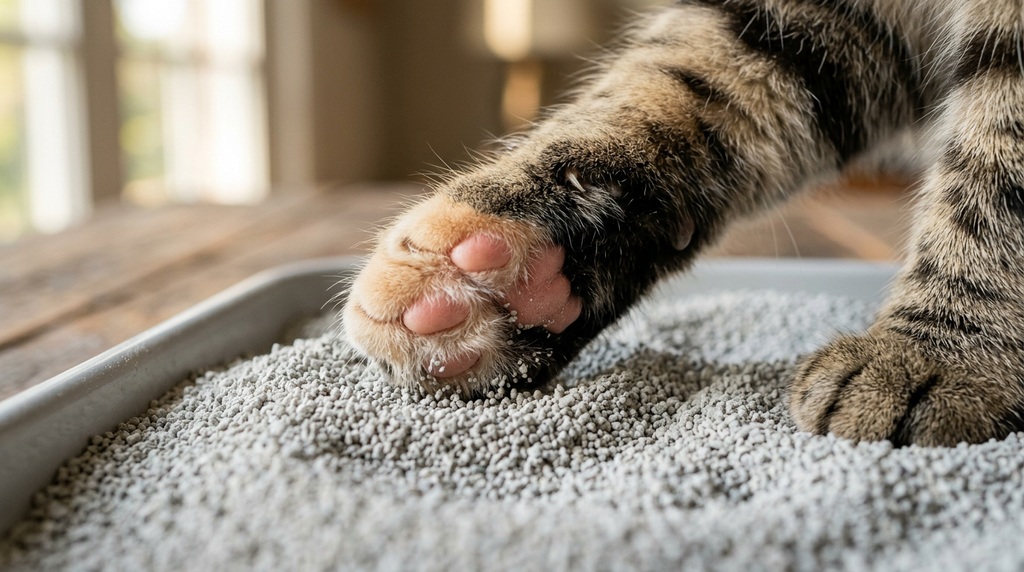
VCA notes that many cats prefer fine, clumping clay litter. Fine particles can resemble the loose substrate cats naturally dig in and may feel comfortable under the paws. Crystal granules are typically larger and firmer. Some cats accept them immediately; others hesitate, perch on the edge of the box, dig less, or choose another surface. Sensitive paws, declawing history, arthritis, and individual preference can make texture especially important.
Do not assume refusal is stubbornness. If a cat has used soft clay for years, a sudden switch to large crystals changes both feel and sound. Walking, digging, and covering may all feel different. A litter that performs brilliantly for odor but causes the cat to avoid the box is not a successful upgrade.
Paw-cleaning behavior can reveal which nuisance matters more to the cat. A cat that steps out of clay and immediately shakes its feet may dislike particles between the toes. A cat that tiptoes across crystals may dislike the firmness itself. Long-haired cats can carry fine clay in paw fur even when the litter seems low-tracking on the package.
Dust and Tracking Are Different Problems
Clay litter can create fine dust, especially when poured or when low-quality granules break down. Dust may bother people or cats with respiratory sensitivity and can coat nearby surfaces. Crystal litter is often marketed as low dust, but it is not automatically dust-free. Particles can fracture, and different formulas behave differently. Pour any litter gently and pay attention to the actual product in your home rather than relying on one category claim.
Tracking depends on particle size, paw fur, box design, litter depth, and the cat’s digging style. Fine clay can cling to paws and travel across floors. Larger crystals may track fewer individual pieces, but the pieces are more noticeable and can feel unpleasant to step on. A textured litter mat can help, provided the cat is comfortable crossing it and it does not create a barrier at the box entrance.
Clumping Clay Makes Daily Urine Monitoring Easier
One practical advantage of clumping clay is that urine often produces visible clumps with a fairly consistent shape and size for that cat. You cannot diagnose disease from clump size, but changes can alert you that drinking or urination may have shifted. With crystal litter, urine may be absorbed and spread through the substrate, so casual volume comparison can be less intuitive. Some crystal products use color indicators, but those should not replace veterinary testing.
If monitoring urine matters because your cat has a medical history, ask your veterinarian what substrate and observations would be most useful. Some diagnostic urine collection methods require special non-absorbent litter, which is different from both normal clay and household crystal products. Everyday convenience should not interfere with a specific veterinary sampling plan.
Weight and storage are practical differences that affect consistency. Large bags of clay are heavy to carry, pour, and store, especially in apartments without elevators. Crystal litter is often lighter for the same perceived box-filling job. If a heavy bag makes you postpone topping up or full changes, that real-world burden matters. On the other hand, if crystal litter costs enough that you stretch replacement far past the recommended interval, the theoretical convenience disappears.
Waste disposal differs too. Clumping clay produces dense daily clumps; crystals may generate less daily urine waste but a larger full-box discard when saturated. Neither should be flushed unless the specific product and local wastewater guidance explicitly allow it—and even then, cat feces raise additional environmental and plumbing concerns. A covered trash system can make either routine easier.
Odor Control Depends on Maintenance More Than Marketing
Crystal litter can manage urine odor well because silica gel absorbs moisture, while clumping clay lets you remove urine from the box each day. Both can fail when waste remains too long. Feces should be removed promptly regardless of substrate. Scented formulas may mask odor for people but can be aversive to cats, whose sense of smell is much more sensitive. A clean unscented box is usually a safer starting point than a heavily perfumed litter.
Box size, ventilation, number of cats, diet, and stool quality also affect odor. If one box smells strongly within hours despite good maintenance, do not assume stronger fragrance is the answer. Confirm that you have enough boxes, the litter depth is appropriate, waste is being removed. And the cat is not having diarrhea or unusually concentrated urine.
Compare the Real-Life Trade-Offs Before You Switch
| Factor | Clumping clay | Crystal litter |
|---|---|---|
| Paw feel | Usually fine and sand-like | Often larger, firmer granules |
| Urine removal | Scoop formed clumps | Moisture absorbed into crystals |
| Weight | Usually heavier | Often lighter |
| Monitoring | Clump size is easy to notice | Urine volume may be less visually obvious |
| Dust | Can be dusty depending on formula | Often lower dust but not dust-free |
| Cat preference | Fine clumping clay is commonly preferred | Highly individual; texture can be a barrier |
Cost per bag is not enough to compare value because replacement frequency differs. Calculate roughly how long one package lasts in your household and how much substrate is discarded, then weigh that against cat acceptance and cleaning effort.
Watch digging behavior during the test, not only whether elimination lands inside the box. A cat that enters, urinates immediately, and leaps out without covering may be tolerating a substrate rather than preferring it. Persistent edge-balancing, paw shaking, or scratching the wall instead of the litter can also suggest discomfort with texture or depth. These are not absolute rules, but they help explain why a “technically used” litter may still be a poor long-term fit.
If the cat has asthma, chronic respiratory disease, painful paws, or a history of urinary or elimination problems, discuss substrate changes with the veterinarian. The goal is not to find a universally healthiest material. It is to minimize avoidable irritation while preserving reliable box use and the ability to monitor changes relevant to that cat.
Switch Litter Gradually Instead of Rebuilding the Whole Box Overnight
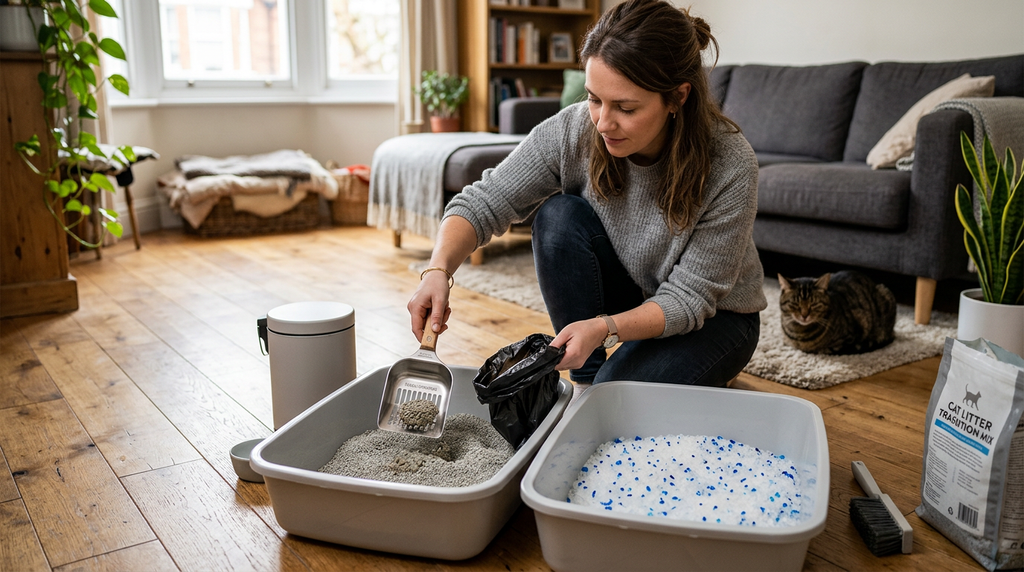
If your cat currently uses the box reliably, protect that success. One method is to offer a second box with the new substrate beside the familiar box and observe which is used. Another is a gradual mix, increasing the new litter over several days if the cat remains comfortable. A side-by-side preference test gives cleaner information because the cat can choose between distinct substrates rather than walking on a mixture that feels like neither.
- keep box style and location the same during the substrate test;
- use similar litter depth in both boxes;
- scoop both on the same schedule;
- avoid adding new scents or liners at the same time;
- watch where the cat urinates and defecates, not just where it digs.
Changing one variable at a time follows the same logic as building a litter-box setup around size, location, substrate, and cleanliness.
Automatic litter boxes add another constraint. Some machines are engineered for specific clumping substrates and may not work with large crystals or non-clumping formulas. If you use an automatic box, follow its litter specifications first. A substrate that is excellent in an open tray can jam sensors, sifting screens, or waste mechanisms in equipment that was not designed for it.
Crystal Litter Is Not Automatically Better for Every Small Apartment
People in apartments often choose crystals because the bags are lighter and odor control can be convenient. Those are legitimate advantages, but small-space success still depends on cat preference. If the cat dislikes the texture and begins eliminating beside the box, the resulting cleanup problem is much larger than the storage space saved by a lighter bag. A well-maintained clumping clay box can work perfectly well in a studio when it is placed sensibly and scooped frequently.
Conversely, a cat that accepts crystals may allow you to reduce heavy litter hauling and fine tracking. Evaluate the whole routine: where replacement litter is stored, how far waste must be carried, whether the litter mat catches granules. And how easy it is to see when the substrate needs changing. Apartment constraints can influence the choice, but they should not override the cat’s willingness to use the box.
Environmental impact may also influence your choice, but it is separate from feline preference. Clay is mined and heavy to transport; silica production and disposal have their own footprint. If sustainability is a priority, compare those factors with plant-based alternatives as a separate decision rather than assuming crystals are automatically the ecological option. Whatever you choose still needs to meet the cat’s toileting needs first.
Before deciding after one day, give a willing cat enough time to use each option for both urine and stool. Some cats show a preference only after several box visits. Stop the trial sooner if avoidance or accidents begin.
The Better Litter Is the One Your Cat Uses Reliably
Clay wins on familiar fine texture, widespread availability, and—when clumping—easy daily urine removal. Crystal litter can be lighter, absorbent, and convenient for households that prefer a different maintenance rhythm. Neither category is universally cleaner, healthier, or more advanced. Formulas vary too much, and the cat’s response is central.
If your cat is currently using an unscented fine clumping litter without problems, there is no requirement to switch because another material sounds newer. If dust, weight, tracking, or maintenance is a genuine issue, a crystal trial can be reasonable. Make the trial controlled, keep the old option available. And let box use—not advertising—decide whether the change is an improvement.
References
- VCA Animal Hospitals — Different Types of Cat Litter — Veterinary guidance on this care decision.
- VCA Animal Hospitals — House Training for Kittens and Cats — Veterinary guidance on this care decision.
- VCA Animal Hospitals — Cat Behavior Problems: House Soiling — Veterinary guidance on this care decision.
