

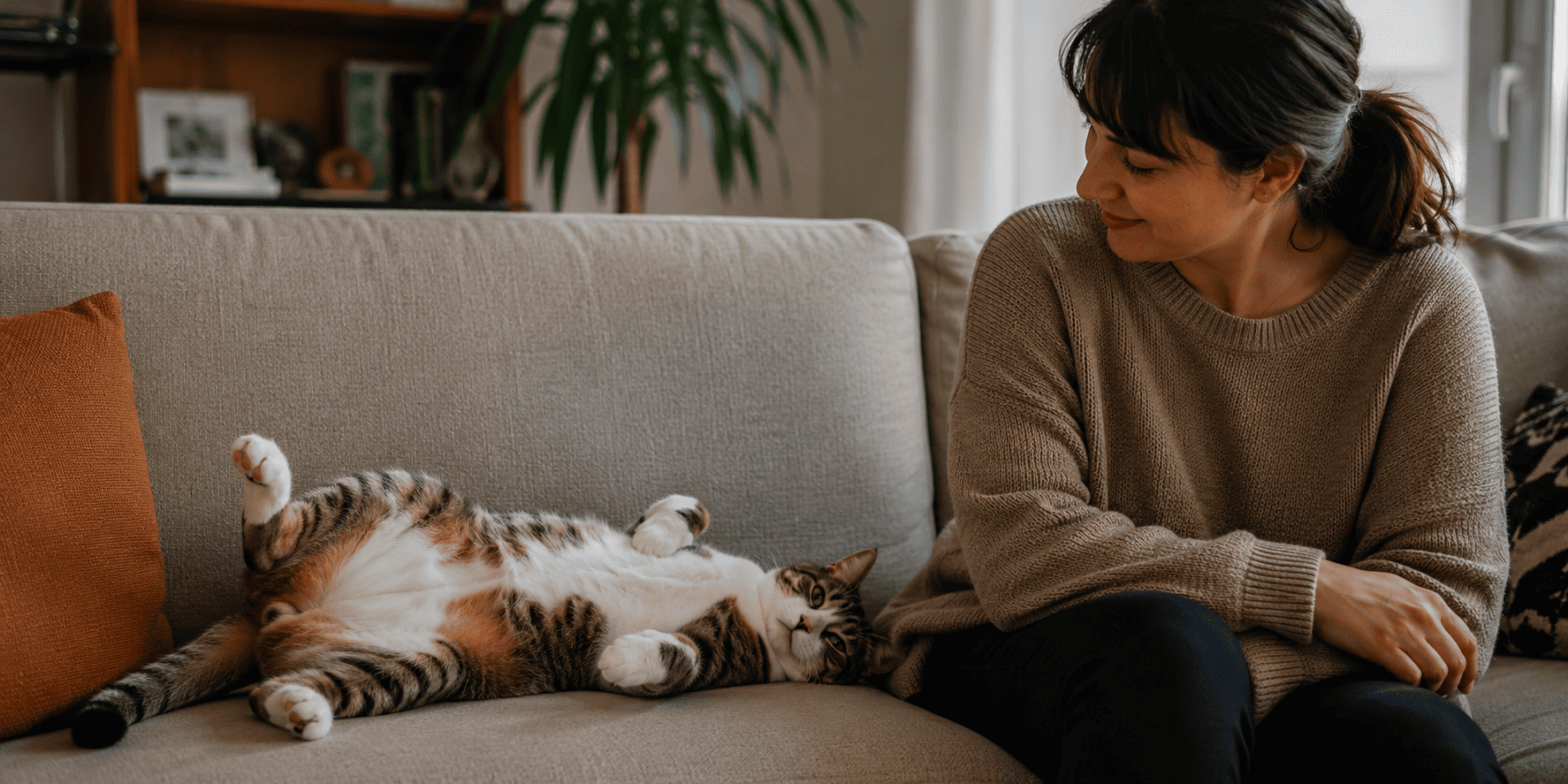
The cat belly meaning people usually want to decode is not one fixed message. Often a cat shows its belly because the cat feels relaxed enough to lie in a vulnerable-looking position, but belly exposure is not a universal invitation to touch. Cats roll, stretch, twist during play, cool themselves, shift sleeping positions, and sometimes expose the abdomen while preparing to use all four paws defensively. The meaning comes from the whole body: muscle tension, tail movement, ears, eyes, movement toward or away from you, and what happened immediately before the roll.
Notice breathing and muscle tone. A relaxed cat’s abdomen moves gently with normal breaths while the limbs rest loosely. A tense cat may hold the legs closer, keep the head elevated, or track your movement continuously. These small differences help distinguish lounging from readiness to react.
Look at orientation too. A cat sprawled with its back toward you may simply be resting, while a cat that rolls to face you and then rubs its head may be initiating social contact. Even then, the invitation may be for cheek or head interaction rather than for touching the exposed abdomen.
Cat Belly Meaning Starts With the Whole Body
A loose cat lying on its side with soft eyes and relaxed paws is communicating something different from a cat that suddenly flips onto its back during a tense interaction. Look at whether the body is soft or rigid, whether the tail is resting or lashing, and whether the cat can easily leave.
One body part rarely works as a dictionary word. Belly exposure becomes meaningful only when it matches the rest of the posture and the situation around it.
Temperature can influence position too. Cats often change sleeping posture with warmth, stretching out more when a room is comfortable or hot. Belly exposure in that context may be about body position rather than social communication. Look at where the cat is resting and whether similar poses happen when nobody is interacting.
Some cats also roll as part of a greeting routine. They may approach, rub, flop onto one side, then stand and continue moving. In that sequence, the roll can be social without being stationary consent for touching. Watch what happens next before deciding the flop has one fixed meaning.
Why Does My Cat Show Me Its Belly When Relaxing?
Some cats sleep or lounge with part of the abdomen exposed because the environment feels comfortable. They may roll during a stretch, shift from side to side, or rest in a position that would be difficult if they felt a need to stay ready to flee.
That can be a sign of ease in the environment without being a request for contact. A cat can trust the room and still dislike hands on the abdomen. Respecting that distinction lets the relaxed posture remain relaxed.
A good relationship does not need a test. If your cat exposes the belly and you leave it alone, nothing is lost. In fact, the cat learns that lying openly does not automatically trigger handling. That can make shared resting time more predictable, especially for cats that enjoy proximity but dislike prolonged petting.
Owners sometimes feel rejected when a cat grabs the hand after showing its belly. The mismatch is usually interpretive rather than personal. The cat may have been relaxed until touch changed the situation. Reading the correction as information helps you adjust future interactions instead of punishing the cat for setting a boundary.
Trust Does Not Automatically Equal “Rub My Belly”
People often interpret exposed belly as the feline version of a dog asking for a belly rub. Cats vary much more in their tolerance for abdominal touch. The abdomen is physically sensitive, and many cats prefer petting on the head, cheeks, or other familiar areas.
Use the cat’s existing touch preferences instead of testing the belly every time it appears. In the broader context of normal indoor cat behavior and communication, choice and the ability to move away are important clues to whether interaction is welcome.
Watch the hind legs. Rapid kicking against a toy, gripping with the front paws, and intense focus usually indicate a play or predatory sequence rather than a request for petting. Let the toy absorb that energy. Reaching toward the abdomen in the middle of this sequence can redirect teeth and claws onto your hand.
A Roll During Play Can Mean Something Completely Different
During play, a cat may roll partly onto the back to grab a toy with the front paws and kick with the hind legs. The belly is visible because of the mechanics of play, not because the cat changed the social rules around touching.
Use a wand or other appropriate toy rather than offering your hand as the target. Hand wrestling can teach the cat that skin is part of play. The roll is easier to interpret when you notice what the cat is focused on: your hand, a toy, another cat, or nothing at all.
Defensive rolling can happen when retreat feels blocked. Move your body sideways, stop advancing, and open the route rather than looming over the cat. If another pet is involved, increase distance between them. The goal is to reduce pressure so the cat can leave the defensive posture on its own.
A defensive posture may also include vocalizing, flattened ears, rapid breathing, or a fixed stare. If you see several of these together, stop interaction completely. Do not try to pick the cat up from that position. Give space and reduce whatever is creating pressure.
Watch for the “Defensive Belly”
A frightened or highly aroused cat can also end up on its back. In that position, all four paws, claws, and teeth can be used if something comes closer. The body may look compressed or rigid, ears may turn back, pupils may be large, and the tail may move sharply.
Do not reach in to reassure a cat in this state. Increase distance and give the cat an open route away. A belly exposed during defensive arousal is almost the opposite of a calm invitation.
The pause also helps with cats that become overstimulated quickly. If the cat rolls, watches your hand, and then turns away, you have useful information before contact happens. A small signal can be respected before it has to escalate into grabbing, kicking, or biting.
If you live with children, teach the pause as a household rule. “Belly showing means hands off until the cat asks for touch” is easier to follow than a complicated list of exceptions. It protects the cat’s choice and reduces surprise scratches caused by well-meaning contact.
Use a Three-Second Pause Before Touching
- Keep your hand still for a moment instead of reaching immediately.
- Notice whether the cat leans toward you or remains resting.
- Offer touch in a familiar area such as the cheek or head first.
- Pause after a few strokes and see whether the cat reinitiates.
- Stop if the tail accelerates, skin twitches, ears rotate back, or the body stiffens.
This simple pause gives the cat a chance to participate rather than turning a relaxed posture into an interaction it did not request.
Keep touch light and avoid restraining the cat in place. A cat that enjoys belly contact should still be free to roll away or stand up. Restraint changes the interaction even when the first touch was welcome. Choice is what makes an individual preference easy to distinguish from tolerance.
Individual preference can be very specific. A cat may tolerate one or two gentle strokes on the side of the abdomen but dislike pressure at the center. Another may enjoy contact only while drowsy. Respect the exact version the cat chooses rather than generalizing from “likes belly rubs.”
Watch for the moment the preference changes. A relaxed cat may begin with soft paws and then curl the front legs toward your wrist or increase tail movement. Stop at that early shift. Waiting for teeth or claws means the quieter signal was missed.
Some Cats Genuinely Like Belly Touch—and That Is Individual
A minority of cats appear comfortable with brief abdominal petting, especially when they have a long history of gentle handling and actively seek it. If your cat repeatedly rolls toward your hand, stays loose, and returns for more after you pause, that individual preference matters.
Keep sessions short and watch for changing tolerance. Enjoying belly touch yesterday does not mean the cat wants it during every roll. Consent can change within seconds as arousal builds.
Repeated licking of the abdomen, hair loss, swelling, a firm-looking belly, or difficulty getting comfortable are also reasons to seek veterinary advice. Those signs move the question away from social body language. Do not press or palpate a painful-looking abdomen at home to “check” it.
A Sudden Change in Belly Posture Can Be Health Information
Behavior deserves more attention when it changes. A cat that suddenly protects the abdomen, reacts painfully to touch, lies in unusual positions, stops jumping, eats less, vomits, or hides more may be uncomfortable.
Do not use body-language interpretation to explain away possible pain. Contact your veterinarian when belly sensitivity or posture change appears with appetite, litter-box, mobility, breathing, or general behavior changes. A familiar social gesture should not suddenly become painful.
Context can even change within one minute. A cat may begin relaxed, become playful when a toy appears, then become overstimulated after repeated touch. Keep updating your interpretation instead of deciding what the belly “means” once and applying that label to the rest of the interaction.
The safest default is simple: enjoy the signal without needing to act on it. If the cat wants contact, it can lean, head-butt, rub, or move closer. That approach protects relaxed belly exposure from becoming a repeated test and keeps the interaction based on voluntary participation.
Over time, build a personal dictionary for your own cat rather than a universal one. Note what usually comes before and after the roll. One cat may flop before play, another before sleep, and another during greetings. Individual patterns are more useful than internet rules applied without context.
Slow blinking, head rubbing, relaxed side lying, and belly exposure can all occur in the same friendly interaction. None needs to be translated alone. The pattern of voluntary approach, loose posture, and easy departure is more reliable than choosing one dramatic body part as the message.
Read the Belly as Part of a Sentence, Not a Word
Belly exposure can accompany deep relaxation, stretching, play, individual affection, or defensive readiness. The correct interpretation comes from posture, movement, context, and what the cat does when you pause.
If the cat looks comfortable, you do not need to prove trust by touching the most vulnerable-looking area. Let the posture be what it is. A cat that can relax without having every signal tested learns that quiet body language is respected.
References
- 2022 AAFP/ISFM Cat Friendly Veterinary Interaction Guidelines — FelineVMA — Detailed guidance on feline emotional states, body language, distance, choice, and low-stress interaction.
- 2024 AAFP Intercat Tension Guidelines — FelineVMA — Describes subtle and overt feline communication, including posture, movement, avoidance, and arousal.
- Meeting the Physical and Emotional Needs of Indoor Cats — FelineVMA — Provides environmental context for safe places, control, social interaction, and normal behavior.
