

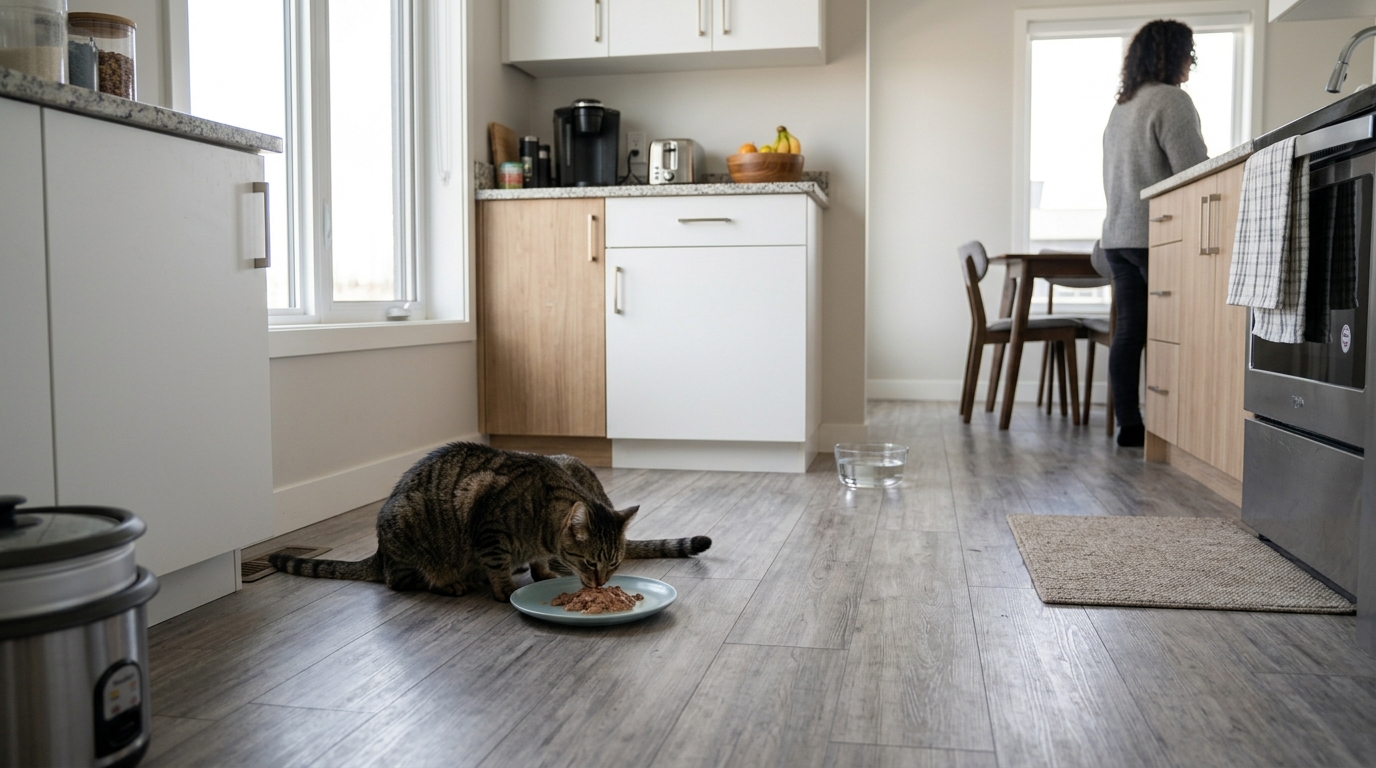
Does wet food provide enough water for cats? For wet food hydration, the useful starting point is that wet food can provide a large share of daily water, and cats eating mostly wet food often drink less visibly than cats eating dry food. That does not mean a water bowl becomes optional or that every wet-food ration automatically covers total fluid needs. The amount of water from food depends on the product’s moisture percentage and how much the cat actually eats. Health, body size, environment, vomiting, diarrhea, kidney function, medications, and individual drinking behavior can change the rest of the picture.
The effect is easiest to see when diets change. A cat moving from dry food to mostly wet food may make fewer obvious trips to the bowl even while total water intake rises. The reverse can happen when wet meals are reduced. Compare the drinking pattern with the food format before deciding that thirst itself changed.
Wet Food Hydration Starts With Water in Every Bite
Commercial canned and pouch foods commonly contain much more water than dry food. Cornell notes that canned food can contain at least about 75 percent moisture, while dry diets contain far less. That difference changes what you see at the bowl.
A cat eating wet meals may visit the water station only occasionally because part of its daily fluid arrives with food. Visible drinking therefore cannot be interpreted without knowing the diet. The key is total intake from food plus drinking, not how dramatic the water-bowl level looks.
Remember that “as fed” moisture describes the food in its current state. The number is useful because it lets you estimate how much water enters with the meal, but it does not tell you how well hydrated the cat is. Hydration still depends on total intake, losses, and the body’s current condition.
Estimate Water From Food With One Simple Calculation
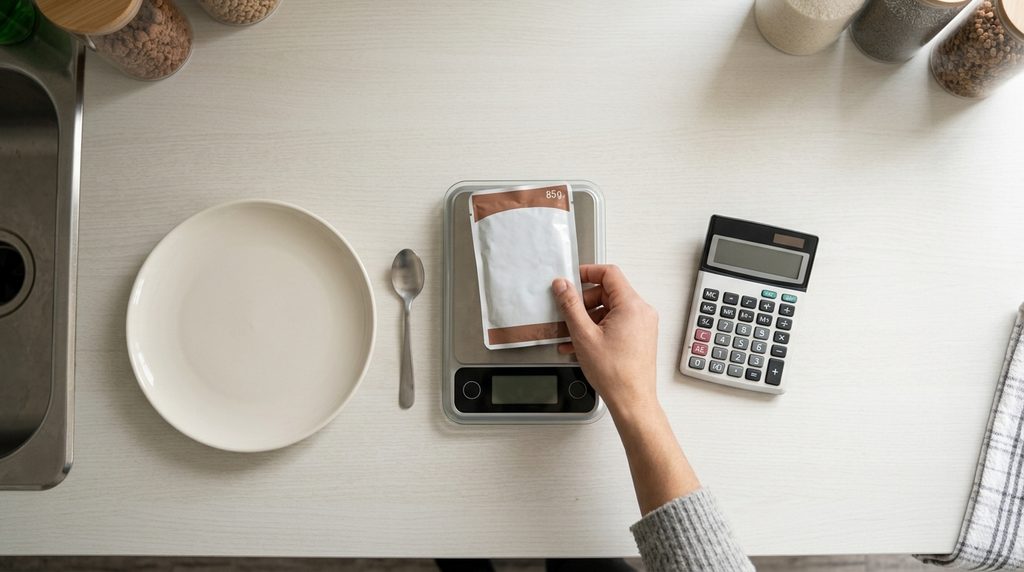
Use the moisture percentage on the label as a practical estimate. If an 85-gram pouch lists 78 percent moisture, multiplying 85 by 0.78 gives about 66 grams of water, which is roughly 66 milliliters. Two such pouches would provide about 132 milliliters before any drinking.
This is an estimate rather than a clinical measurement. Cats may not finish the serving, labels give guaranteed values rather than a perfect laboratory reading of your exact pouch, and individual needs vary. Still, the calculation is far more informative than simply calling wet food “hydrating.”
If your cat eats part of a pouch, calculate from the amount actually consumed. A 78-percent-moisture pouch provides no benefit from the portion left drying on the plate. Weighing leftovers can be useful when intake is uncertain, especially in a cat whose appetite has recently changed.
Worked examples are most useful when you use the exact food your cat eats. A 156-gram can at 78 percent moisture would contain roughly 122 milliliters of water if the cat finished it. Half a can would contribute about half that amount. The calculation helps you understand scale without pretending the result is a medical prescription.
Does Wet Food Provide Enough Water for Cats? Compare the Whole Day
Cornell gives a broad daily estimate of about four ounces of water per five pounds of lean body weight. A roughly 10-pound cat would therefore need about eight ounces across all sources. Wet food may provide much of that amount, but the exact contribution depends on how many grams the cat eats and the food’s moisture.
That broader question of how much water a cat needs across food and drinking is why one can or pouch cannot be judged in isolation. If the cat eats less than usual, food-derived water also falls at the same time.
Daily estimates are best treated as orientation, not a target to force. Individual cats differ, and clinical conditions can change needs substantially. If your veterinarian has asked you to monitor water because of kidney, urinary, endocrine, or heart disease, follow that specific plan instead of applying a generic formula.
Some cats prefer water away from food. Others use a fountain in one room and a plain bowl in another. There is no need to force a specific arrangement if the cat has clean, safe access and actually uses the options. Multiple stations also protect against a bowl being tipped, contaminated, or temporarily inaccessible.
A Wet-Food Cat Still Needs Fresh Drinking Water
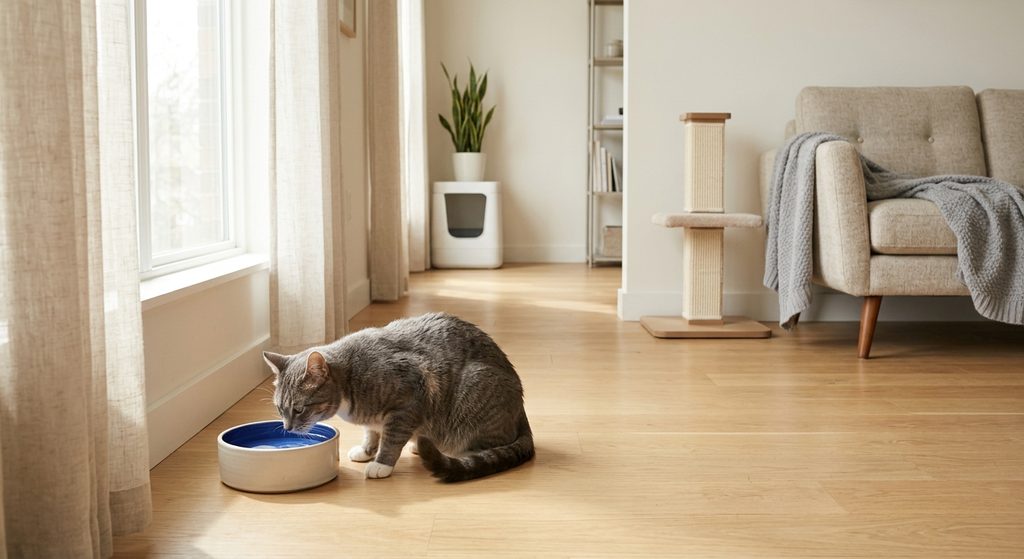
Keep clean fresh water available even when wet food provides most visible fluid intake. The cat may need more on a hot day, after activity, during a diet change, or when a meal is smaller than usual. Water access should not depend on whether you expect the cat to use it.
Offer more than one easy-to-reach station when practical, especially in multi-cat homes. A cat can be reluctant to approach a shared bowl if another pet controls the route. Water placement, bowl cleanliness, and social access matter even when actual drinking volume is modest.
Water availability should also survive routine disruptions. Keep a bowl accessible when a fountain is unplugged for cleaning, during a power outage, or when a room is closed. A cat accustomed to one moving-water source should not suddenly have no familiar alternative because the equipment is temporarily unavailable.
Body weight can add another practical clue when intake changes over more than a few days. Unexplained weight loss alongside altered thirst or appetite deserves veterinary attention. A stable scale trend does not prove hydration is perfect, but a falling trend makes a quiet water bowl harder to dismiss as preference alone.
Signs Food Moisture Is Not the Whole Story
- Your cat is eating less wet food than usual.
- Urine clumps become clearly smaller or less frequent.
- Vomiting or diarrhea increases fluid loss.
- Your cat becomes weak, lethargic, or unusually withdrawn.
- Gums feel dry or tacky.
- A medical condition or medication changes fluid balance.
- Your cat suddenly drinks much more despite eating the same wet diet.
These signs do not prove dehydration by themselves. They show that fluid intake should be interpreted with health and losses, not just with the moisture printed on a food label.
A sudden increase in drinking deserves attention too. Wet-fed cats often drink less visibly, so a clear new pattern of frequent bowl visits can stand out. Increased thirst can accompany several diseases. Record the change and discuss it with your veterinarian rather than assuming the cat simply “decided to drink more.”
Adding More Water to Wet Food Can Help—If the Cat Still Eats
Some cats accept a small amount of extra water mixed into wet food. Start with a modest change rather than turning a familiar meal into soup. If the cat dislikes the new texture and eats less, the strategy can backfire by reducing both calories and food-derived water.
Do not use salty broth or seasoned cooking liquid as a default hydration tool. Ingredients such as onion and garlic are unsafe for cats, and added flavor can complicate calorie or medical plans. For cats with disease-specific diets, ask the veterinary team before making routine additions.
If you dilute food, serve manageable portions and follow safe handling guidance. Added water does not make a wet meal safe to leave out indefinitely. Small fresh servings can be easier to monitor and may be more appealing than one large bowl that sits for hours.
Older cats deserve closer monitoring because kidney disease and other chronic conditions become more common with age. A senior cat that suddenly drinks much more, loses weight, or produces larger urine clumps should be evaluated even if its wet-food routine has not changed. The new pattern matters more than the diet category.
Wet Food Does Not Cancel Fluid Losses
Hydration is the balance between intake and loss. Vomiting, diarrhea, kidney disease, diabetes, hyperthyroidism, and some medications can increase water loss. A cat can eat a wet diet and still become dehydrated if losses rise enough or appetite falls.
This is why “my cat eats wet food” should not be used to dismiss new weakness, poor appetite, reduced urine, or other illness signs. Wet food is a useful source of water; it is not protection against every condition that affects fluid balance.
Mixed feeding changes the calculation again. If part of the day’s calories come from dry food, only the wet portion contributes substantial food moisture. Estimate each component separately instead of assuming that “some wet food” makes the whole day equivalent to a fully wet diet.
Do not deliberately reduce water access to see whether the cat becomes thirsty. That kind of home test is unsafe and tells you little about normal behavior. Keep fresh water available and observe voluntary intake. If exact measurement is medically important, use the method your veterinary team recommends.
Use Urine and Appetite as Practical Context
Home monitoring does not need to become laboratory work. Learn the normal number and approximate size of urine clumps for your cat, while recognizing that litter type and multi-cat sharing limit precision. Pair that with how much of each wet meal is actually eaten.
If the cat normally finishes two wet meals and produces a stable litter pattern, that baseline is more useful than an internet average. A clear change in food intake, urine output, energy, or drinking should be recorded together because the clues become more meaningful as a group.
Multi-cat litter boxes make urine monitoring less precise, but behavior still adds context. A cat that finishes meals, moves normally, and uses the box as usual is a different case from one that leaves food, hides, vomits, or seems weak. Patterns matter more than any single home estimate.
The practical takeaway is to avoid two extremes: assuming wet food makes drinking irrelevant, or assuming a cat must visibly drink a large bowl volume every day. Food moisture can do substantial work. Fresh water still remains available, and changes in appetite, urine, thirst, or behavior are interpreted together.
If you want a rough home estimate, calculate food moisture for one normal day and then stop chasing precision. The useful question is whether the pattern remains stable. Recalculate when the food, portion size, or appetite changes. Constant daily math adds little if the cat is healthy and the routine is consistent.
If your cat eats several wet-food brands, calculate from the food used most often rather than from the wettest product in the cupboard. Occasional high-moisture meals should not be treated as the daily baseline. Use the routine that actually happens most days.
Think of Wet Food as Part of the Hydration Plan
Wet food can provide a substantial portion of a cat’s daily water, sometimes enough that bowl drinking looks minimal. Whether it supplies “enough” cannot be answered from texture alone. Use the food’s moisture percentage, the amount eaten, access to fresh water, urine trends, and the cat’s health.
If your cat is eating normally, behaving normally, and producing its usual urine while on a wet diet, quiet water-bowl behavior may be expected. If appetite or fluid balance changes, contact your veterinarian rather than assuming the moisture in the food will compensate.
References
- Hydration — Cornell Feline Health Center — Explains total water needs, food moisture, visible drinking, dehydration, and causes of increased fluid loss.
- Feeding Your Cat — Cornell Feline Health Center — Reviews moisture differences among cat foods and notes that canned food is a substantial dietary source of water.
- “Complete and Balanced” Pet Food — FDA — Explains how moisture is listed and why foods with different water content should not be compared directly without accounting for moisture.
