

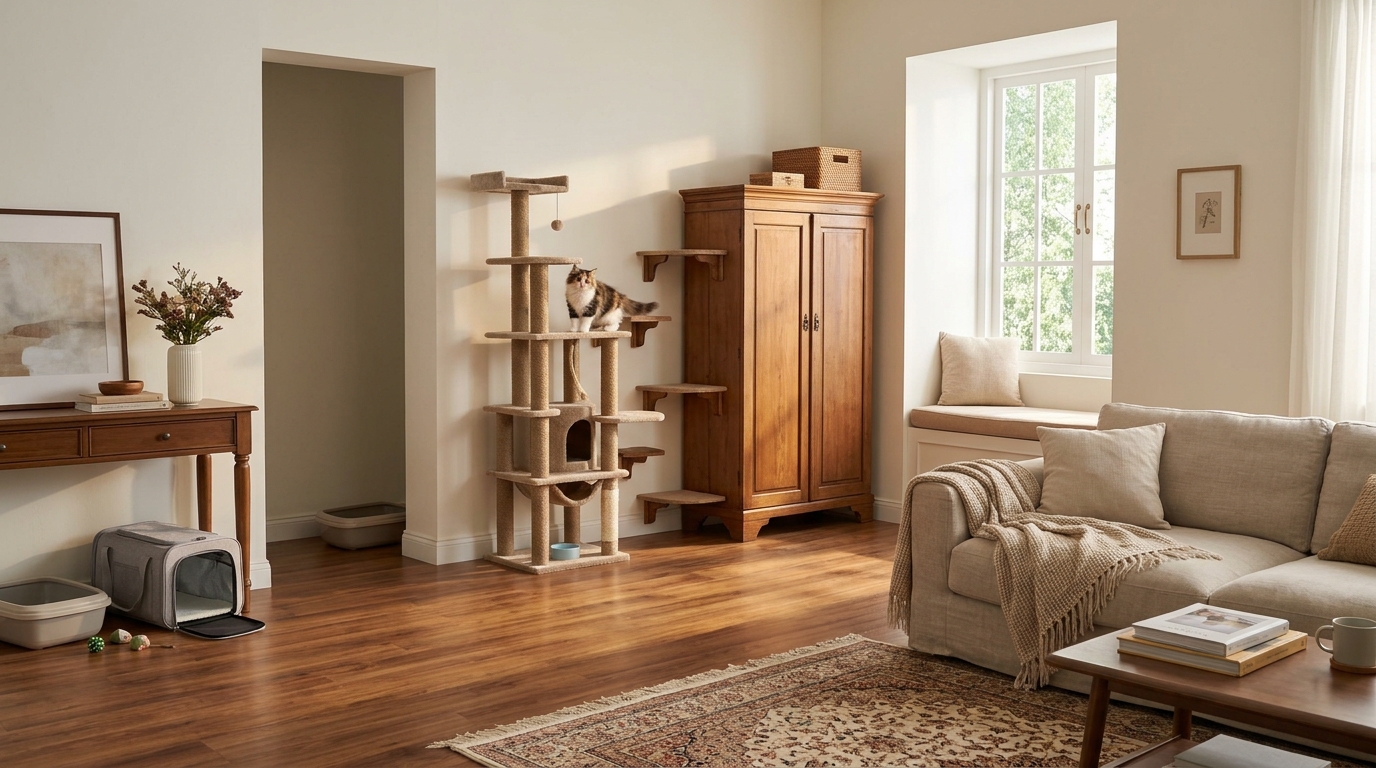
Learning how to create vertical space for cats is less about covering a wall with shelves and more about giving a cat useful territory above floor level. Good vertical space lets a cat climb, pause, observe, rest, and move away from traffic without being trapped at the top. It also gives small homes more usable feline territory without adding much floor furniture. The strongest setup is not the tallest one. It is the one with stable landings, sensible routes up and down, and elevated spots placed where your cat already wants to spend time.
Map the Routes Your Cat Already Tries to Use
Before buying a cat tree or drilling into a wall, watch how your cat moves through the room. Cats often reveal preferred routes by jumping onto the sofa back, stepping to a windowsill, climbing a bookcase, or pausing on a table before reaching somewhere higher. Those choices tell you where height is useful. A shelf placed on the opposite side of the room may look attractive but remain unused because it does not connect to anything your cat values.
Notice both destinations and transitions. A cat may love a window perch but hesitate if the only route requires one large jump from the floor. Another cat may use the top of a cabinet but struggle to descend. Mark the places your cat already pauses. Then ask whether one secure intermediate step would turn an awkward jump into a comfortable route. This observation-first approach prevents you from creating a vertical feature that works visually but not behaviorally.
- List the rooms where your cat already climbs voluntarily.
- Note favorite windows, warm areas, and quiet observation points.
- Watch which furniture becomes an unofficial stepping stone.
- Look for difficult descents as carefully as difficult climbs.
- Identify routes that become blocked when people use the room.
Create Vertical Space for Cats as a Route, Not a Single Platform
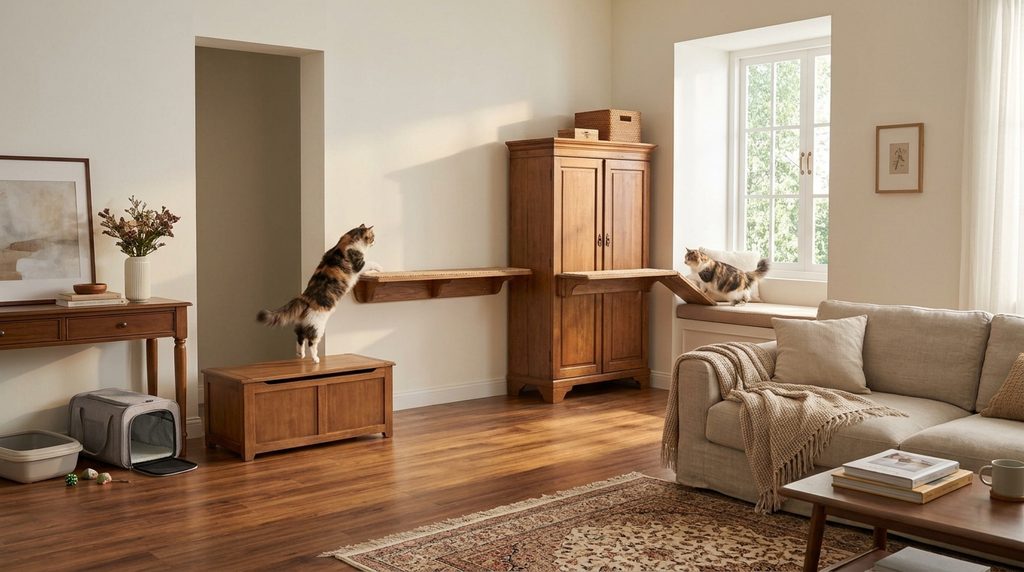
One high platform adds a destination. A sequence of usable levels adds territory. Think in steps: floor to bench, bench to shelf, shelf to perch. The exact heights depend on your cat’s size, confidence, and mobility. What matters is that each landing is large enough for a secure pause and that the next move feels obvious. A cat should not have to turn on a narrow edge or leap blindly around a corner to continue.
Routes matter even more in busy or multi-cat homes. An elevated path can let one cat cross a room without passing close to a dog, child, or another cat. It can also create more than one way to leave an area. That supports the broader principle of giving cats separated resources, safe resting places, and more than one comfortable route through the home. Vertical space works best when it connects with the rest of the environment rather than existing as isolated furniture.
Test one short route before building a full wall. For example, move a sturdy bench beside the window your cat already watches. If the cat begins using the bench as a step within a few days, that tells you the location has value. You can then add a more permanent perch above it. If the bench is ignored, investigate the destination, traction, and approach before buying more hardware. A small reversible test can save a large installation that the cat never uses.
Use Stable Furniture Before You Add Wall Shelves
You may already own useful vertical structure. A sturdy bookcase, low cabinet, bench, sideboard, or sofa back can become part of a climbing route if the surface is safe and the furniture cannot tip. Clear breakable objects first. Add non-slip material where paws may slide. If furniture is tall or narrow, secure it appropriately so a jumping cat cannot shift its center of gravity enough to make it unstable.
This approach is especially useful in rentals. Instead of installing several permanent shelves, you can create height with a tall stable cat tree beside a piece of furniture the cat already uses. A low stool can serve as an intermediate step. A wide windowsill may need only a stable perch extension. Test whether the route gets used before investing in a larger build. Cats often tell you quickly which heights and locations are worth keeping.
| Existing feature | Possible cat function | Safety check |
|---|---|---|
| Low cabinet | Intermediate landing | Stable surface, no hot appliances |
| Bookcase top | High observation spot | Furniture secured, clear landing |
| Bench | Step to a window | Non-slip top, enough width |
| Sofa back | Short elevated route | No unstable décor nearby |
| Window ledge | Observation perch | Secure screen and stable support |
Choose Perch Depth for Resting, Not Just Standing
A shelf that supports four paws is not automatically a good resting place. If you want the cat to nap, turn, or stretch, provide enough surface area for those behaviors. Narrow display shelves may work as short transitions but can be uncomfortable as destinations. Wider platforms are especially useful for large cats, cats that like to sleep on their sides, or cats that turn several times before settling.
Surface texture matters too. Smooth painted wood can become slippery during a quick landing. A washable non-slip mat or securely attached fabric can improve traction. Avoid loose materials that slide under the cat. Check edges, brackets, and hardware regularly. A shelf that was stable when installed can loosen over time, especially if the cat repeatedly launches from the same corner.
Window Height Is Valuable Only if the Window Is Safe
Windows combine elevation with visual stimulation, so they often become highly valued territory. A perch near a secure window can support resting, watching birds, and observing household activity. However, height should never depend on an unreliable screen. Check that the screen is firmly fitted and that the window cannot open in a way that creates a fall or escape risk. Do not assume a screen designed to keep insects out can resist a cat pushing against it.
Also check heat and direct sun. A window spot that feels pleasant in the morning may become too hot in the afternoon. Give the cat an easy way to leave. If the perch sits above a radiator, heater, or air-conditioning outlet, monitor how the temperature changes. Good vertical space should increase choice, not create one attractive spot that becomes uncomfortable once the environment shifts.
Design the Descent Before You Celebrate the Height
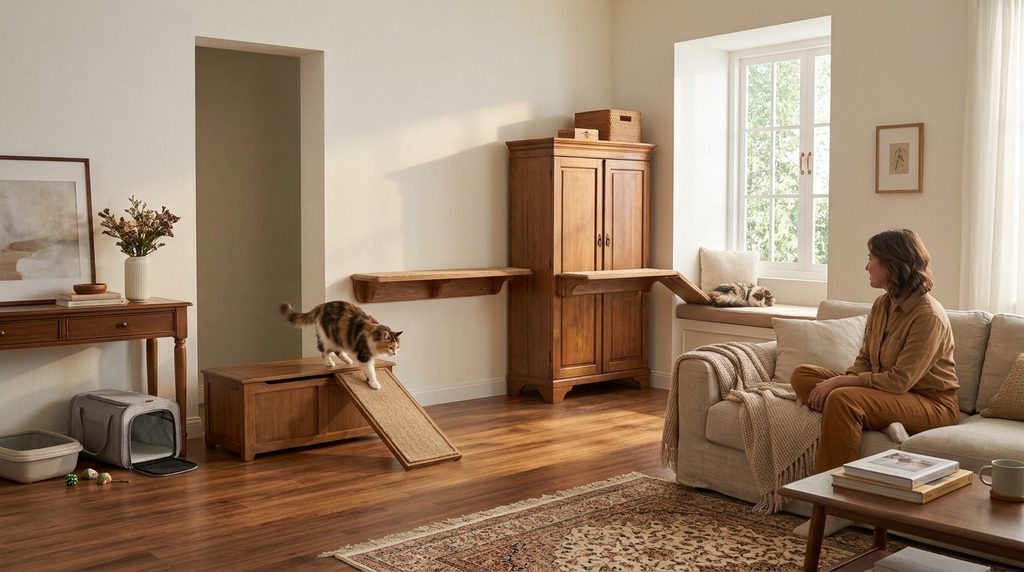
People tend to notice whether a cat can get up. Cats also need to get down safely. Descending can require different confidence and body control than climbing. A young athletic cat may jump down from a cabinet with no hesitation, while a senior cat may reach the top and then search for a smaller step. If you see repeated hesitation, paw-testing, backing up, or a jump that looks hard on landing, improve the route down.
Add an intermediate platform below and slightly to the side rather than directly under the edge. This gives the cat a visible landing target. Keep the floor below free of clutter. In homes with older cats, a series of lower steps may preserve access to a favorite window without requiring one large jump. Vertical territory should evolve with the cat’s mobility instead of disappearing as soon as high jumps become difficult.
Height can also help during ordinary household events. A perch beside the living room may let a cat stay near people without sharing sofa space. A shelf above floor traffic can give the cat a place to observe a vacuum, delivery, or visitor from a safer distance. The useful feature is control: the cat can choose proximity without being forced to remain at floor level.
Give Multi-Cat Homes More Than One Elevated Destination
A single prime perch can become a bottleneck. If two cats both want the same window platform, one may wait, stare, block the approach, or give up without an obvious fight. More vertical space does not automatically reduce tension if all routes lead to one destination. Spread elevated resting spots across the room or home so a cat can choose height without having to negotiate one narrow staircase.
Watch access from both directions. If one cat rests on the middle shelf of the only route, can the other cat still reach or leave the top? A second route can be more useful than a second platform. In a small room, that may mean placing a cat tree at one side and a stable cabinet at the other. The two cats do not need identical furniture. They need enough choices that one individual cannot quietly control the whole vertical system.
Common Vertical-Space Mistakes Make Good Furniture Useless
The most common mistake is building for appearance instead of movement. Shelves can be too narrow, too far apart, too slippery, or arranged in a line that ends with no comfortable resting spot. Another mistake is placing the entire route in a loud or contested area. A beautiful wall beside a slamming door may be less appealing than a plain shelf near a calm window.
- Keep the first step away from places a dog or another cat can block.
- Avoid unstable freestanding furniture for a high launch.
- Give important landings enough room for turning and resting.
- Provide an easy descent instead of a dead-end perch.
- Clear breakable décor and dangling cords from the route.
- Leave a familiar route available until the new one is being used.
Introduce new structures gradually. A cautious cat may inspect a shelf for several days before using it. You can place a familiar blanket or occasionally toss a toy onto a low landing, but avoid repeatedly lifting the cat onto a high surface it did not choose. Voluntary use tells you whether the route actually feels safe.
Do a monthly physical check of the route. Press gently on freestanding furniture to check wobble. Inspect wall hardware, shelf edges, non-slip surfaces, and any fabric that has begun peeling. Look for new obstacles underneath. A moved lamp, plant, or storage basket can turn a once-clear landing into a risky jump. Vertical space is active furniture, so it needs the same maintenance attention as other equipment the cat uses every day.
Review Vertical Space When Your Cat’s Body or Routine Changes
A vertical setup is not permanent just because the hardware is. Reassess it after weight changes, injury, arthritis, a move, new furniture, or the arrival of another pet. A route that worked when the cat was young may become too demanding. A perch that used to overlook a quiet room may become exposed after a desk or doorway changes. Watch use rather than assuming the resource still works because it remains physically present.
The strongest vertical environment has several levels, predictable landings, traction, safe exits, and destinations the cat actually values. Add height where it improves choice. Keep floor space available for normal household life. When the system works, the room feels larger to the cat without necessarily looking more crowded to the person.
References
- Setting Up the Environment for Success — FelineVMA — Explains why climbing surfaces, hiding options, dispersed resources, and safe routes matter in indoor feline environments.
- 2024 Indoor/Outdoor Lifestyle Position Statement — FelineVMA — States that indoor cats need safe territory with vertical space along with appropriate resting, play, feeding, and toileting resources.
- AAFP/ISFM Environmental Needs Guidelines — FelineVMA — Provides the evidence-based framework for safe places, environmental resources, control, and opportunities for normal feline behavior.
