

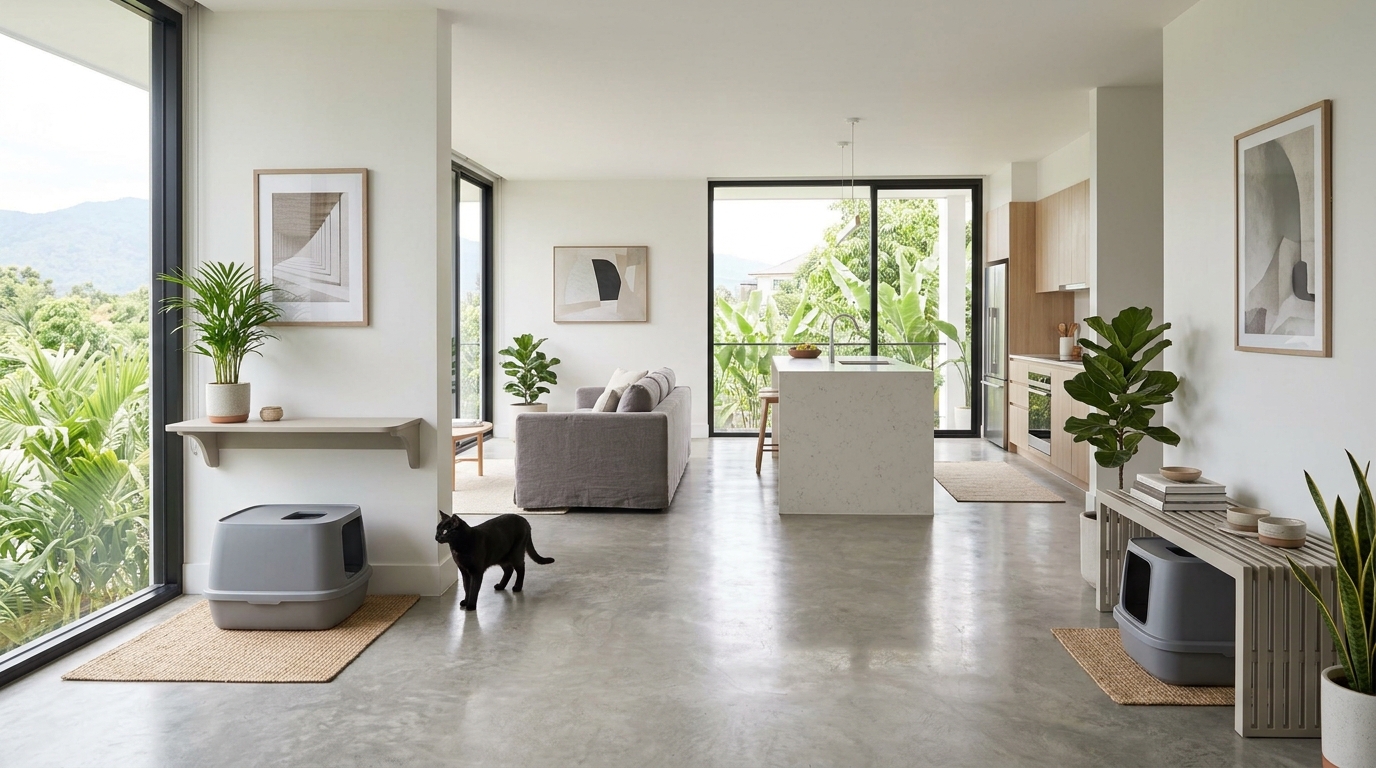
How many litter boxes does one cat need? A common rule is one box per cat plus one extra. For one cat, that means two boxes. The guideline creates choice and a backup. It cannot fix poor placement or an unsuitable box by itself. One excellent box may work in some small homes, while two boxes can be especially useful in multi-level homes, for cats that separate urine and stool, during illness, or when access to one location is sometimes inconvenient.
Understand What the “One Cat Plus One” Rule Is Trying to Achieve
The extra box is about choice and reliability. A cat may prefer one location at night and another during the day. One box may be dirty when the cat wants to use it. A door can accidentally close. Nearby appliances may make a familiar area temporarily unpleasant. The second box prevents one small problem from removing every acceptable toilet option.
FelineVMA and Cat Friendly Homes commonly recommend one box per cat plus one extra, especially in multi-cat households. For a single cat, that translates to two. Treat it as a strong starting point rather than proof that any two boxes will work. If both are tiny, scented, dirty, or placed side by side beside a washing machine, the number is technically correct but the setup is poor.
Walk the route at night. Is a door closed? Does a robot vacuum park in the hallway? Is the basement stairwell dark? Does the cat spend most evenings upstairs? These details can make a box technically present but practically distant. Put toilet access where the cat already lives. Do not make one box convenient for humans and inconvenient for the cat.
How Many Litter Boxes One Cat Needs Depends on the Floor Plan Too
A multi-level home changes the answer because distance and stairs affect access. A healthy young cat may easily travel between floors, but urgency, age, arthritis, injury, or a closed door can make one distant box less practical. Having a box on each level the cat regularly uses can prevent long trips and give the cat a reliable option wherever it spends time.
In a small one-level apartment, two boxes may be closer together, but they should still be in genuinely different locations when possible. Box size, litter, cleaning, placement, and safe access all shape whether a litter-box setup actually works. Adding a second box does not compensate for an uncomfortable first box; both should be good options.
Test separation by imagining one location becoming unavailable. If a plumber closes the bathroom, can the cat still reach the other box? A dog may also sleep beside one hallway and block that route. When both locations fail together, the boxes do not provide much backup. The second box earns its space when it survives a problem that affects the first.
Two Boxes Side by Side May Function Like One Resource
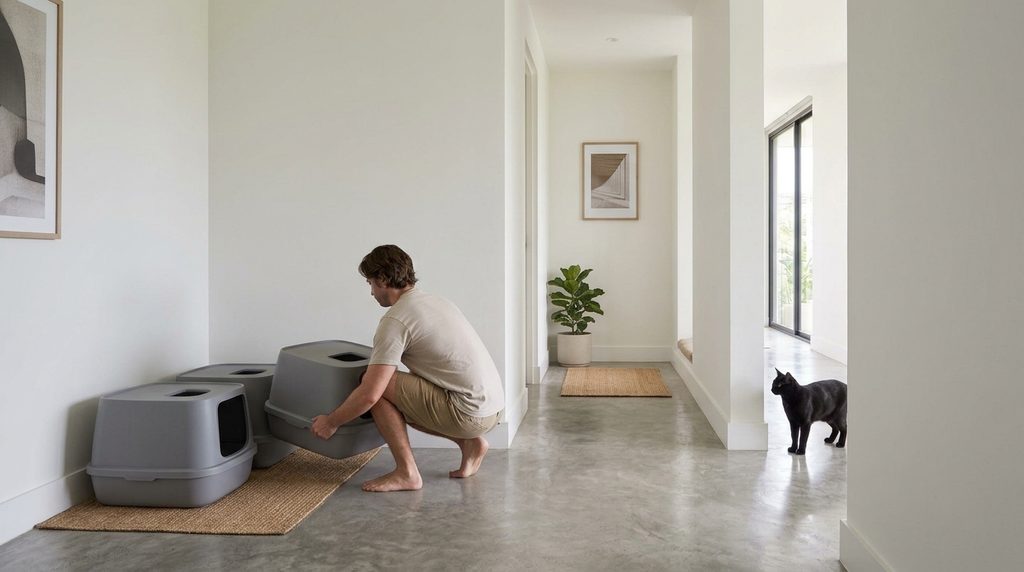
People often place the extra box directly beside the first because it is convenient for cleaning. From the cat’s perspective, the two trays may not provide meaningful location choice. The same noise, doorway, another pet, or frightening event affects both at once. Cat Friendly Homes notes that boxes close together can be perceived as one large toileting area.
Separate them enough that the cat gains a different route or environment. One might be in a quiet bathroom corner and another in a bedroom or hallway nook. Avoid creating a setup where one cat—or a dog, child, or household activity—can block both boxes simultaneously. Even with one cat, distinct locations create a useful backup when something changes.
Do not swap the box roles on purpose. Let the cat decide. Keep both litter types and cleaning routines stable while you observe. If one box suddenly changes from stool to no use at all, check cleanliness and location. If the cat starts defecating elsewhere, look at stool quality and pain. A preference can be normal. A sudden break in a stable preference still deserves investigation.
Some Single Cats Naturally Use One Box for Urine and Another for Stool
Some cats separate elimination types. One box may be used for urine and another for stool. That can be a normal individual preference. Keep both boxes clean and accessible. Removing the preferred stool box may lead to accidents even though another box remains available.
This pattern can also appear after a painful or frightening experience. If the split is sudden, check stool, urine, mobility, and box comfort rather than assuming a new harmless preference. A second box can reveal what the cat wants, but a sudden behavioral change still deserves context. Pain, constipation, urinary disease, and location aversion can all change toileting choices.
Measure the available box if space is tight. Many commercial trays are smaller than people realize. A storage tote with a suitable low entrance can provide more usable floor area. Make sure edges are smooth. Keep the box stable. Size is especially important for large cats. One roomy box can be more acceptable than two cramped boxes, even though two good boxes remains the stronger default.
In a studio or very small apartment, look for vertical separation and visual separation rather than forcing two boxes into the same nook. One box may fit beside the bathroom. Another can sit behind a low screen near a hallway edge. Keep both away from food. The boxes do not need to be invisible. They need to be accessible, clean, and different enough to offer real choice.
One Box May Work Better Than Two Bad Boxes
If your home truly cannot accommodate two boxes, focus on making the available box excellent. It should be large enough for the cat to enter, turn, dig, and posture comfortably. Use a litter the cat accepts, keep it away from food and water, scoop at least daily, and place it where access is reliable and the cat cannot be cornered.
Then watch behavior closely. Does the cat use the box consistently? Is urine and stool normal? Does the cat hesitate, perch on the edge, rush out, or eliminate beside it? If problems appear, finding room for a second box becomes a higher priority. A space-saving home is not successful if the only toilet is barely tolerated.
Cats With Mobility Problems Often Benefit From More Accessible Boxes
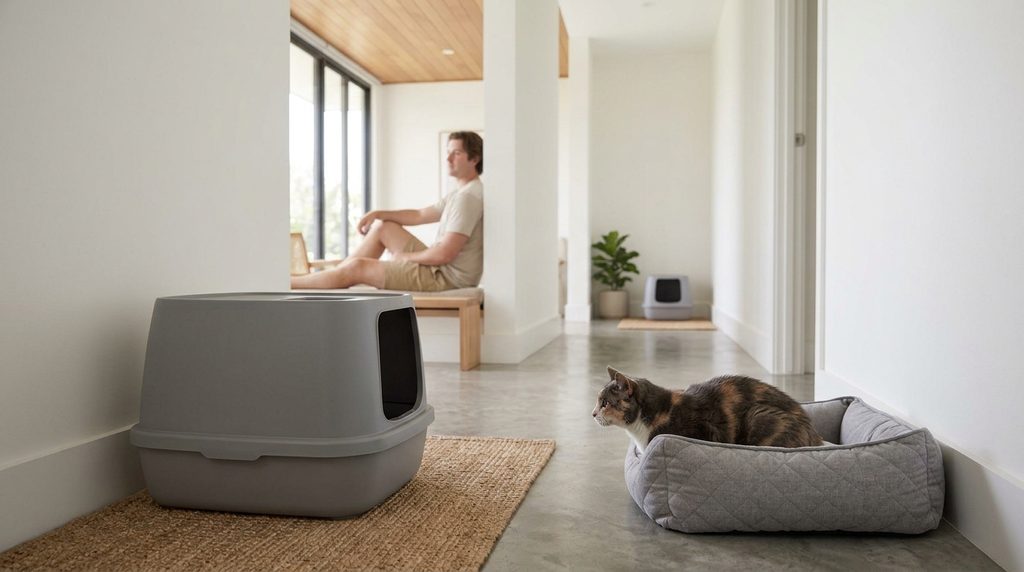
An older cat or a cat with arthritis may need a low-entry box close to the area where it spends most of the day. A second box can reduce the need to cross a long home or climb stairs. The box itself may also need to be larger so turning and squatting are easier. Mobility changes can make a formerly adequate one-box setup fail without any change in litter preference.
- Use a low entrance if stepping over the side is difficult.
- Keep at least one box on the cat’s main living level.
- Avoid slippery routes to the box.
- Do not hide the only box behind stairs or a difficult doorway.
- Report sudden house-soiling or straining to your veterinarian.
Environmental adaptation can help, but pain should not be assumed away. If the cat stops jumping, moves stiffly, or begins eliminating near the box, veterinary assessment may be needed alongside the lower-entry setup.
A Second Box Is Useful During Illness, Recovery, or Close Monitoring
Temporary situations can change what “enough” means. A cat recovering from surgery may need a low-sided box in a quiet recovery area while the usual box remains elsewhere. During diarrhea, faster access may be useful too. If you are monitoring urine or stool, a second clean box in the cat’s current living area can make observations easier.
Do not make a sick cat travel unnecessarily to preserve the normal household layout. Bring resources closer when needed. Once recovery is complete, you can decide whether the temporary box should stay. Many cats appreciate the extra option even after the original reason has passed.
Keep a spare scoop if the boxes are far apart. Convenience supports consistency. Store litter safely near each area when possible. If one box needs a full wash, the second box also gives the cat a toilet during drying. That is another quiet benefit of the extra box. It keeps access continuous during normal maintenance.
Cleaning Frequency Does Not Become Optional Because You Added a Box
Two boxes can distribute waste, but they still need regular scooping. A cat may ignore a dirty box and use only the cleaner one, effectively turning the home back into a one-box system. Scoop at least daily and more often when needed. Replace litter and clean the box on a schedule appropriate for the litter and household.
| Situation | Practical setup | Why |
|---|---|---|
| One healthy cat, one level | Two separated boxes is a strong starting point | Choice and backup |
| One cat, two floors | At least one box on each used level | Reliable access |
| Senior or painful cat | Multiple low-entry accessible boxes | Reduce travel and climbing |
| Urine/stool separation preference | Keep both preferred boxes | Respect established use |
| Very small apartment | Prioritize one excellent box; add a second if possible | Quality still matters when space is tight |
The maintenance routine should make both boxes worth choosing. If one becomes the neglected “backup,” it may not function as a real resource when the cat needs it.
Keep a small map during the first week after adding a second box. Note which box receives urine. Note which receives stool. Mark unused days. This shows whether the cat values both locations. An unused second box may still be useful as backup, but persistent avoidance can reveal a location or litter problem. Move one variable at a time if you test improvements.
Use the Cat’s Behavior to Decide Whether the Setup Is Enough
A good number of boxes produces boring behavior: the cat enters, eliminates, covers if that is its habit, and leaves without hesitation. Repeated edge-perching, rushing, accidents nearby, sudden avoidance, or excessive digging can signal that something about the setup deserves review. Do not respond only by buying a third box; inspect size, litter, cleanliness, location, and health.
New house-soiling should include a veterinary check because medical problems can change litter use even when the box setup appears reasonable. The environment and health can interact. A cat with urinary urgency may stop reaching a distant box, then develop a new location preference. Catching the first change early makes the pattern easier to solve.
For One Cat, Two Good Boxes Is a Strong Default
So, how many litter boxes does one cat need? Two well-placed boxes is a strong default because it follows the one-cat-plus-one guideline and creates genuine choice. In a multi-level home, distribute boxes where the cat spends time. In a small home, separate locations as much as the layout allows.
If you can provide only one, make it large, clean, accessible, quiet, and easy for the cat to enter. Then let behavior tell you whether the arrangement is working. The number matters, but the cat does not use a number. It uses a particular box in a particular place at a particular moment, and that experience determines whether the setup feels reliable.
References
- Everything You Should Know About Litter Boxes — Cat Friendly Homes — Current guidance on the one-box-per-cat-plus-one rule, box placement, separation, access, size, and litter-box management.
- Feline Behavior Problems: House Soiling — Cornell Feline Health Center — Explains box number, location, size, litter preference, medical causes, and why cats may avoid or divide toilet use.
- Not Using the Litter Box — Cat Friendly Homes — Updated feline-veterinary guidance on box distribution, quiet locations, safe access, social pressure, and troubleshooting house-soiling.
