

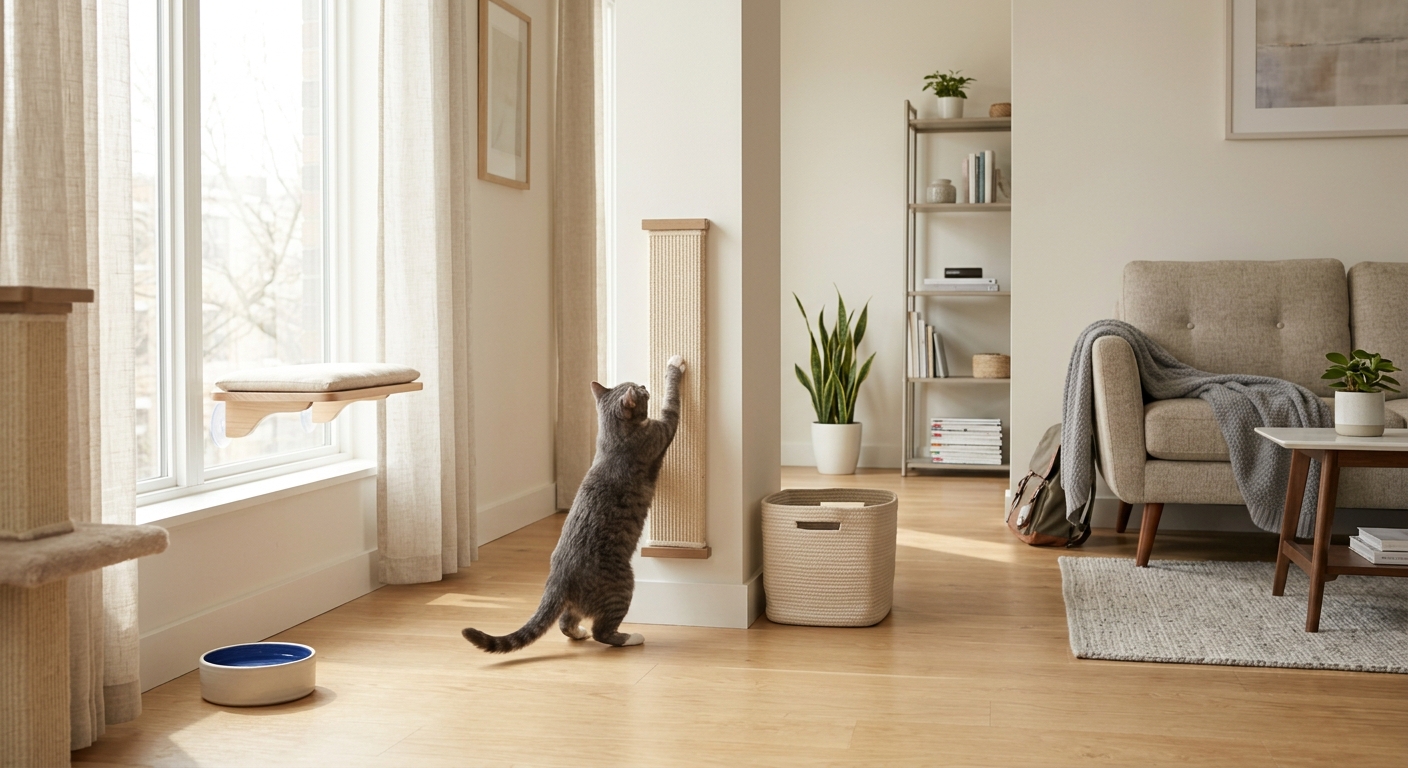
A good small apartment cat setup uses height, edges, corners, and existing furniture instead of trying to squeeze a full-size cat product into every function. A studio can still provide separate food, water, litter, scratching, hiding, rest, play, and observation areas if those resources are distributed thoughtfully. The most useful ideas are compact, easy to clean, and reversible. They should make the apartment work better for the cat without making it difficult for the human to walk, store things, or maintain the space.
Small Apartment Cat Setup: Turn One Wall Into a Vertical Route
When floor area is scarce, one vertical route can add several usable cat locations. Wall shelves are one option when secure mounting is allowed. Renters can use a tall freestanding cat tree, tension-mounted climbing system, sturdy bookcase, or furniture arranged as safe steps. The route should have more than one comfortable landing point, not just one tiny shelf near the ceiling.
Use different heights. A low bench can lead to a windowsill, then to a stable upper perch. This also makes the route easier for cats that are less athletic. Add non-slip surfaces where needed. Avoid fragile decor, unstable narrow shelves, and routes directly above a stove or other hazard. If there are two cats, a vertical path that includes alternate exits is better than one dead-end perch where one cat can trap the other.
Use the Window Zone for Observation and Rest
A window can become one of the highest-value areas in a small home. A secure perch, clear windowsill, or sturdy piece of furniture can provide light, observation, and a resting place without using new floor space. Check that screens and window mechanisms are safe. Do not rely on a standard insect screen to prevent a fall if a cat pushes against it.
Keep cords from blinds secured. If the window receives intense sun, make sure the cat can move to a cooler place. Not every cat needs a hammock stuck to the glass; some prefer a nearby chair. Use the setup the cat actually chooses. If outside cats visible through the window trigger agitation or spraying, reduce the view rather than assuming more visual stimulation is always better.
Choose a Slim Scratcher That Matches the Cat’s Style
A tall vertical scratching post can take less floor area than a wide cat tree, while a horizontal cardboard scratcher can slide under a chair when not in use. The best choice depends on whether the cat stretches vertically or scratches flat surfaces. Place the scratcher where the behavior already occurs, such as beside the sofa, near a sleeping spot, or at a room entrance.
Wall-mounted scratchers save space if they can be installed securely. Door-hanging products can work for some cats but may move too much for a full stretch. Stability is important. In a compact apartment, a multifunction cat tree with a good scratching surface can be worthwhile if it replaces the need for separate climbing and resting furniture. Do not choose by footprint alone if the product is too small for the cat to use comfortably.
Hide the Litter Box Visually, Not Functionally
Small apartments make litter placement difficult because every location feels close to human living space. The answer is not to bury the box where the cat or person can barely reach it. Use a furniture screen, plant-free divider, or layout angle to reduce direct visual exposure while keeping the route open. The cat should be able to enter and leave without being cornered, and you should be able to scoop without moving furniture.
If you use litter furniture, measure the usable interior, not only the outer cabinet. Some enclosures force a large cat into a tight turn or trap odor. An open box behind a simple screen may work better. Keep the box away from food and water. In a one-bedroom apartment, a bathroom, quiet hallway recess, or low-traffic corner can work depending on access and noise. The broader home setup still depends on safe routes and separated resources even when everything fits within a small footprint.
In a studio, protect one clear human walkway. Do not place every cat item along the shortest path from bed to kitchen. The cat can still use room edges and vertical surfaces. Keeping one open route reduces tripping. It also stops people from constantly moving cat resources out of the way.
Use Furniture for More Than One Cat Function
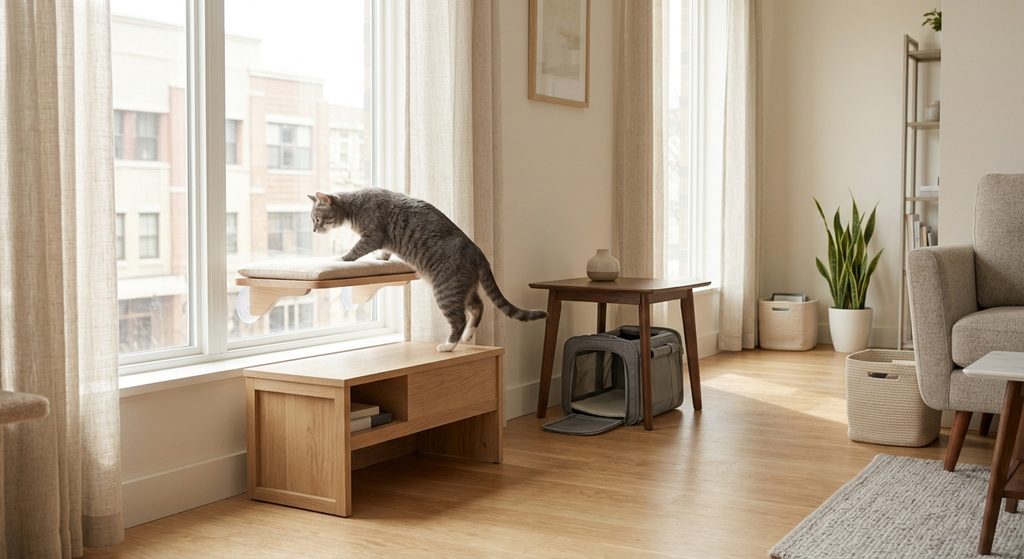
Existing furniture can carry part of the cat setup. A stable bench can be a step to a window and storage underneath. An open shelf can hold household items on lower levels while the top becomes a perch. A side table can create a protected resting area underneath. The carrier can stay open with bedding and function as a hide rather than taking closet space between vet visits.
| Small-space item | Human function | Possible cat function |
|---|---|---|
| Storage bench | Seating and storage | Climbing step or window access |
| Bookcase | Vertical storage | Secure top perch |
| Side table | Surface for household use | Protected hide underneath |
| Open carrier | Emergency/vet transport | Everyday familiar hide |
| Washable throw | Protects furniture | Preferred resting texture |
Safety comes first. Do not encourage climbing on furniture that can tip. Secure tall pieces appropriately and keep heavy or breakable objects away from routes the cat uses.
Create Micro-Zones Instead of One Cat Corner
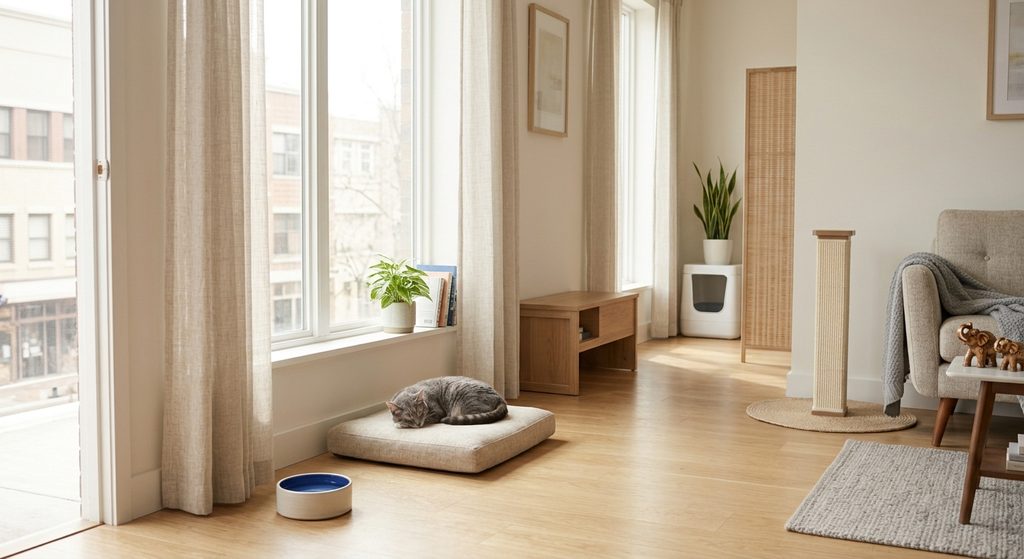
A studio may not have separate rooms, but resources can still be distributed. Put water beside a quiet wall, not next to the litter box. Place the scratcher near the sofa. Use a window perch for observation and a covered hide under a table for retreat. Feed in a calm area that is not the only walkway through the apartment. These small zones reduce crowding without requiring major distance.
Use furniture to create visual separation. A low shelf between food and litter areas can change how the space feels even when the physical distance is modest. In a multi-cat studio, true separation is harder and requires more planning. Duplicate key resources where possible and avoid placing all important items along one narrow wall that a single cat can control.
A one-bedroom apartment can distribute resources across two rooms. Put a quiet rest area in the bedroom. Keep active play in the living area. Water can appear in both. The litter box can occupy a third micro-zone. This creates choice without buying more floor furniture.
Keep Toys Rotating Instead of Permanently Spread Out
You do not need a permanent playroom. Keep a small basket of safe toys and rotate a few at a time. Interactive wand toys can be stored after play. Cardboard boxes can be used for several days and recycled. A food puzzle can appear for one meal and then return to a cupboard. Changing what is available can make familiar items more interesting without adding clutter.
Use open floor space temporarily. A hallway can become a chase route during a short play session and return to normal afterward. Move wand toys like prey rather than swinging them directly in the cat’s face. Let the cat catch the toy. For food-motivated cats, hide a few pieces from the measured ration in easy locations to encourage searching, provided the cat can safely access them and all food is accounted for.
- Rotate three or four toys instead of leaving a large collection out.
- Store string and wand toys safely after supervised play.
- Use boxes and paper bags without handles as temporary exploration items.
- Put part of a normal meal into a simple puzzle feeder.
- Use short play sessions that fit the apartment’s open spaces.
Measure before ordering. Record ceiling height. Check window depth. Measure the litter footprint. Confirm door clearance. Mark the base of any cat tree with tape first. Live with the taped footprint for a day. If people keep stepping over it, the product is too large for that location.
Test sound as well as size. A fountain can echo in a studio. An automatic feeder can sound louder at night. A litter cabinet door may bang against a wall. Quiet equipment is easier to live with in one room. The cat may also use it more comfortably.
Use Renter-Friendly Options Before Drilling Holes
Wall shelves can be excellent, but they are not the only route to vertical space. Freestanding towers, tension systems rated for the intended use, furniture steps, window furniture, and sturdy stools can create height without permanent changes. Adhesive products should not be trusted with a cat’s body weight unless the manufacturer clearly rates the installation for that purpose and the wall surface is suitable. Failure can injure the cat and damage the property.
Protect floors under water and litter with washable mats. Use furniture protectors strategically while redirecting scratching to a better surface. If the lease restricts screens, balcony changes, or wall mounting, work within those limits rather than improvising unsafe solutions. A renter-friendly setup should be easy to move and inspect, not merely easy to install.
Storage can double as routine support. Keep replacement litter nearby. Store toys in one small bin. Put nail clippers with grooming supplies. Keep food containers sealed. A compact home feels less cluttered when care items have fixed places. That also makes daily tasks faster.
For a very small studio, think in four anchors. Use one window or high perch. Give one protected hide. Place one stable scratcher near the main living area. Keep litter in the quietest workable corner. Water can sit on another edge of the room. These anchors cover several needs without filling the center floor.
Keep the Setup Easy to Clean
Compact spaces become unpleasant quickly when litter tracking, food crumbs, fur, and water spills accumulate. Leave enough clearance around the litter box to sweep or vacuum. Choose bowls and fountains you can dismantle and clean easily. Wash bedding and throws. Avoid building a beautiful litter cabinet that you dread opening or a complex fountain that is rarely scrubbed.
Store supplies close to where they are used. A scoop and waste bags near the litter area make daily cleaning easier. Keep a small towel near a water station if your cat splashes. A lidded container can store food without occupying the counter. Good small-space design reduces the effort required for care because maintenance has nowhere to hide in a studio.
Try One Change at a Time
Do not remodel the entire apartment in one weekend because a checklist says cats need ten products. Watch where your cat already sleeps, scratches, looks outside, and asks for play. Add height where the cat seeks height. Add a scratcher beside the current target. Improve litter privacy without blocking access. Move water to a location the cat uses comfortably. This approach makes the setup feel designed for the individual cat rather than for an imaginary standard cat.
A small apartment cat setup works when every essential function has a usable place and the people can still live comfortably. Vertical routes, multifunction furniture, micro-zones, rotating enrichment, and easy cleaning let a small home provide more choice than its square footage suggests.
References
- 2025 Meeting the Physical and Emotional Needs of Indoor Cats — FelineVMA — Current framework for safe places, separated resources, play, social interaction, and sensory needs in indoor environments of any size.
- Setting Up the Environment for Success — FelineVMA — Practical guidance on hiding, climbing, scratching, resource placement, object play, and making the home feel safe and controllable.
- 2024 Indoor/Outdoor Lifestyle Position Statement — FelineVMA — Explains why indoor cats need vertical space, clean toileting areas, food, water, safe territory, play, and hunting-style enrichment.
