

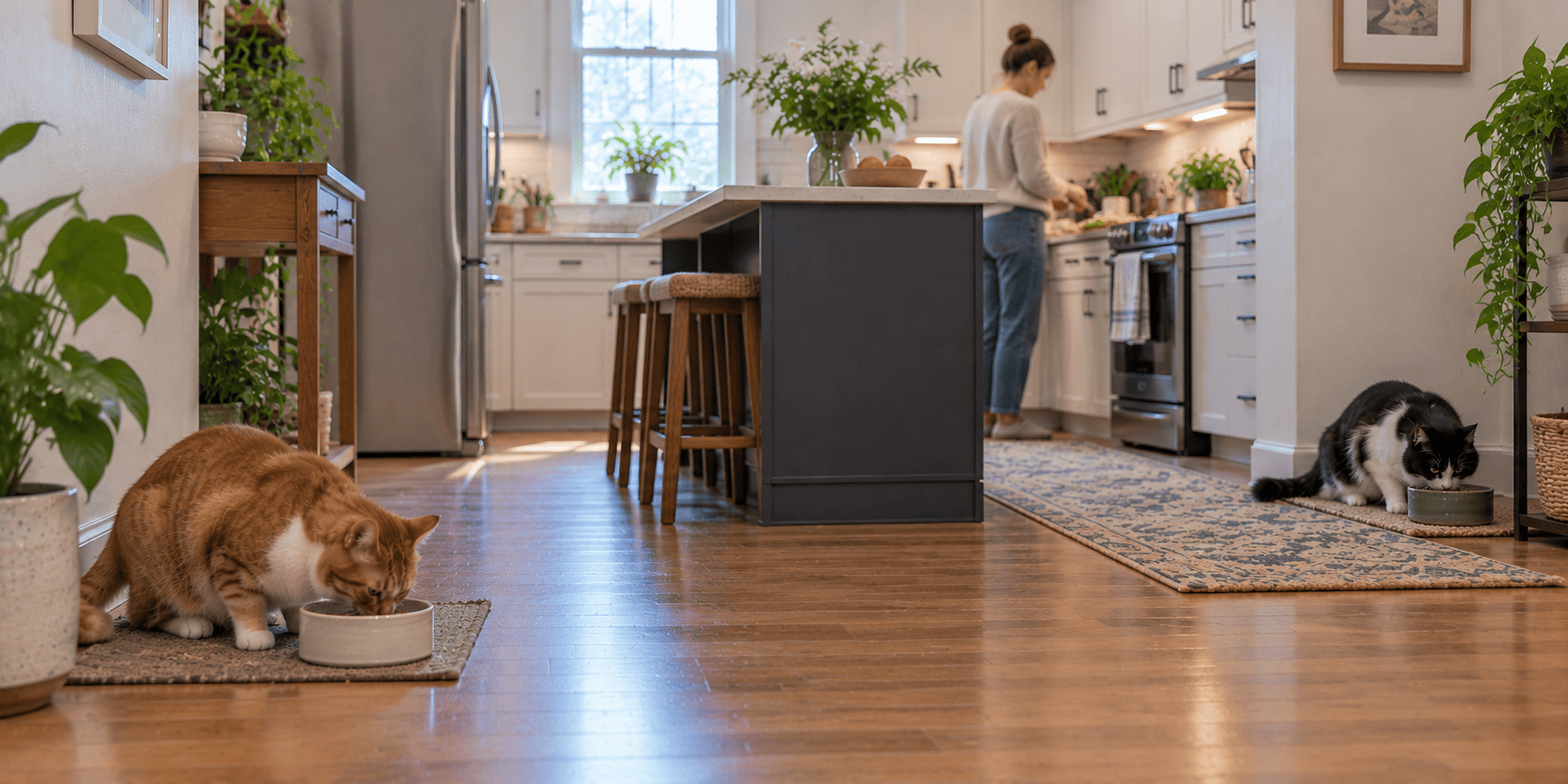
Learning how to feed two cats gets complicated when one grazes and the other inhales meals, one eats wet food and the other prefers dry, or one needs a therapeutic diet. The solution is not to force both cats into the same eating style. It is to control access well enough that each cat receives the correct food and amount without having to defend a bowl. That may mean separate rooms, staggered meal windows, a timed feeder, or a microchip feeder depending on the specific mismatch.
Write Down the Exact Difference You Are Trying to Manage
“Different eating habits” can hide several separate problems. A fast eater may steal from a slow eater. A grazer may want to return to food over several hours while the second cat finishes anything left out. One cat may be overweight and need measured calories; the other may be thin or have a higher energy need. Medical diets add another layer because even small amounts of the wrong food may matter for some treatment plans. Start by defining the conflict before choosing equipment.
Track what each cat is offered and what each cat actually eats for several days if health permits. This is easier with scheduled feeding than with one shared bowl. Note speed, leftovers, begging, food stealing, vomiting after fast eating, and whether either cat hesitates when the other is nearby. The broader decisions about food type, daily amount, life stage, and whether wet, dry, or mixed feeding fits each cat should be set first; then the household routine can deliver those individual plans.
Feed Two Cats Separately Even If They Will Eat Side by Side
Cats often prefer to eat alone, and feline feeding guidance recommends separate feeding stations with distance and visual separation in multi-cat homes. Two cats may tolerate shoulder-to-shoulder meals without obvious fighting while one still eats faster, leaves early, or watches the other instead of finishing. Separate feeding makes intake easier to measure and reduces quiet competition.
Use different rooms when possible. A doorway closed for ten or fifteen minutes can be more effective than placing bowls three feet apart. If separate rooms are not available, use furniture or visual barriers and enough distance that one cat cannot simply turn and reach the other bowl. Elevated stations can help in specific households if one cat can access height comfortably and the other cannot, but do not rely on height if mobility changes or the determined cat can still reach the food.
For a Fast Eater and a Slow Eater, Protect the Slow Cat’s Meal
A slow eater should not have to race. Feed the cats behind separate doors or remain nearby until the faster cat finishes and is redirected away. Slow-feeder bowls or puzzle feeders can reduce speed for some cats, but they are not a substitute for separation if food theft continues. Use part of the normal ration in any puzzle device rather than adding extra calories for enrichment.
Give the slower cat enough uninterrupted time to eat, then refrigerate perishable leftovers safely. If the slow cat repeatedly eats only a small amount even when alone, treat that as an appetite issue rather than assuming personality. Dental pain, nausea, chronic disease, or stress can make a cat appear naturally “slow.” A feeding system is successful only if both cats maintain appropriate intake and body condition.
| Mismatch | Useful first strategy | When equipment may help |
|---|---|---|
| Fast eater + slow eater | Separate rooms for meals | Slow feeder for the fast cat |
| Grazer + meal eater | Protected access for leftovers | Microchip feeder for the grazer |
| Different diets | Separate feeding stations | Microchip feeder or controlled rooms |
| Different calorie needs | Measure each daily ration | Timed feeders for scheduled portions |
Test separation before buying equipment. Close one door. Feed both cats. Stay nearby. Watch whether the slower cat eats more calmly. Check whether begging falls afterward. This simple trial can show whether access is the main problem. It also tells you whether a protected feeder is likely to be worth the cost.
A Grazer and a Food Thief Usually Need Controlled Access
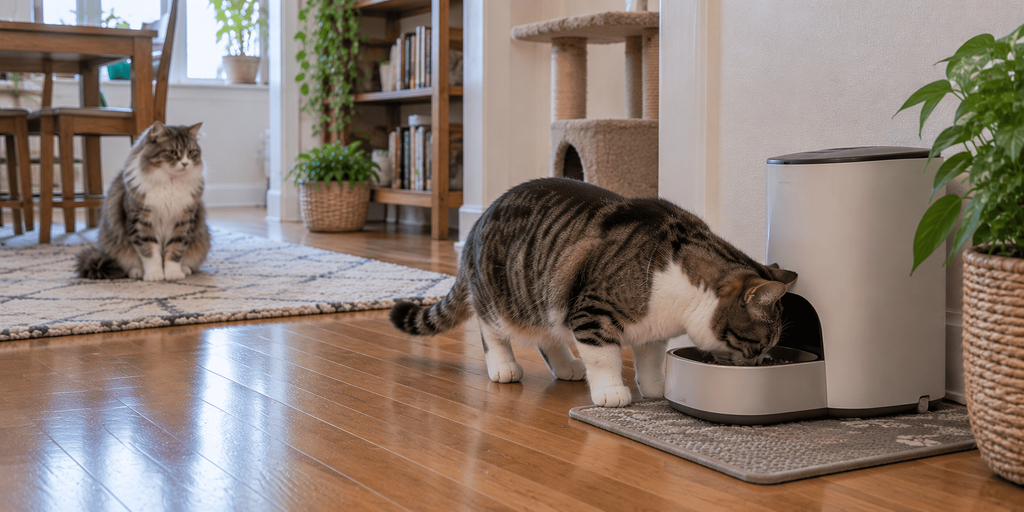
Free feeding one cat becomes difficult when the second cat treats every bowl as available. Simply placing the grazer’s bowl farther away rarely works if both cats can reach it. A microchip-activated feeder can be useful because it opens only for the assigned cat, allowing protected grazing. Before buying one, consider whether the intended cat is comfortable putting the head inside the feeder and whether the other cat can push in from the side. Some households still need supervision while the cats learn the device.
Another option is to transition the grazer gradually toward several scheduled small meals. Measure the current daily intake first, then offer portions at predictable times rather than suddenly removing all-day access. This can work when the cat is healthy and adapts comfortably, but it is not mandatory if protected grazing suits the household better. The important point is that the food thief should not be gaining weight while the grazer gradually loses access.
Different Diets Need More Than Different-Colored Bowls
If one cat eats a prescription or therapeutic diet, ask the veterinarian how strict separation needs to be. In some conditions, repeated access to the other cat’s food can undermine the nutritional plan. Feed behind closed doors, pick up leftovers, and prevent shared grazing unless your veterinary team says occasional crossover is acceptable. Do not assume the cats will remember which bowl is theirs.
For wet and dry differences, storage and timing matter. Wet food should not sit out indefinitely while a grazer returns all day. Offer smaller fresh portions or use a feeder designed to manage wet food safely according to its instructions. Dry food is easier to protect in a microchip feeder. If medication is mixed into food, confirm that the intended cat consumes the full medicated portion before allowing access to the other cat.
Keep water separate from the food conflict. Each cat should be able to drink without crossing the other cat’s feeding station. Do not use food placement to force social closeness. Mealtime is not an introduction exercise. Cats can share a home successfully without sharing a bowl or eating within touching distance.
Measure the Whole Day Before You Divide It Between Feedings
Multi-cat homes are especially vulnerable to portion drift because several people may feed or refill bowls. Measure each cat’s daily allowance separately. Containers labeled for each cat can make the remaining ration visible to everyone in the household. Treats, toppers, puzzle-feeder food, and stolen bites all affect the total. If one cat needs weight loss, do not simply cut visible meals while leaving shared snacks and stolen food unchanged.
Weighing dry food in grams can improve consistency. Wet food can be divided by can, pouch, or weight depending on the package. Recheck body condition and weight regularly. A cat that receives the “correct” portion on paper but is losing weight may not actually be consuming it. A cat that gains despite measured meals may be finding extra calories elsewhere. Intake tracking is part of the feeding system, not an optional audit after problems appear.
- Measure each cat’s daily food separately.
- Label portions when more than one person feeds.
- Count treats and puzzle-feeder food.
- Pick up or protect leftovers.
- Track weight and body condition trends.
- Reassess the routine when one cat’s health or mobility changes.
Use Timed Feeders to Solve Timing Problems, Not Social Problems
Timed feeders can divide one cat’s ration into several meals and help with overnight or workday schedules. They do not automatically stop the other cat from eating the released food. If the cats share access, a timed feeder may simply serve breakfast to whoever arrives first. Use timed feeding when timing is the main issue, and protected or microchip access when identity is the main issue.
You can combine tools. For example, the fast eater might receive measured meals in a slow feeder in one room while the grazer uses a microchip feeder elsewhere. Another household may use two timed feeders located in separate rooms. The best system is often simpler than the most technological system. Doors, routine, and measured portions can solve many problems without electronics.
Technology needs training time. Introduce a microchip feeder while the cat is relaxed. Let the lid move gradually if the device allows training stages. Keep familiar food inside. Never let the hungry second cat crowd the learner during practice. A protected feeder only works if the intended cat is comfortable using it.
Watch for Quiet Food Competition
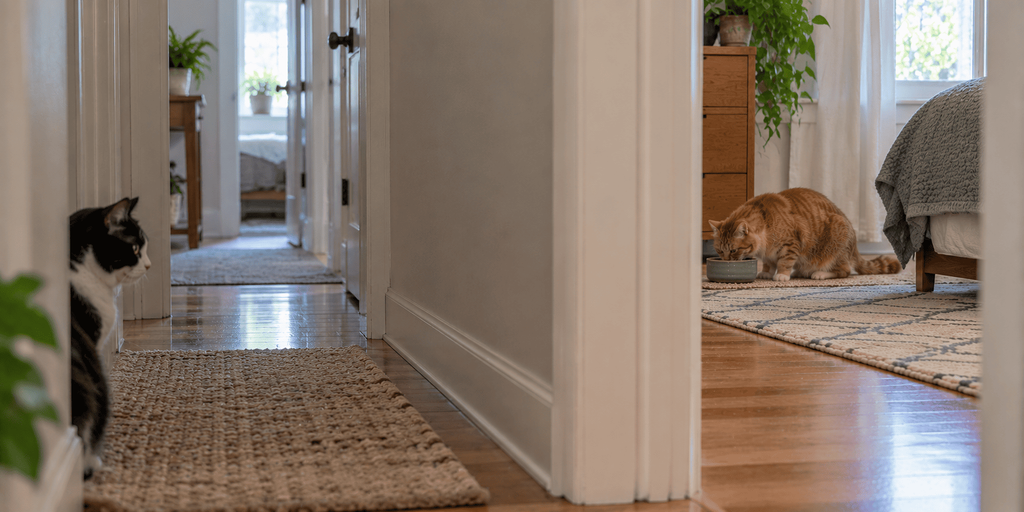
Competition does not always look like growling at the bowl. One cat may sit in a doorway, stare, follow the other to the feeding area, or finish early and hover nearby. The more cautious cat may eat only when the other is asleep. FelineVMA guidance on multi-cat households emphasizes separated resources because access can be socially controlled without overt fights.
Watch who approaches first and who leaves first. Does one cat repeatedly look over the shoulder while eating? Does the slow cat return only after the room is empty? Are there weight differences developing? Feed in locations with more than one safe route where possible, and avoid placing both feeding stations in a narrow dead end. If tension extends beyond food to litter boxes, resting areas, and movement through the home, the household may need a broader environmental plan.
Review the plan monthly at first. Check both weights. Look at leftovers. Confirm feeder batteries and schedules. Ask whether either cat now waits for the other to leave. A system that worked last season may need adjustment as appetite, mobility, or household routines change.
Change the System When Health Changes the Eating Habit
A cat that once grazed may need scheduled medication. A senior may become slower or less willing to climb to an elevated feeding station. Dental disease can turn a fast eater into a hesitant one. Kidney disease, diabetes, obesity treatment, and gastrointestinal conditions can change diet, appetite, or meal timing. Do not preserve an old household system when it no longer fits the cat in front of you.
Unexpected weight loss, repeated vomiting, a major appetite change, or a cat that stops competing for food should be evaluated medically. It is easy to misread a health change as the second cat “stealing more.” Separate the cats long enough to observe individual intake and contact your veterinarian when the pattern is new or significant.
Make Access Individual
The key to feed two cats with different habits is not making their behaviors identical. Give each cat an individual feeding plan, then control space, timing, and access so the plan actually reaches the right cat. Separate rooms are often the simplest tool. Microchip feeders are useful for protected grazing or different diets. Timed feeders help with meal distribution, while slow feeders can help with speed.
Review the system by outcomes: each cat eats the intended food, maintains an appropriate weight, and can approach the feeding area without pressure. If those outcomes are not happening, change the setup rather than blaming the cats for eating differently.
References
- How to Feed a Cat — Cat Friendly Homes — Current caregiver guidance on solitary feeding, multiple small meals, separate feeding stations, and feeding challenges in multi-cat homes.
- Feline Feeding Programs: Addressing Behavioral Needs to Improve Feline Health and Wellbeing — FelineVMA — Consensus guidance on feeding cats individually, reducing competition, using multiple stations, puzzle feeders, and automatic feeders.
- 2024 AAFP Intercat Tension Guidelines — FelineVMA — Framework for recognizing subtle resource-related tension and improving access in households with two or more cats.
