

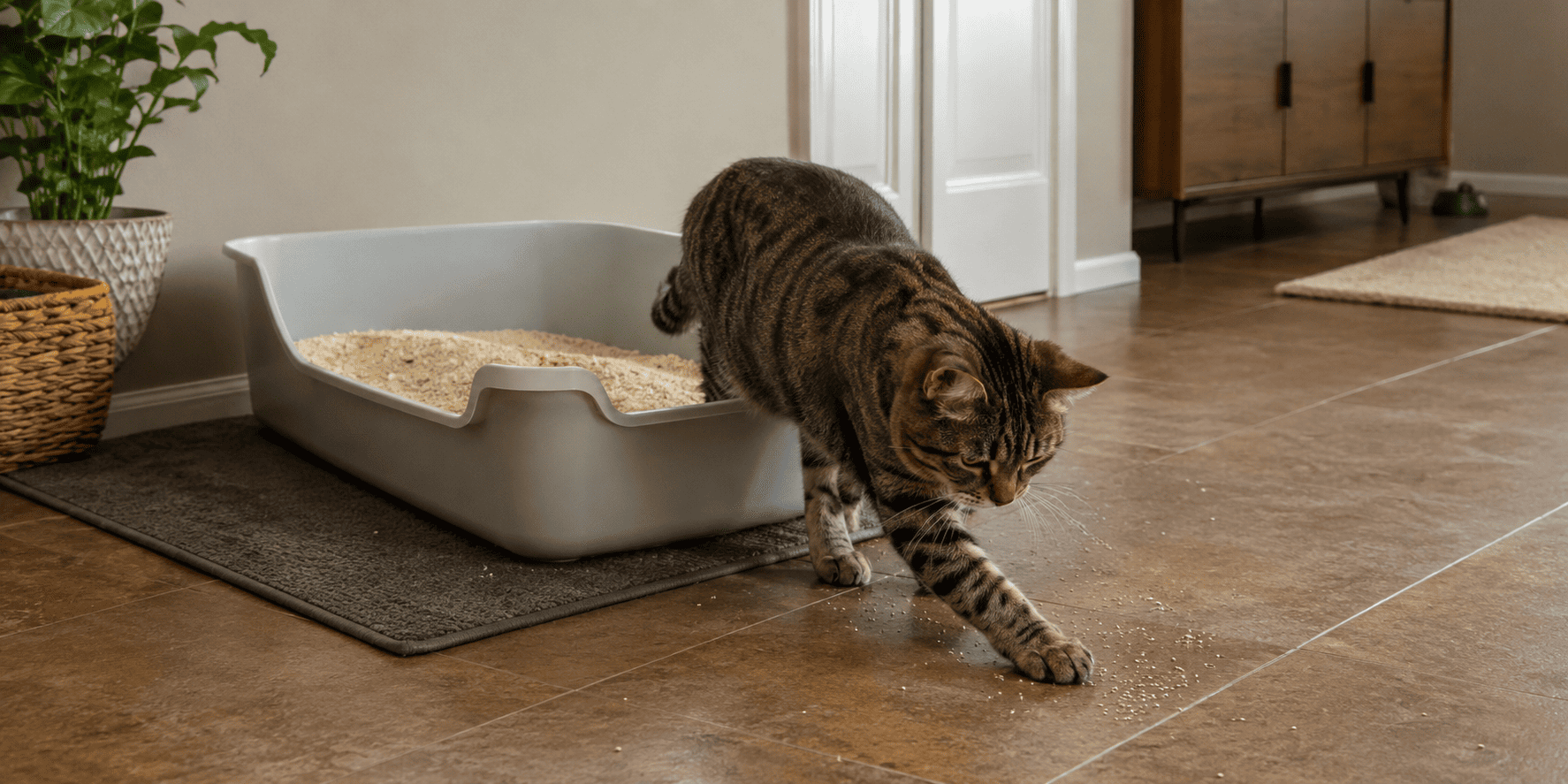
If you are wondering why your cat scratches the floor around the litter box, the first clue is when the scratching happens. Many cats dig before eliminating and try to cover urine or stool afterward. You may also see a cat scratch the floor as the same covering motion continues beyond the edge of the box. Some continue the same burying motion on the box wall, mat, or floor even though there is no litter there to move. That can be harmless. It becomes more useful to investigate when the behavior is new, prolonged, paired with accidents, or looks like the cat cannot get comfortable inside the box. Box size, litter depth, texture, cleanliness, and pain can all change the pattern.
Watch Whether the Scratching Happens Before or After Elimination
Video can help if the sequence is hard to catch, but place a camera far enough away that it does not alter the cat’s route. You only need to see entry, digging, posture, elimination, covering, and exit. The order tells you more than the sound of scratching heard from another room.
Scratching before toileting often looks like searching for the right spot. The cat may dig, turn, sniff, and reposition before squatting. Scratching afterward is more often part of covering behavior. Cats naturally dig around elimination sites. FelineVMA guidance notes that cats may dig and posture over a larger area before choosing a spot when they are not constrained by a home litter box. A small plastic tray compresses that whole sequence into a tight space.
If your cat uses the box normally and produces normal urine or stool, a few swipes at the floor may be harmless. Brief covering followed by a comfortable exit fits the same pattern. Notice duration. Brief scratching after a normal bowel movement is different from several minutes of frantic pawing. Repeated entering and leaving, especially without producing urine or stool, deserves closer attention. The second pattern deserves closer attention because the cat may be uncomfortable, dissatisfied with the box, or trying repeatedly to eliminate.
Why Does My Cat Scratch the Floor Around the Litter Box? Check the Box Footprint
Pay attention to tail and hind-leg clearance. A large cat may stand partly outside a short tray or turn with its body pressed against the walls. If the cat’s paws repeatedly land beyond the litter during ordinary turning, floor scratching may simply reflect a box that ends too soon.
A cat can fit inside a box and still not have enough room to dig, turn, squat, and cover comfortably. Many commercial boxes are smaller than the space a cat would naturally use. When the cat reaches the edge after eliminating, the paw may continue the digging motion onto the floor or wall. Larger boxes give the cat more usable litter surface and reduce the chance that normal scratching immediately meets plastic.
Measure the box against the cat rather than the room corner. Feline house-soiling guidance commonly recommends boxes around one and a half times the cat’s body length from nose to the base of the tail. Older cats may need a lower entrance even if the rest of the box is large. The broader relationship between box size, litter depth, placement, and cleaning matters because floor scratching can be the visible part of a setup that feels cramped or awkward.
Litter Depth Can Change How Much the Cat Keeps Digging
Keep depth consistent while you test. If litter depth swings from a thin layer to several inches, the test becomes hard to interpret. Behavior may change because the surface changed rather than because the cat revealed a stable preference. A simple mark on the box wall can help caregivers refill to roughly the same level.
Too little litter may leave the cat unable to cover waste in the way it expects, so it keeps scraping at nearby surfaces. Very deep litter can feel unstable underfoot for another cat and create more vigorous digging. FelineVMA educational material notes a general feline preference around 1.5 inches of litter, while also emphasizing individual preference. Treat that as a starting point rather than an exact rule for every cat.
Watch what your cat does with the litter itself. If it digs down to the plastic base every time, you may need slightly more depth or a different texture. If the cat perches on the edge and barely touches the substrate, it may dislike the litter. Change one variable at a time. Adding a new box with a different depth beside the familiar option can tell you more than replacing every box at once. Keep the original available during the test so the cat is not forced to accept the experiment.
The Floor May Be Easier to Scratch Than the Litter
Long-haired cats can add another variable because litter may cling to paw fur. Check whether the cat shakes its paws, steps gingerly, or leaves with pieces trapped between the toes. If this is new, inspect the feet gently and ask your veterinarian about painful or irritated paws.
Texture matters. Most cats tend to prefer soft, easy-to-rake substrates, although individual preferences vary. Large pellets, hard crystals, strong fragrance, dusty litter, liners, or a substrate that catches long fur may change how a cat uses the box. A cat may perform the covering motion on the smooth floor because the litter itself is less comfortable to rake. That does not prove the cat hates the litter, but it is a useful clue when paired with shallow digging, edge-perching, or accidents near the box.
Do not respond by adding scented deodorizers or several inches of a new product. Offer a second large box with a soft, unscented litter if you suspect preference. Keep both boxes clean and in similarly acceptable locations so you are testing the substrate rather than comparing a quiet box with one beside the washing machine. If the cat consistently chooses one, you have learned something useful without turning the litter area into a constant series of changes.
Scratching the Wall or Mat Can Be the Same Behavior
A mat should not slide or bunch under the cat. If it moves during scratching, the cat may avoid stepping on it or become more frantic. Choose a stable washable surface and keep the path out of the box clear, especially for older cats that need confident footing.
Some cats scrape the side of the box, nearby wall, cabinet, or litter mat after eliminating. The paw movement resembles covering even though nothing moves. If the cat has done this for years and otherwise toilets normally, it may simply be an idiosyncratic part of the elimination sequence. You do not need to correct every scrape.
Protect the surroundings if needed. A larger washable mat can catch litter without becoming a noisy or unstable surface. A wall shield can protect paint if the box is near a wall. Avoid startling devices, foil, or punishment around the litter area. The cat needs the toilet to remain predictable and safe. A sudden shift from scratching litter to scratching walls is worth noting. It matters more when the cat also leaves waste uncovered, spends less time in the box, or toilets elsewhere.
Cleanliness Changes How Much Covering Work the Cat Has to Do
In a multi-cat home, a box can become crowded between your normal scooping times. If floor scratching appears only after another cat has used the box, adding another well-placed box may help more than changing litter. Spread boxes rather than putting every tray in one station.
A dirty box can make a cat search, dig, and reposition more because clean substrate is harder to find. Scoop at least daily and more often when several cats use the same area. Top up litter as needed rather than letting the usable depth shrink over time. Wash the box regularly with mild soap and water, avoiding strong ammonia-like or heavily scented products that may leave an unpleasant smell.
- Remove urine clumps and stool before the box becomes crowded.
- Keep litter depth reasonably consistent after scooping.
- Replace damaged boxes that retain odor or have rough surfaces.
- Avoid strong fragrances around the litter area.
- Keep the floor dry and stable so the cat can exit confidently.
- Provide more than one box when household size or social tension requires it.
Cleanliness does not mean sterilizing the box after every use. The aim is a predictable substrate with enough clean space for normal digging and elimination.
Know the Difference Between Digging and Straining
Do not wait for an obvious cry before taking straining seriously. Cats with urinary discomfort may make frequent quiet trips, lick afterward, or produce small spots. When the amount of urine is uncertain, err on the side of veterinary guidance rather than assuming the cat is simply fussy about covering.
Floor scratching can distract from the more important question: did your cat actually urinate or defecate normally? Repeated trips, prolonged squatting, vocalizing, licking the genital area, blood, or producing very little urine are not ordinary covering behavior. Difficulty urinating can be an emergency, particularly in male cats. Repeated hard stool, constipation, diarrhea, or obvious pain also deserves veterinary attention.
Watch the whole sequence rather than focusing on the paws. A cat that urinates a normal amount, covers, scratches the floor twice, and leaves comfortably is usually showing a different pattern. Repeated entry, squatting, minimal output, and a quick return to the box is more concerning. If you cannot tell whether your cat is trying to urinate or defecate, call your veterinarian. Do not keep changing litter while a possible medical problem goes unassessed.
Use the Scratching Pattern as a Simple Setup Test
Take a photo of the setup before changing it. If behavior improves, you can remember the litter depth, box position, and surrounding mat that worked. This is especially useful in households where different people clean the box and may unknowingly recreate the old problem.
If the behavior is harmless but messy, test the physical setup before buying a special product. Try a larger open box, maintain a comfortable litter depth, and place it where the cat can turn and exit easily. If litter scatters, use higher sides where mobility allows or a larger catch mat outside the entrance. Keep the entrance low enough for older or painful cats.
Change one feature for a week and observe. Look for less pawing outside the box. Notice whether covering becomes more efficient, and check whether the cat chooses the new box voluntarily. A calmer, shorter elimination sequence is better evidence than whether the floor stays perfectly clean. The aim is to give the cat enough space and suitable substrate for normal behavior, not to train away every natural digging motion.
Investigate a New or Escalating Pattern
A few floor scratches after normal litter-box use can be harmless. A new pattern paired with accidents, prolonged digging, straining, pain, or avoidance needs more attention. Look at box size, litter depth, texture, cleanliness, access, and health together. When the cat’s elimination itself changes, veterinary assessment matters more than protecting the floor.
References
- Setting Up the Environment for Success — FelineVMA — Describes normal digging, substrate preferences, elimination behavior, and environmental context.
- AAFP/ISFM House-Soiling Guidelines — FelineVMA — Covers box size, litter preference, access, medical causes, and systematic litter-box troubleshooting.
- Not Using the Litter Box — Cat Friendly Homes — Updated guidance on environmental, social, medical, and litter-box factors.
