

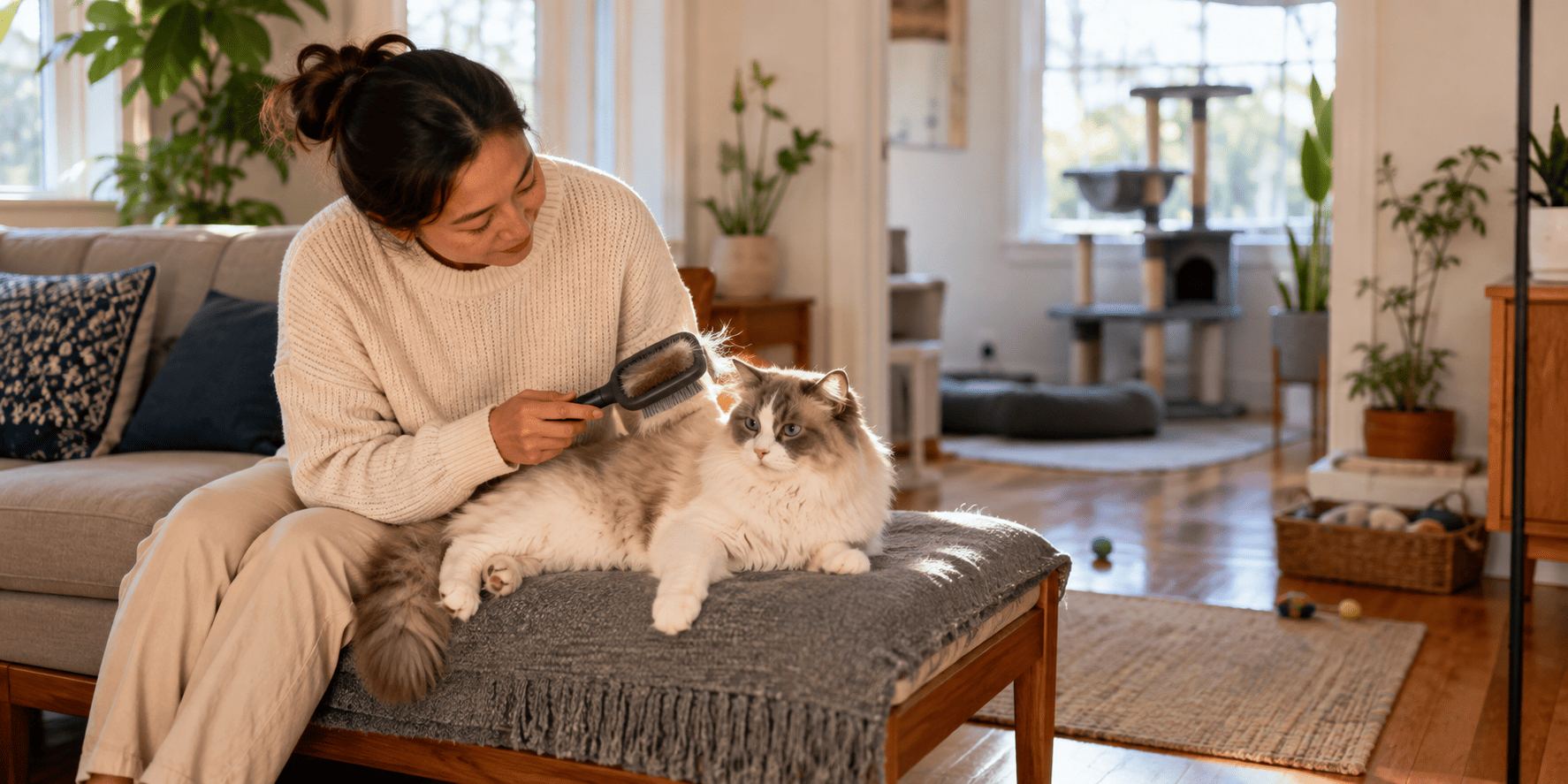
How often should you brush your cat? The useful answer depends less on a calendar than on coat length, density, shedding, mat risk, and how well your cat can groom independently. A healthy short-haired adult may stay comfortable with one or two thorough sessions a week, while a long, silky, curly, or mat-prone coat may need attention every day. Age, weight, arthritis, illness, and seasonal shedding can also change the schedule. The aim is not to brush as often as possible. It is to remove loose hair and small tangles before they become a problem while keeping grooming predictable enough that your cat still accepts it.
How Often Should You Brush Your Cat? Match the Schedule to the Coat
Coat type sets the starting frequency because different coats trap loose hair and form tangles at different rates. ASPCA guidance suggests that many short-haired cats benefit from one or two brushings each week, while VCA notes that long, silky, or curly coats may require daily brushing to stay free of mats. Medium or dense double coats often fall between those patterns, but the exact schedule is easier to judge by what the comb finds. If a weekly session pulls out large clumps or you keep finding small knots behind the legs, the gap is probably too long. If a daily session finds almost nothing and your cat becomes irritated, you may be doing more than that coat needs.
| Coat pattern | Useful starting rhythm | What changes the schedule |
|---|---|---|
| Short, smooth coat | About 1–2 times a week | Heavy shedding, age, poor self-grooming |
| Medium or dense coat | Several times a week | Thick undercoat, seasonal shedding, tangles |
| Long, silky, or curly coat | Often daily | Mat-prone areas, coat texture, grooming tolerance |
| Any coat with reduced self-grooming | More frequent checks | Arthritis, obesity, illness, senior age |
Treat those frequencies as a baseline, not a rule. A short-haired cat with a thick undercoat can need more help than a fine-coated longhair that rarely tangles. The coat in front of you is the better guide.
One practical way to calibrate the schedule is to compare two consecutive sessions. If a Monday brushing removes little but a Sunday session is full of loose undercoat, try moving the second session earlier. The useful frequency is the one that prevents buildup before the coat becomes difficult, not the one that sounds most disciplined.
Use Your Hands to Decide Whether the Current Frequency Is Enough
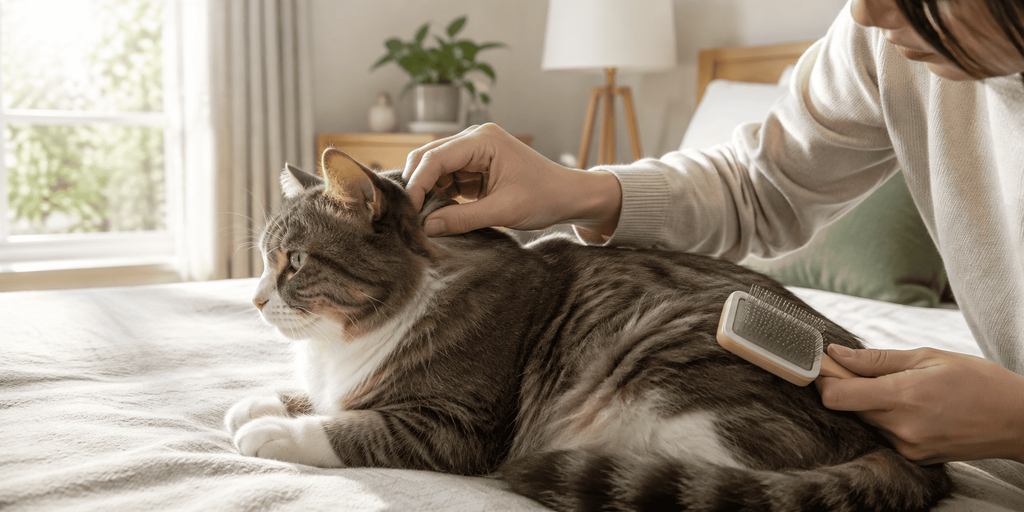
A quick coat check between brushing sessions tells you whether the schedule is working. Run your fingertips gently through the fur rather than only looking at the surface. Areas behind the ears, in the armpits, along the back of the legs, under the chest, and around the belly can hide early tangles. A healthy coat should not feel packed with loose undercoat, greasy, sharply knotted, or painful when touched. If you repeatedly find tiny tangles before the next planned brushing, shorten the interval. If the coat stays smooth and your comb passes through easily, the current rhythm may be enough.
This check also prevents a common mistake: waiting until a grooming day to discover a mat that has been tightening for a week. Daily inspection can take less than a minute and does not need to become a full grooming session. That distinction matters for cats that dislike prolonged handling. You can monitor the coat often while keeping the actual brush sessions short and predictable.
Pay attention to friction under your fingertips. Early tangles often feel like a slightly thick or resistant patch before they look like a knot. Catching that stage lets you use a few gentle comb passes instead of a long detangling session. That makes frequent inspection valuable even on weeks when very little hair needs to be removed.
Shedding Season Can Temporarily Change the Routine
Indoor cats can shed throughout the year, but some still have periods when loose undercoat increases noticeably. During those weeks, a cat that normally needs brushing twice a week may benefit from shorter daily or every-other-day sessions. The reason is practical: removing loose hair before it packs into the coat makes tangles easier to prevent and reduces how much fur ends up on furniture or is swallowed during self-grooming. Increase frequency because the coat is changing, not simply because the calendar says spring or fall.
When shedding settles, scale the schedule back instead of assuming the temporary routine must continue forever. A useful test is the amount of loose hair you collect and how easily the comb moves through the coat. If each session is still productive and comfortable, continue. When brushing starts finding very little, return to the normal rhythm. This keeps grooming responsive to the coat rather than turning it into a fixed chore.
Shedding can also change by room temperature, daylight exposure, coat type, and the individual cat. Indoor life does not create one universal season. If your vacuum and brush both collect more fur for several weeks, respond to that real change. When the loose undercoat drops again, there is no benefit in maintaining an intensive schedule by habit.
Keep notes only if they help. If you are trying to solve repeated mats, record the date, areas that tangled, and which tool worked. After two or three weeks, the pattern is usually clearer. Once you know the vulnerable zones, you can focus there instead of brushing the entire cat more aggressively. Consistency, gentle technique, and early detection matter more than hitting a universal number of sessions.
Older, Overweight, or Painful Cats May Need More Help
A cat can have the same coat for years and suddenly need more brushing because self-grooming becomes harder. Arthritis may make twisting toward the lower back uncomfortable. Extra body weight can make the rump or base of the tail difficult to reach. Dental pain, weakness, or illness can also reduce normal grooming. The first sign may be a coat that looks separated, oily, flaky, or slightly matted in one area rather than an obvious medical symptom. In these cats, increase assistance gently but also ask why grooming ability changed.
Do not solve a sudden coat change only by brushing harder. New mats, poor coat condition, touch sensitivity, or a dramatic drop in self-grooming can deserve veterinary attention. A softer tool, shorter session, non-slip surface, and easier body position can make home grooming more comfortable while the underlying issue is assessed. Brushing should support a cat whose grooming ability has changed, not hide the fact that it changed.
A grooming change can also reveal mobility loss before it is obvious during walking. For example, a cat may stop reaching the middle of the back yet still move normally across the room. If one coat region deteriorates repeatedly, note whether that area requires twisting, balancing, or prolonged licking that has become physically difficult.
Short Sessions Usually Work Better Than One Long Battle

Frequency only helps if your cat can tolerate the routine. A five-minute session that ends while the cat is still relaxed is often more useful than a weekly twenty-minute struggle. Begin in an area your cat already accepts, such as the shoulders or side of the body, and pause before moving to sensitive zones. Watch for tail flicking, skin twitching, ears turning back, a sudden head turn toward the brush, or the body leaning away. Those are useful signals to stop or switch areas before the cat needs to escalate.
For a cat that is new to brushing, separate training from coat maintenance. Touch the brush to the coat, make one or two gentle passes, then finish with something the cat values. Gradually extend the session over days. If you need frequent grooming because the coat mats easily, building tolerance is part of the care plan. Forcing long sessions can make tomorrow’s brushing harder even if you remove more hair today.
If your cat becomes restless after three minutes, stop at two minutes while the experience is still neutral. You can brush a different section tomorrow. Dividing coat care over several short sessions is not incomplete grooming; for many cats, it is the most realistic way to keep the coat maintained without creating avoidance.
A good brushing schedule is the least frequent routine that keeps the coat comfortable, clean, and free of developing tangles while remaining easy for your cat to accept. For one short-haired cat, that may be a calm session every Sunday and Wednesday. For a long-haired cat, it may be three minutes every evening with extra attention behind the ears and legs. The routine can also change during shedding, illness, weight change, or aging. Review the coat instead of defending the schedule.
Choose a Tool That Reaches the Coat Without Scraping the Skin
The right frequency cannot compensate for the wrong tool. Short coats often respond well to a rubber grooming tool, soft bristle brush, or comb that lifts loose hair without aggressive pulling. Medium and long coats usually need a comb with teeth long enough to reach through the coat, because a brush can make the top layer look smooth while a tangle remains underneath. Dense undercoats may need a tool designed to lift loose undercoat, used lightly and only as needed. More pressure is not more effective.
A practical grooming routine includes more than coat brushing, so brushing, nail care, teeth, and ear checks can fit into separate low-stress sessions instead of becoming one long appointment at home. This also prevents over-handling. Your cat does not need every grooming task done on the same day just because the brush is already out.
Check the skin after using any new grooming tool. Red lines, repeated scratching, flinching, or a cat that avoids being touched afterward can mean the tool is too harsh or your pressure is too strong. A brush that removes impressive amounts of fur is not useful if it irritates healthy skin.
Mats Change the Question From Frequency to Safety
Small loose tangles may come apart with fingers or a wide-toothed comb while you support the fur near the skin. A tight mat is different. Mats can pull on skin, hide irritation, and sit closer to the body than they appear. Cat skin is thin and can be drawn up into a mat, which makes cutting with household scissors risky. If the mat does not loosen with gentle handling, stop trying to win the problem in one session. A veterinarian or experienced cat groomer can advise on safe removal, especially for extensive mats.
- Increase brushing if you keep finding new small tangles between sessions.
- Do not repeatedly rake a painful area to break a mat apart.
- Avoid scissors close to the skin, even when the mat looks easy to lift.
- Get help if mats are tight, widespread, damp, dirty, or painful.
- After removal, adjust the routine so the same area is checked earlier.
The useful lesson from a mat is not simply “brush more.” Note where it formed and how quickly. That tells you which body area needs more frequent attention.
After professional mat removal, ask which areas were most affected and how short the coat was clipped. Those details help rebuild a prevention schedule. A long-haired cat may need daily attention only in high-risk zones, while easier sections can be combed less often. Targeted grooming is usually more sustainable than treating every inch identically.
Build a Brushing Rhythm Your Cat Can Keep
A stable routine can be linked to something that already happens, such as evening television or a weekly weigh-in. Keep the brush within easy reach and end before the cat becomes irritated. The schedule is working when grooming feels ordinary enough that neither the cat nor the person needs a special battle plan.
References
- Cat Grooming Tips — ASPCA — Practical coat-care guidance, including weekly brushing for many short-haired cats and more frequent care for long-haired coats.
- Grooming and Coat Care for Your Cat — VCA Animal Hospitals — Explains why long, silky, or curly coats may need daily brushing and how age, mats, tools, and coat condition affect grooming.
- The Kitten Checklist — International Cat Care — Notes the greater grooming commitment of long-haired cats and the value of making coat care comfortable from an early age.
