


When a cat wags its tail, do not translate the movement with a dog dictionary. A feline tail can swish, flick, thump, twitch at the tip, puff, wrap, or rise upright, and the meaning changes with context. Slow tail-tip twitching while watching a bird is different from a hard side-to-side lash during petting. Puffed fur after a sudden noise is different again. The useful question is not “what does wagging mean?” but “what is the whole cat doing while the tail moves, and does the cat want to continue, pause, approach, or create distance?”
Read Speed and Stiffness Before You Label the Tail
Begin with how the tail moves. A loose, small tip twitch can accompany focused attention or mild arousal. A broad slow sweep may appear while a cat watches something interesting. Fast lashing, repeated thumping, or a rigid tail moving with increasing force can signal rising arousal, frustration, irritation, or conflict. The same motion is more meaningful when it changes during an interaction. If the tail was still during petting and begins flicking harder with each stroke, that transition tells you the cat’s state is changing.
| Tail movement | Common context | What to check next |
|---|---|---|
| Small tip twitch | Focus or mild arousal | Eyes, ears, target of attention |
| Slow side-to-side sweep | Watching, deciding, building arousal | Body tension and ability to disengage |
| Fast lashing or thumping | High arousal, irritation, frustration | Stop pressure and give space |
| Puffed tail | Startle, fear, intense arousal | Body size, ears, distance, trigger |
These are patterns, not fixed translations. Context keeps the tail from becoming a misleading dictionary.
Compare the movement with the tail’s baseline position. A low tail that suddenly begins hard lateral sweeps in a crouched cat carries more tension than a gently raised tail with a moving tip. The direction, starting posture, and whole-body change all contribute to interpretation.
Your cat’s personal tail patterns become useful only after you have watched them across many contexts. Keep curiosity rather than certainty. The same cat can swish during focused hunting, irritation, and social tension, so the surrounding sequence always decides which interpretation fits best.
During Petting, Tail Movement Can Be an Early Stop Signal
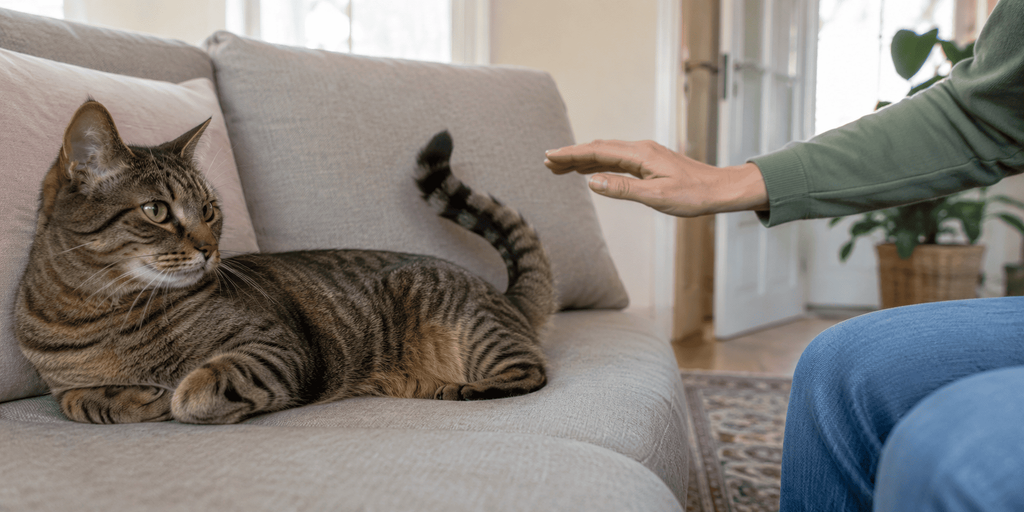
Some cats enjoy a few strokes and then become overstimulated. The tail may begin with a small tip flick, progress to stronger side-to-side movement, and appear alongside skin twitching, ears turning back, a head turn toward the hand, or body stiffening. If you keep petting until the cat swats or bites, you miss the useful early communication. Pause when the movement begins to escalate and let the cat decide whether to reinitiate contact.
This is easier when petting sessions include natural pauses. Stroke a few times, stop, and watch. A cat that leans back in, rubs, or remains loose may want more. A cat that turns away, leaves, or keeps the tail active is giving a different answer. Tail movement during petting is often most useful as a trend within that specific session rather than a universal sign.
Some cats have a very low threshold for repetitive touch on the back or sides. If tail movement begins at roughly the same point in every petting session, stop earlier next time. Predictable pauses can prevent escalation and teach people in the home where the cat’s comfortable limit usually sits.
A Wagging Tail During Play Can Mean Focus, Not Annoyance
Play creates arousal on purpose. A cat stalking a wand toy may crouch, shift weight, widen pupils, and twitch the tail tip while calculating a pounce. A broader sweep can appear as excitement builds. Those movements do not automatically mean the cat wants play to stop. Look at whether the body stays oriented toward the toy, whether the cat repeatedly re-engages after pauses, and whether the movement remains fluid rather than rigid and defensive.
Good play contains opportunities to catch the toy and reset. If the cat becomes frantic, begins redirecting bites toward hands, or cannot settle after the toy stops, lower the intensity. scratching, hiding, climbing, hunting-style play, and other normal indoor-cat behaviors make more sense when read in context rather than as isolated signals. The tail is one part of that larger behavior sequence.
During play, the cat should still be able to pause and reset. If tail movement becomes frantic and the cat begins grabbing hands or attacking nearby objects, end the game more calmly. High arousal is not bad by itself, but play should stay directed toward appropriate toys and remain recoverable.
When you are unsure, respond to the safer interpretation without overreacting. A brief pause in petting or a little more space costs almost nothing, while continuing to handle a cat that is becoming tense can escalate the interaction. Good body-language reading is less about being certain and more about making small adjustments early.
Window Watching Often Produces a Different Kind of Tail Action
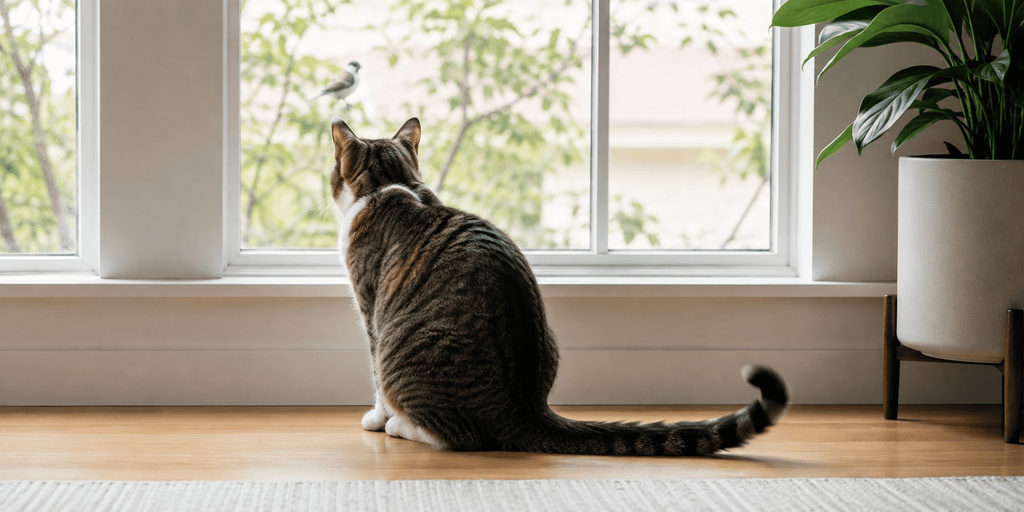
A cat watching birds, insects, outdoor cats, or movement through a window may show intense focus with tip twitching or a tail that moves in controlled sweeps. The cat may chirp, crouch, or shift from side to side. This can reflect predatory interest or heightened arousal without being directed at the person nearby. Touching a highly focused cat at that moment can still trigger a sharp response because the cat is already aroused.
Give the cat space to watch and provide play later if the window view creates repeated frustration. If outdoor cats trigger pacing, spraying, growling, or prolonged agitation, the issue is no longer just an interesting tail movement. Visual barriers, resource changes, and behavior support may be needed. The tail tells you how strongly the cat is reacting to the scene, but the broader pattern tells you whether the environment is becoming stressful.
Outdoor-cat sightings can create arousal that lingers after the animal disappears. A cat may continue swishing, pacing, or guarding the window. If that happens regularly, block part of the view or change access during peak times so the trigger does not dominate the cat’s daily environment.
A Puffed Tail Belongs to Startle and High Arousal
When the fur on the tail stands out, the cat is making the tail look larger. This commonly occurs with sudden fear, startle, defensive arousal, or intense excitement. Check the rest of the body. A cat with an arched back, flattened ears, and weight shifted away from a trigger is communicating something different from a kitten that puffs briefly during exuberant sideways play and then relaxes. Recovery time matters.
Do not pick up a frightened cat because the tail looks dramatic. Increase distance from the trigger, leave an escape route, and allow arousal to fall. If two cats are involved, separate them without putting hands between highly aroused animals. A brief puff after a dropped object that resolves quickly is different from a cat remaining tense and hidden for an hour.
A puffed tail can appear for only seconds during playful surprise, especially in young cats. Look at what happens immediately after. A kitten that bounces sideways and re-engages in play is different from a cat that retreats, hisses, and remains hidden. Recovery separates many similar-looking moments.
Notice how quickly the tail returns to normal after the trigger passes. Fast recovery supports a brief startle; prolonged tension suggests the cat needs more distance.
Between Cats, Watch the Tail and Who Controls Distance
Tail signals between cats make sense only with movement and access. An upright tail can appear during friendly approach. A tail held low or close to the body may accompany uncertainty. Swishing during a face-to-face stare can occur as tension rises. One cat may remain almost still while the other retreats, which means the quieter cat can be the one controlling space. Do not judge the relationship by which tail moves the most.
Watch who can walk through doorways, reach food, use litter boxes, and rest without being followed. Healthy play usually includes pauses and role changes. If one cat repeatedly tries to leave while the other pursues, or if tail lashing accompanies blocking and staring, create more distance and distribute resources. Social safety is measured by choice of movement, not by absence of open fighting.
Friendly tail-up approaches between familiar cats often include relaxed body movement and easy passing. Tension looks different: stiffness, staring, blocking, or one cat changing direction. Do not use one elevated or moving tail as proof that the relationship is positive.
Tail Movement Can Reflect Pain or Touch Sensitivity
A new sharp tail response when you touch the lower back, hips, or tail base can be information about discomfort rather than mood alone. Cats with pain may become less tolerant of handling, avoid jumping, change grooming, or react defensively in areas that were previously accepted. Skin disease, injury, arthritis, and other problems can alter touch response. The tail may lash because the interaction hurts, not because the cat suddenly developed a bad temperament.
- Notice whether the response is new.
- Compare one body area with the cat’s usual touch tolerance.
- Look for limping, stiffness, poor grooming, or reduced jumping.
- Do not keep pressing the sensitive area to test the reaction.
- Arrange veterinary advice for persistent or sudden pain-related changes.
Behavior changes are useful health clues when they appear out of character.
If touch sensitivity is localized near the tail base, note whether grooming, jumping, toileting, or sitting posture also changed. A pattern across several activities is more useful than repeatedly touching the area to reproduce the tail reaction. Give the veterinarian observations rather than a home pain test.
What to Do When the Tail Starts Escalating
If tail movement becomes faster, harder, or paired with body tension during an interaction, reduce pressure. Stop petting, lower the toy intensity, move your hand away, or give the cat a clear path to leave. Avoid scolding the cat for communicating. If the early signal reliably changes what happens, the cat has less reason to progress to hissing, swatting, or biting. This is especially important with children, who may interpret a moving tail as an invitation to keep touching.
You do not need to retreat from every tail flick. Ask whether the cat can disengage and whether the rest of the body is loose. A curious tail-tip twitch while the cat remains comfortable may require no response. The skill is noticing escalation rather than reacting to the existence of movement itself.
Teach children one simple rule: when the tail begins moving harder during touch, hands stop. This creates a visible boundary they can follow without needing to interpret every ear or whisker. Early respect for body language reduces the chance that the cat needs to use claws or teeth.
Over time, individual patterns become easier to recognize. One cat may twitch the tip during every focused play session. Another may begin lashing just before leaving a lap. Learn those personal sequences without turning them into fixed rules for every cat. Understanding feline body language is less about memorizing symbols and more about responding to changes early enough that the cat’s quieter signals work.
When a Cat Wags Its Tail, Use the Whole Cat to Interpret It
A tail is most informative when you combine it with posture, ears, pupils, whiskers, movement, trigger, and recovery. Slow motion with loose muscles means something different from the same motion in a rigid cat that is cornered. A tail that begins moving after ten strokes tells you more than a still photograph of a tail mid-swish. Ask what changed immediately before the movement and what the cat does next.
References
- 2022 AAFP/ISFM Cat Friendly Veterinary Interaction Guidelines — FelineVMA — Detailed guidance on feline emotional states, body language, choice, distance, arousal, and low-stress interaction.
- 2024 AAFP Intercat Tension Guidelines — FelineVMA — Covers subtle social signals, staring, blocking, avoidance, posture, play, and conflict between cats sharing a home.
- Feline Behavior Guidelines — FelineVMA — Background on normal feline communication, including the tail, ears, pupils, body posture, play, and environmental behavior.
