

Deciding what to feed an indoor cat can feel harder than it should. Pet-food shelves are full of indoor formulas, high-protein recipes, wet food, dry food, and different feeding claims. The useful starting point is simpler. Choose a complete and balanced food for your cat’s life stage, then feed an amount that supports a healthy body condition.
Indoor living still matters. Many house cats move less and have food available more often, so slow weight gain can be easy to miss. Others are active, naturally lean, growing, or entering their senior years. There is no single perfect portion for every indoor cat. Age, activity, neuter status, muscle mass, and health all affect how much food a cat needs.
What to Feed an Indoor Cat: Start With Complete and Balanced Nutrition
For most healthy indoor cats, the main diet should be a commercial cat food labeled complete and balanced for the correct life stage. In the United States, check the nutritional adequacy statement on the package. It may say the food meets AAFCO nutrient profiles or has passed an appropriate feeding test.
This statement matters more than marketing words such as “premium,” “natural,” or “indoor.” Those terms may describe a product, but they do not prove that it supplies every nutrient a cat needs. Cats have specific requirements, including taurine and preformed vitamin A. Plain meat, tuna, or homemade mixtures can leave important gaps when used as the regular diet.
Palatability matters too. A nutritionally suitable food is not useful if your cat refuses to eat it. Texture, smell, temperature, and even bowl placement can affect acceptance. When changing foods, make the switch gradually when possible. That also gives you time to watch appetite, stool quality, and digestion.
Cats with kidney disease, diabetes, urinary problems, food allergies, or other medical needs may require a different plan. In those cases, ask your veterinarian before making a major diet change.
Do not assume that a food labeled “indoor” is automatically lower in calories or better for every house cat. Compare the actual calorie content and feeding guide. Your cat’s body condition is more useful than the word on the front of the bag.
Wet Food, Dry Food, or Both?
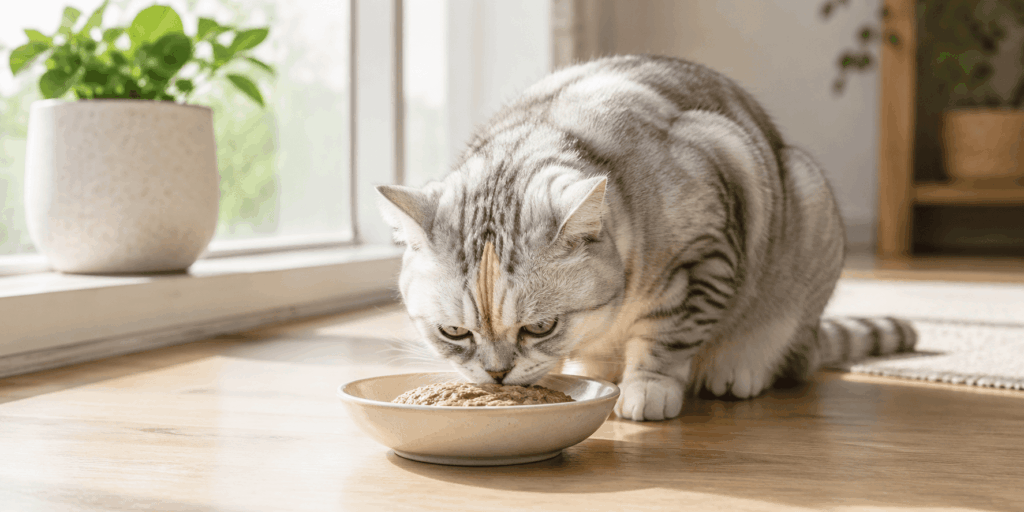
Wet and dry foods can both provide complete nutrition when they are properly formulated. The better choice depends on your cat and your routine. Moisture, calorie density, convenience, cost, and food preference all matter.
| Feeding option | Where it works well | What to watch |
|---|---|---|
| Wet food | Provides plenty of moisture and is easy to portion by can or pouch. Many cats also enjoy the soft texture. | Opened food needs refrigeration. Uneaten food should not sit out for long periods, and cost per calorie may be higher. |
| Dry food | Stores easily and works well in timed feeders or puzzle feeders. Small measured meals are simple to prepare. | Dry food is calorie-dense. A little extra in the scoop can add more calories than expected. |
| Mixed feeding | Combines the moisture of wet food with the convenience of dry food. It can also add texture variety. | Count calories from both foods. Do not add wet food on top of the normal dry portion without adjusting it. |
You do not need to choose one format just because your cat lives indoors. Some cats do very well on wet food. Others thrive on carefully measured dry food. Mixed feeding can work just as well. The main goal is to provide complete nutrition without letting total calories creep upward.
If you use both, decide the daily amount of each before filling the bowl. This is more reliable than adding wet food whenever the dry bowl looks low. It also makes it easier to change the ratio later without accidentally increasing the day’s total calories.
How Much Food Does an Indoor Cat Need?
Think about portion size in calories per day, not only cups, cans, or pouches. Two foods can look similar in the bowl but contain very different calories. As a broad example, WSAVA lists roughly 225–250 kilocalories per day for a healthy 4 kg adult cat in ideal body condition. That is only a starting range.
A small, neutered, quiet indoor cat may need less. A lean and active cat may need more. Check the calorie information on the package before deciding the portion. If one can contains 90 kcal, include those calories in the daily target. Dry food, treats, and toppers must fit into the remaining amount.
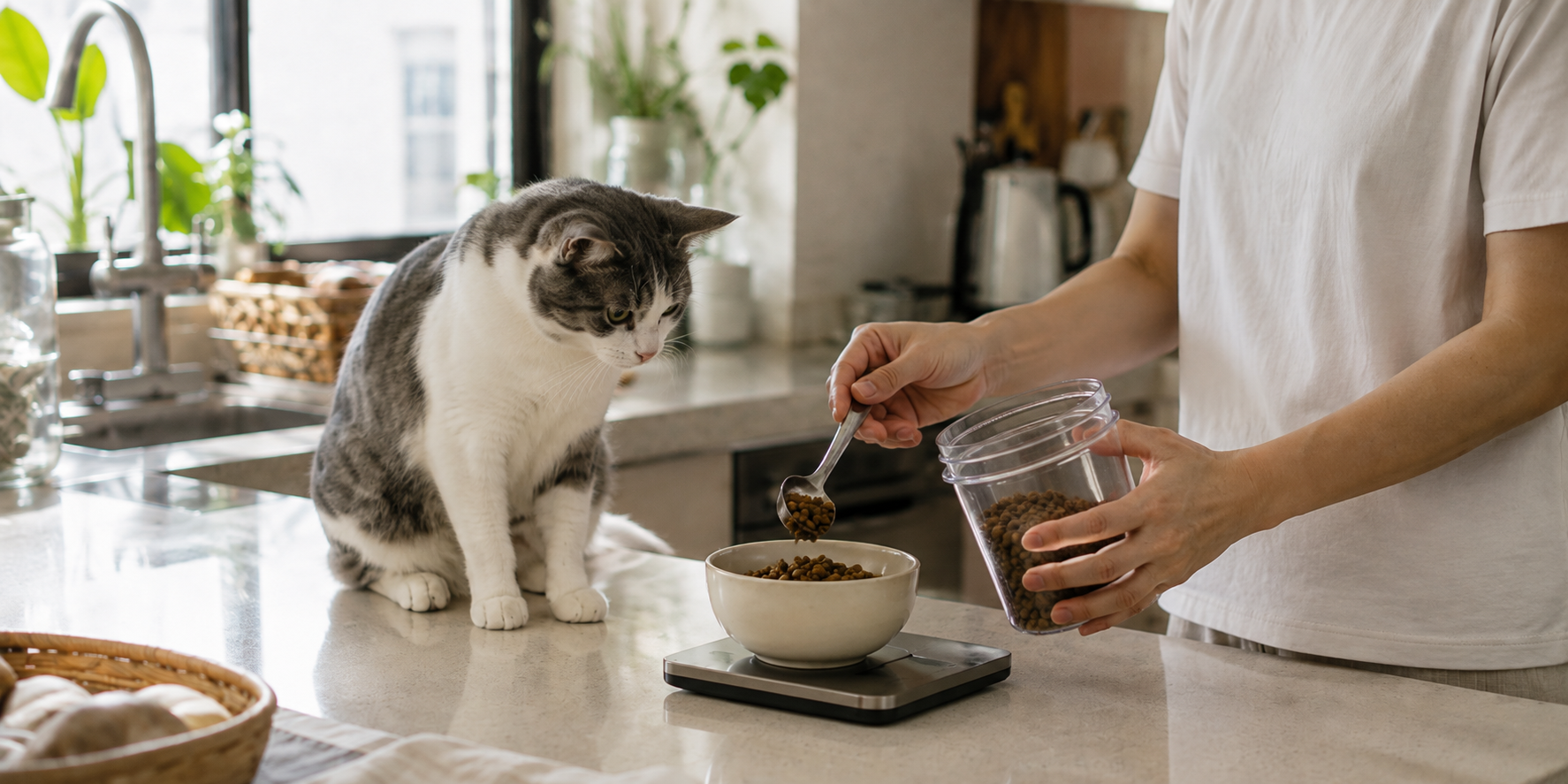
A kitchen scale can make dry-food portions more consistent than a cup or scoop. This is especially useful when the serving is small. Then watch your cat’s body condition and weight trend. You should usually be able to feel the ribs under a light fat covering. A visible waist from above is another useful sign.
Weighing your cat once a month can help you catch gradual changes. If weight rises steadily, reduce calories modestly and reassess. Unplanned weight loss, a major appetite change, or a need for aggressive restriction should be discussed with your veterinarian.
Package feeding guides often use broad weight ranges, so two cats in the same row may still need different portions. Start near the suggested amount, then adjust slowly. Small changes are easier to evaluate than large cuts or sudden increases.
A Simple Indoor Cat Feeding Schedule

A predictable schedule makes portions easier to control. It also turns food into several small activity points during the day.
- Morning: Offer a measured meal, ideally after a short play session.
- Midday: Put part of the daily ration in a timed feeder or puzzle feeder if your cat likes smaller meals.
- Evening: Serve another measured meal after interactive play or normal household activity.
- Before bed: Reserve a small part of the daily food for cats that regularly become hungry overnight.
- All day: Keep fresh water available in a comfortable location. Multi-cat homes may need several feeding and water stations.
Every meal, snack, topper, and puzzle-feeder portion should come from the same daily calorie budget. Four feedings do not mean four full portions. You are dividing the same total amount across the day.
Try to keep the timing reasonably consistent. A timed feeder can help when your work schedule changes. It may also reduce early-morning begging because not every meal comes directly from you.
In multi-cat homes, feeding separately can be useful when one cat eats faster or steals food. It also lets you see who actually finished a meal. That becomes especially helpful if one cat needs a different portion or prescription food.
How Often Should You Feed an Indoor Cat?
Many healthy adult cats do well with two main meals a day. Others prefer three or four smaller feedings. Indoor cats often benefit from measured meals because you can see exactly how much food is offered. Changes in appetite are also easier to notice.
Free-feeding dry food can work for a cat that truly self-regulates and stays lean. However, an always-full bowl makes intake difficult to track. It can also hide gradual weight gain, especially when several people refill the bowl.
If your cat seems hungry between meals, do not immediately increase the daily ration. Move some of the same food into an extra small feeding instead. Puzzle feeders can slow eating and add mental stimulation. A short play session before a meal can also help cats that have learned to ask for food whenever they are bored.
The best schedule is one you can repeat without constantly guessing portions. It should support a healthy weight while keeping food from becoming the only interesting event of the day.
Meal frequency can also depend on how your cat eats. A cat that gulps a large serving and vomits soon after may do better with smaller portions. A slow feeder or puzzle feeder can help too. Repeated vomiting still deserves veterinary attention.
What to Look for on a Cat Food Label
You do not need to decode every ingredient to choose a sensible food. Focus first on details that affect nutrition and portioning.
- Nutritional adequacy: Confirm that the food is complete and balanced for your cat’s life stage.
- Calorie content: Find the kcal per can, pouch, cup, kilogram, or listed serving.
- Feeding directions: Use them as a starting estimate, not an unchangeable rule.
- Life-stage wording: Kitten growth, adult maintenance, and reproduction have different nutritional needs.
- Manufacturer details: Prefer companies that provide clear contact information and can answer nutrition or quality-control questions.
- Special claims: Treat terms such as “indoor,” “hairball,” or “weight control” as features, not proof of a perfect match.
Ingredient lists can still be useful, but they do not tell the whole nutritional story. Ingredients are listed by weight before processing, which makes simple comparisons misleading. Nutritional adequacy, calorie density, your cat’s health, and your cat’s response are better starting points.
Also check whether the package gives calories in a unit you can actually measure at home. If it lists kcal per kilogram only, the manufacturer may provide a per-cup or per-can figure online or through customer support.
Treats, Toppers, and Human Food: Where They Fit
Treats are easiest to manage when they stay a small part of the diet. A common guideline is to keep treats and extras below about 10% of daily calories. For a cat eating 230 kcal a day, that leaves roughly 23 kcal for treats and toppers.
Small extras add up quickly. A few treats after breakfast may seem harmless. So can a spoonful of topper at dinner or extra kibble during play. Together, they may add a meaningful number of calories. One simple trick is to measure the day’s treat allowance each morning. Everyone in the home can then use treats from the same container.
Check calories on packaged treats too. Some tiny treats are surprisingly energy-dense. Large dental treats may contain more calories than expected. If you reward your cat often, use very small pieces or reserve part of the normal kibble ration for training.
Human food should not become the nutritional foundation of the diet. Dog food is also not a suitable long-term replacement. Raw meat and unbalanced homemade diets can create nutritional and food-safety problems. If you want to prepare food at home regularly, ask your veterinarian about a qualified veterinary nutritionist.
Adjusting Food for Kittens, Seniors, and Less-Active Cats
A good feeding plan changes as your cat changes. Kittens need food formulated for growth. They also need more energy relative to their body size than adult cats. Several smaller meals often suit them because they are growing quickly and have small stomachs.
Adult indoor cats often need closer attention to portion size. Activity can drop after neutering, with age, or after a change in routine. Do not assume an “indoor” formula can be left out without limits. Measure the portion and check body condition regularly.
Senior cats need individual attention too. Some become less active and need fewer calories. Others lose weight or muscle and may benefit from a more calorie-dense or highly palatable food. Dental discomfort can also change how a cat eats.
Texture may become more important with age. A cat with mouth pain may approach the bowl but hesitate to chew. Others may eat better when wet food is slightly warmed to release more aroma. New feeding behavior should not always be dismissed as pickiness.
Track appetite, weight, muscle condition, and eating behavior as your cat ages. A noticeable change deserves attention, especially when it appears suddenly.
What to Feed an Indoor Cat When Needs Change
The answer to what to feed an indoor cat should change with the cat. Start with complete and balanced food for the right life stage. Choose wet, dry, or both based on what works in your home. Measure total daily calories, then adjust them as weight, activity, age, or health changes.
Recheck portions whenever you switch foods. If appetite, weight, drinking, vomiting, or chewing changes suddenly, contact your veterinarian rather than relying on another food experiment.
References
- Feeding Your Cat — Cornell Feline Health Center — Practical guidance on feline nutrition, feeding, and body condition.
- Reading Labels — AAFCO — Explains nutritional adequacy, life-stage labeling, calorie information, and feeding directions.
- Calorie Needs for an Average Healthy Adult Cat — WSAVA — Provides starting calorie ranges by body weight for healthy adult cats.
