
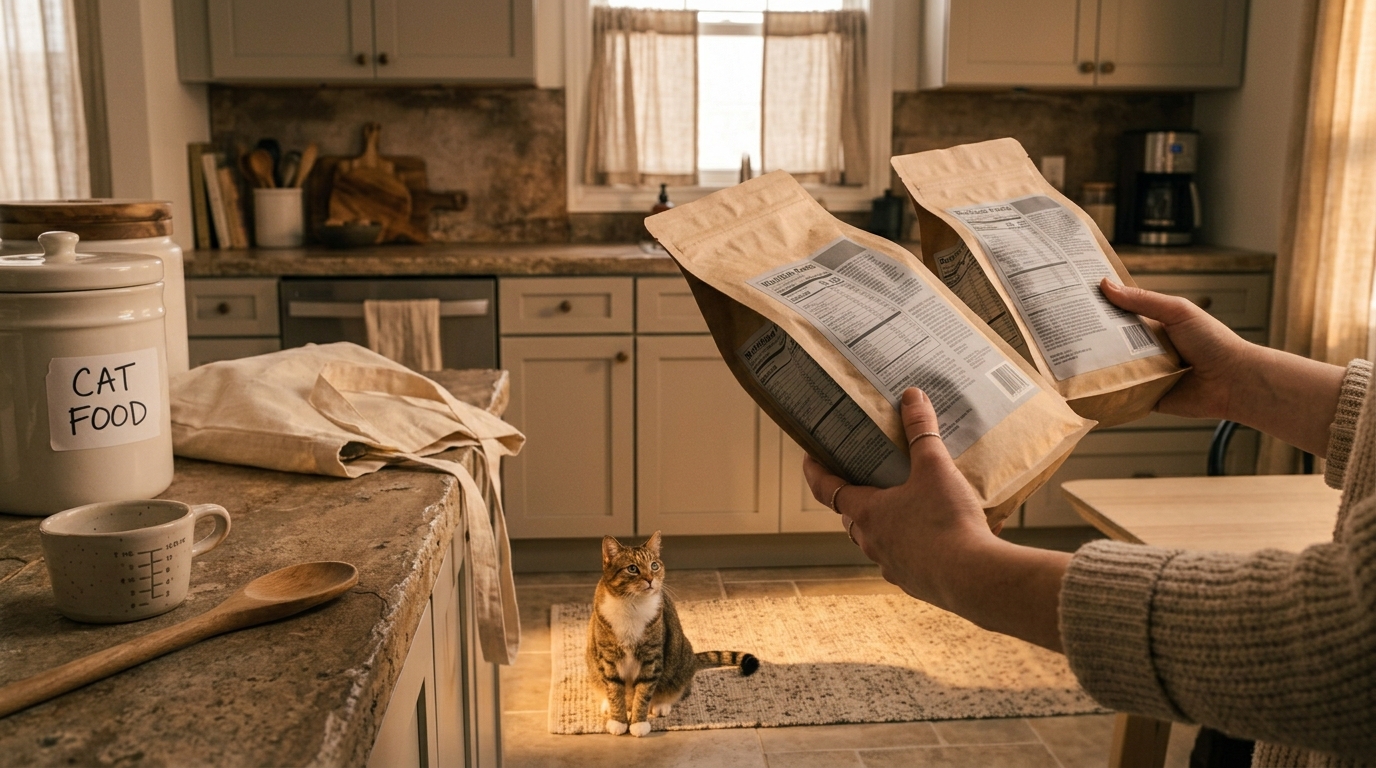
Grain-free cat food versus grain-inclusive food sounds like a simple ingredient debate, but the presence or absence of grain does not tell you whether a diet is complete, appropriately formulated, digestible for your cat, or suitable for its health needs. Cats are obligate carnivores and require nutrients associated with animal tissues, yet that fact does not make every grain-containing food poor quality or every grain-free recipe better. Start with nutritional adequacy, manufacturer quality, calories, life stage, and your cat’s actual response before using “grain-free” as the deciding label.
The term also does not reveal ingredient quality. A grain-free recipe can use excellent raw materials and strong quality control, or it can be poorly formulated. The same is true of grain-inclusive food. Brand practices, formulation expertise, and finished-product testing are separate questions from which starch source appears on the ingredient list.
“Grain-Free” Describes an Ingredient Choice, Not a Quality Grade
Grain-free usually means ingredients such as wheat, corn, rice, barley, or similar grains are omitted and replaced with other carbohydrate or plant ingredients. It does not mean the food contains no carbohydrate, nor does it automatically tell you how much animal protein is present.
Grain-inclusive foods can also vary widely. Two foods that both contain rice may differ in protein sources, calorie density, nutrient formulation, quality control, and digestibility. Treat the front-of-bag phrase as a description, not a shortcut for evaluating the entire formula.
The replacement ingredients matter because “grain-free” is not the same as “plant-free.” Recipes may use potatoes, peas, lentils, tapioca, or other starch sources for processing and texture. That is another reason the label claim alone tells you little about the finished nutrient profile.
Grain-Free Cat Food Still Starts With Complete Nutrition
Look for a nutritional adequacy statement indicating that the food is complete and balanced for the relevant life stage. FDA guidance explains that this statement is more useful for nutritional adequacy than promotional seals or marketing language.
Then look at calories and the manufacturer’s nutritional information. WSAVA recommends evaluating who formulates the diet, quality-control practices, whether the company can provide nutrient data, and how clearly it communicates with consumers. These questions apply equally to grain-free and grain-inclusive products.
A complete-and-balanced claim does not mean every food is ideal for every cat. Calorie density, digestibility, palatability, medical needs, and body condition still matter. The point is that nutritional adequacy is a better first filter than whether the package highlights the absence of one ingredient group.
Protein percentage should also be interpreted carefully when comparing wet and dry foods. Moisture makes the “as fed” numbers look very different. FDA guidance shows why nutrients may need to be compared on a dry-matter basis when moisture levels differ substantially. The front label cannot replace that context.
Cats Need Animal-Derived Nutrients, but That Is a Different Question
Cats are obligate carnivores. They need specific nutrients found naturally in animal tissues and have higher protein requirements than many other species. That biological fact is important, but it does not translate into a rule that grains are inherently inappropriate in every commercial diet.
A complete food is formulated to deliver required nutrients in the correct balance. When deciding what to feed an indoor cat day to day, the meaningful question is whether the finished diet meets nutritional needs and suits the individual cat, not whether one ingredient category appears on the label.
Obligate carnivore biology is sometimes used in marketing to imply that any plant ingredient is biologically inappropriate. The more precise interpretation is that cats require nutrients that must be supplied in appropriate amounts. Commercial formulations can include plant ingredients while still meeting those requirements when the finished diet is properly formulated.
If symptoms improve after a diet change, that still does not prove grain was the problem. The new food may have changed the animal protein, additives, fat level, or several other ingredients at once. A controlled elimination and challenge process is what allows a veterinarian to identify a likely dietary trigger with more confidence.
Do Not Diagnose a Food Allergy From the Word “Grain”
Food allergy can cause skin or gastrointestinal signs, but identifying the trigger requires a structured veterinary approach. Cornell describes elimination or novel-diet trials as a way to investigate suspected food allergy after other causes are considered.
Switching to a random grain-free food does not identify the allergen because the new diet usually changes many ingredients at once, including animal proteins. If your cat has chronic itching, skin lesions, vomiting, diarrhea, or another suspected food reaction, work with your veterinarian on a controlled trial rather than relying on a marketing category.
A genuine elimination trial is much stricter than simply buying a bag with “grain-free” on the front. Treats, flavored medications, table food, and other exposures can interfere with interpretation. If allergy is the concern, use the diet and duration your veterinarian recommends so the result can actually answer a question.
Marketing terms such as “natural,” “premium,” or “ancestral” can sit beside grain-free claims and make the package feel more evidence-based than it is. WSAVA specifically recommends focusing on information that reflects formulation and quality control. A polished ingredient story is not a substitute for nutritional expertise.
Compare the Finished Food, Not Just the Ingredient List

Ingredient lists are ordered by weight before processing, which can make them difficult to use as a simple quality score. WSAVA specifically cautions that ingredient lists can be misleading when owners try to judge overall nutritional quality from them alone.
- Check the nutritional adequacy statement.
- Confirm the food matches your cat’s life stage.
- Compare calories per can, cup, pouch, or gram.
- Ask whether the manufacturer employs qualified nutrition expertise.
- Look for clear quality-control and contact information.
- Monitor body condition, stool, coat, appetite, and weight over time.
These checks tell you more than whether peas replaced rice or whether corn appears on the ingredient panel.
Ask what changed between formulas. If the new food uses a different protein, fat level, fiber source, moisture level, and calorie density, you cannot attribute a stool or coat change to grain status alone. Multiple variables moved at once, which is common in real-world diet switches.
Weight trends provide useful feedback after any diet change. Weigh your cat under similar conditions every few weeks and look at body condition, not just appetite. A food that is eagerly eaten can still be too calorie-dense for the current portion. Conversely, a cat losing weight on a new diet may not be eating enough of it.
Calories Can Change Even When the Marketing Claim Does Not
A grain-free food can be more calorie-dense, less calorie-dense, or similar to a grain-inclusive food. The label claim alone gives no answer. Indoor cats are vulnerable to gradual portion creep because small calorie differences matter when daily energy needs are modest.
Compare the serving based on calories, not the scoop volume used for the previous food. If you switch formulas, weigh or measure the new ration and track body condition. A “healthier sounding” ingredient list does not protect against overfeeding.
Portion labels can also differ between products. Start with the new food’s calorie information, then adjust based on body condition and weight trends rather than keeping the same cup volume automatically. This matters most with dry foods, where a small volume difference can carry many calories.
The same caution applies to cats with gastrointestinal disease or suspected food sensitivity. A veterinary hydrolyzed or novel-protein diet is chosen for a specific clinical reason. An over-the-counter grain-free product is not an equivalent substitute simply because it removes wheat or corn.
Medical Diets Should Not Be Replaced for Ingredient Philosophy
If your cat is eating a therapeutic diet for urinary disease, kidney disease, diabetes, gastrointestinal disease, or another condition, the medical goal comes first. Do not swap it for a grain-free over-the-counter formula because the front label sounds cleaner.
Therapeutic foods may be designed around nutrient levels, urine characteristics, energy density, fiber, digestibility, or another clinical target that is not obvious from the ingredient list. Ask the prescribing veterinarian before replacing or combining a medical diet.
For urinary diets in particular, the intended mineral and urine effects may be central to the treatment plan. For kidney diets, phosphorus and other nutrient targets matter. Those clinical goals cannot be evaluated from the phrase “grain-free,” so ingredient philosophy should not displace the reason the diet was prescribed.
Palatability matters because a nutritionally sound food is only useful if the cat eats enough of it. If a grain-free formula causes persistent refusal, do not keep reducing options in pursuit of the label. Cats can develop serious problems when intake falls substantially. A suitable diet must work nutritionally and practically.
Switch Diets Gradually and Judge the Result
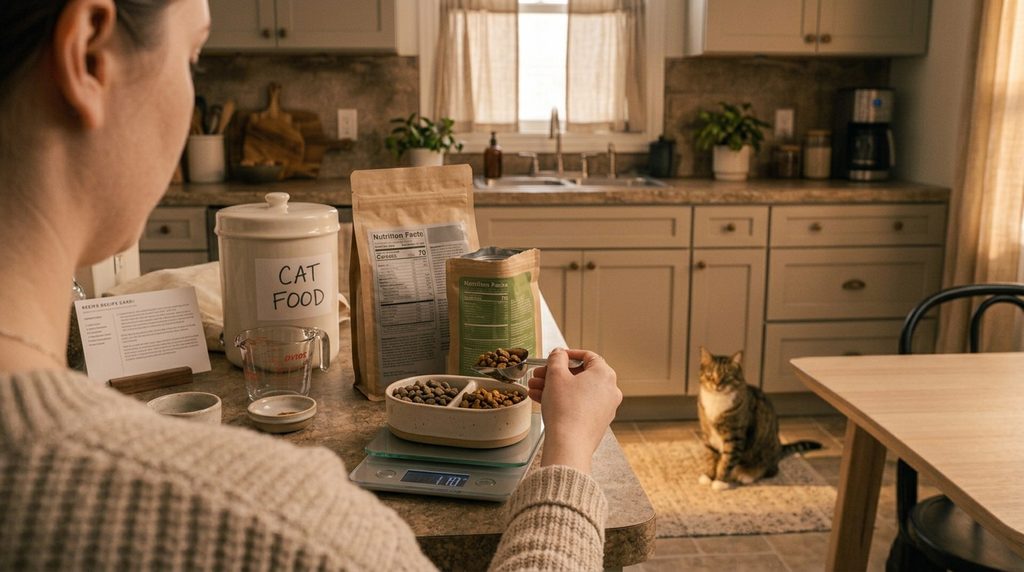
When both foods are appropriate and your cat is healthy, transition gradually rather than changing the entire bowl overnight. A slow shift makes digestive changes easier to interpret and can reduce rejection caused simply by unfamiliar smell or texture.
Watch appetite, stool, vomiting, body weight, and skin over the following weeks. Do not credit or blame the grain label for every change. The new formula may differ in fat, fiber, calorie density, protein sources, texture, or palatability at the same time.
Keep the old package or photograph the label during a transition. If problems develop, the ingredient list, calorie statement, guaranteed analysis, and lot information can help you and your veterinarian compare what changed. A clear record is more useful than remembering only that one bag was grain-free.
Price is another weak quality shortcut. A more expensive grain-free bag is not necessarily a better nutritional match, and a moderately priced grain-inclusive food is not automatically inferior. Spend attention on formulation, calories, feeding response, and manufacturer transparency before treating price or ingredient fashion as evidence.
A practical final check is whether you can explain why you chose the food without using the phrase “grain-free” or “contains grains.” If the answer is complete nutrition, appropriate calories, good manufacturer information, healthy body condition, reliable appetite, and veterinary fit, you are using stronger criteria than a single ingredient category.
If your cat is healthy and thriving on a grain-inclusive complete diet, there is no nutritional requirement to change simply because grain-free products are popular. Likewise, a suitable grain-free food does not need to be abandoned merely to include grains. Judge the individual food and the cat’s response.
Choose the Diet on Evidence, Not the Front of the Bag
There is no general rule that grain-free cat food is healthier than grain-inclusive food for all cats. Both categories can contain suitable or unsuitable products. Start with complete and balanced nutrition, life stage, manufacturer transparency, calories, and the cat’s health.
If a veterinarian suspects a food allergy or recommends a therapeutic diet, follow that structured plan. Otherwise, choose a nutritionally appropriate food your cat eats well and maintains healthy body condition on. The goal is a reliable diet, not winning an ingredient-label argument.
References
- “Complete and Balanced” Pet Food — FDA — Explains nutritional adequacy statements and how to compare pet foods beyond marketing language.
- Guidelines on Selecting Pet Foods — WSAVA — Provides practical criteria for evaluating manufacturers, nutritional expertise, labels, calories, and quality control.
- Food Allergies — Cornell Feline Health Center — Describes feline food-allergy signs and the role of structured elimination or novel-diet trials in identifying triggers.
