

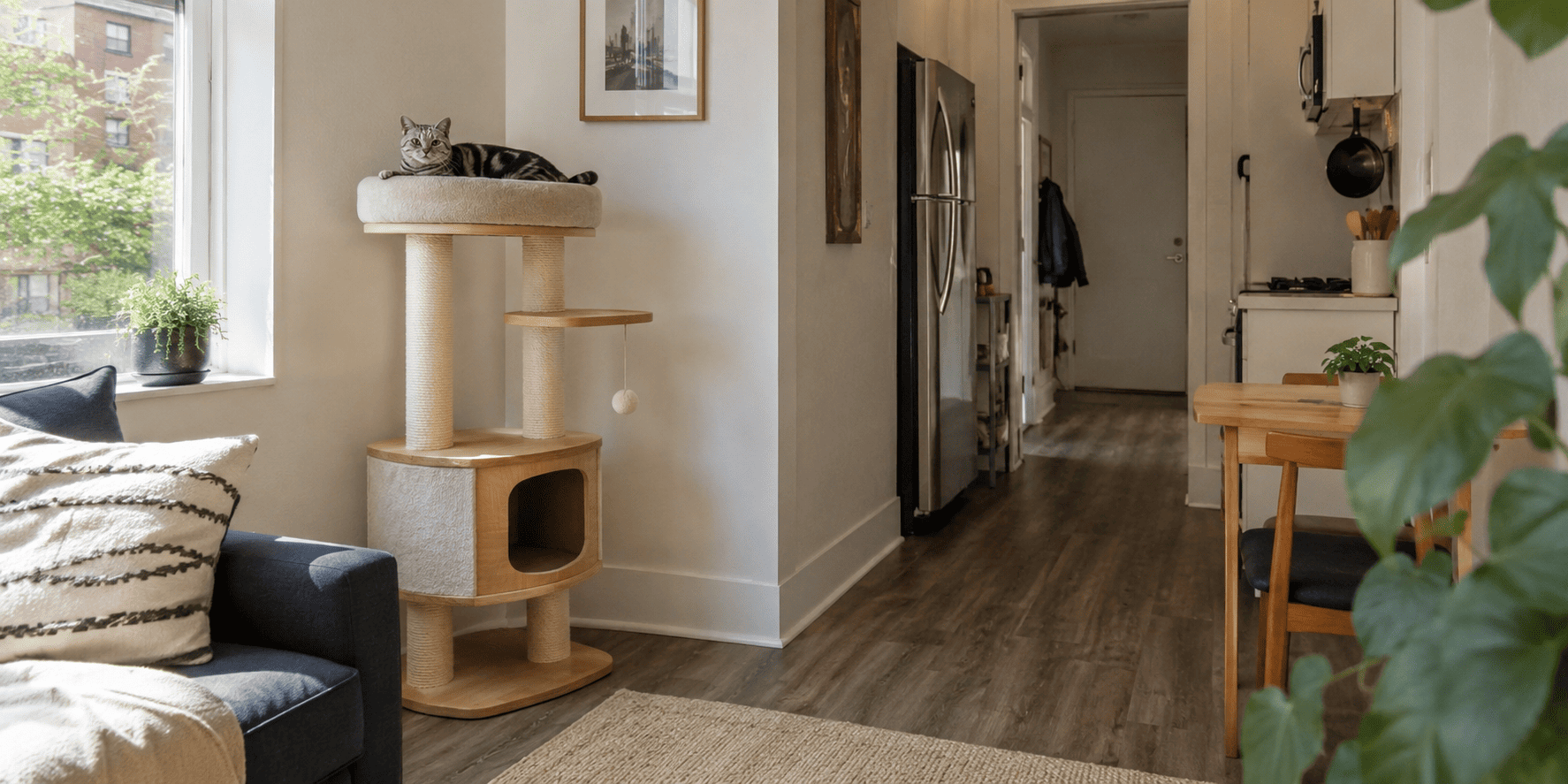
A good small apartment cat tree uses vertical space efficiently without becoming unstable, blocking human circulation, or offering platforms too small for the cat. A narrow footprint can be useful, but “space-saving” should not mean a tall wobbly column with tiny steps. The right tree earns its floor area by doing several jobs well: climbing, resting, scratching, observation, and sometimes creating a route to a window or shelf. Start with the exact corner and the cat’s movement pattern before comparing product height.
Measure ceiling height too. Low beams, ceiling fans, curtain rods, and shelves can interfere with tall structures. Leave enough clearance above the top perch for the cat to sit upright comfortably. A tower that technically fits under the ceiling but gives no headroom wastes the highest platform.
Use furniture overlap carefully. A tree can sometimes occupy space beside a sofa arm or at the end of a cabinet without narrowing the main walkway. The goal is to share visual space without sharing unstable support. Do not lean the tree against furniture and assume the furniture will keep it upright.
Measure the Floor Footprint and the Traffic Around It
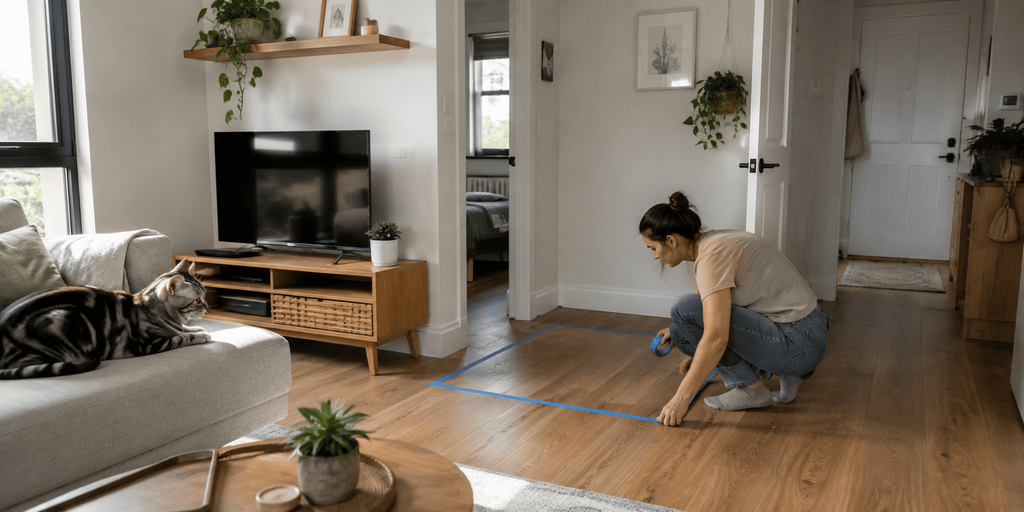
Mark the proposed footprint with tape or cardboard before buying. Then walk around it for a day. If the outline blocks a drawer, chair, doorway, or the route between bed and kitchen, the finished tree will be frustrating no matter how attractive it looks.
Include the space the cat needs to jump on and off. A tree squeezed exactly between furniture can create awkward landings. Small apartments benefit from precise measurement because a few centimeters can determine whether the tree works with daily life.
Corner placement can improve stability because two walls reduce the direction of movement, but do not rely on walls to compensate for a weak frame. The tree should still stand securely on its own before anchoring. Uneven floors and thick rugs can also create wobble, so test the exact surface where it will live.
Freestanding tension-pole trees can save floor area, but they must match ceiling construction and be installed exactly as directed. Recheck tension periodically. A product that relies on pressure against the ceiling is only space-efficient if that pressure remains secure under repeated climbing and household vibration.
Small Footprint Does Not Mean Narrow Base at Any Cost
Tall slim trees save floor area by moving mass upward, which can make stability more challenging. Look for a broad enough base, strong vertical supports, and wall anchoring when appropriate. Stability should be tested near the top, not only by pressing on the bottom platform.
A shorter tree with a slightly wider base may be safer and more useful than a dramatic ceiling-height model that flexes. If wall mounting is allowed, secure attachments can help. Renters should confirm wall type and lease restrictions before drilling.
Think of route width, not only vertical spacing. A cat turning around on a narrow shelf may step off accidentally or choose not to use it. Wider intermediate platforms create confidence without requiring more floor area because they extend above the base rather than expanding the whole footprint.
A Small Apartment Cat Tree Needs a Useful Vertical Route
Height only matters when the cat can use it. Staggered steps, reachable platforms, and enough room to turn create a practical route. A vertical tower with widely spaced ledges may look efficient on paper but require difficult jumps.
Consider how the tree connects with the rest of the home’s cat-friendly layout. A medium tree beside a secure windowsill or low cabinet can create more usable territory than an isolated tall structure in a dead corner.
One roomy lower cubby can double as a hidden resting place. A side-mounted scratch panel may save a separate floor scratcher. These combinations are useful only when each component meets the cat’s real size and behavior. Tiny multifunction features often save space on paper but fail in practice.
Storage built into the base sounds efficient, but it should not compromise stability or create a door that opens into the cat’s route. If a hollow base is designed for storage, keep heavy items low and make sure opening it does not require moving the entire tree. Convenience should not reduce structural safety.
A built-in feeding shelf is usually less useful than a good scratcher or perch because food placement needs may change and bowls require frequent cleaning. In small spaces, prioritize permanent features that support behaviors all day rather than features tied to one short routine.
Choose Features That Replace Other Objects
In a small apartment, one piece of furniture should earn its footprint. A tree with a genuinely good scratch surface may reduce the need for a separate vertical post. Likewise, a roomy top perch can replace an extra cat bed. A stable step can make a window easier to reach.
Do not count decorative features that your cat will not use. Tiny hanging toys, miniature cubbies, and short scratch posts add marketing value but may not save meaningful space. Judge each feature by whether it replaces another object or adds a behavior opportunity.
Measure your cat while it is curled in a favorite bed. That resting footprint gives a realistic minimum for the main perch. Add a little margin for turning and stretching. This simple measurement is more reliable than choosing a platform based on breed labels or manufacturer photos.
Hammocks are another space-efficient feature, but check how they are attached. A sagging sling may fit a cat well while an undersized rigid ring does not. If the hammock is removable, that is useful for washing and eventual replacement. Soft components often wear faster than the frame.
Perch Size Matters More When You Only Have One Main Tree
If the apartment has room for only one tree, the main resting platform should fit the adult cat comfortably. Check the flat usable dimensions inside any raised rim. Kittens make small perches look generous in product photos.
A cat should be able to turn and curl without constantly balancing over an edge. Large cats may need a wider tree even if it uses more floor area. Buying a compact model that the cat cannot sleep on wastes more space than a slightly larger model that becomes a daily favorite.
Window glare and seasonal sun can change use. A perch that is pleasant in winter may become hot in summer. If the tree is heavy and difficult to move, choose a location with shade options or curtains that can be managed safely without dangling cords near the climbing route.
Do not block the only easy route to curtains or windows you open regularly. If the tree must be moved every time you clean glass or use the blinds, it will eventually end up elsewhere. Choose a position that works with normal human use of the window as well as the cat’s view.
Use the Window, but Check the Whole Jump Map
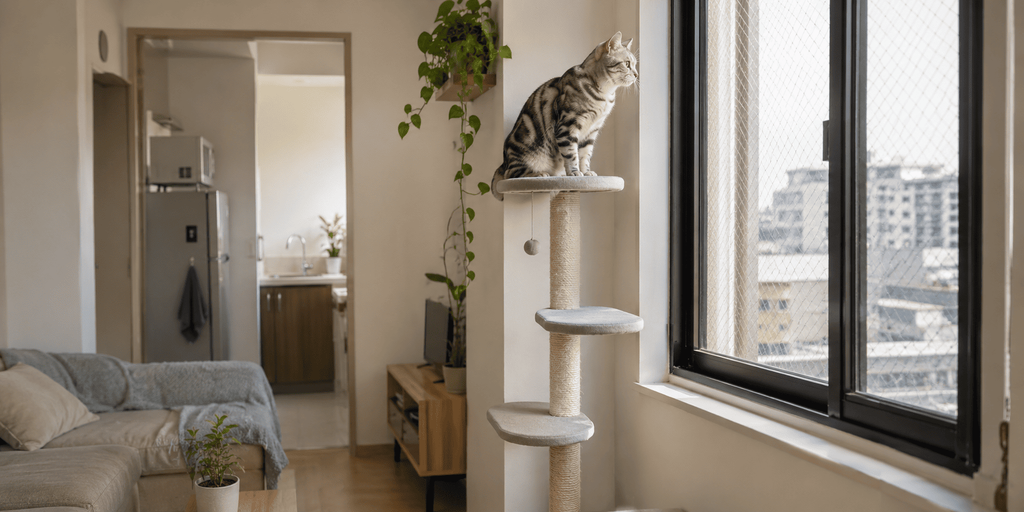
A window can make a modest tree much more valuable because the cat gains a view and a destination. Place the tree close enough for comfortable observation without creating access to unsafe openings, blind cords, unstable shelves, or breakable items.
Look at every upper platform as a launch point. In a small room, one jump can reach a kitchen counter, wardrobe, or shelf that was previously inaccessible. Move hazards before the cat discovers the route.
For seniors, a tree can remain useful even when the top levels are no longer appropriate. Choose models whose lower platforms still function as beds or steps. A structure that offers value at multiple heights adapts better as mobility changes than one designed around a single spectacular top perch.
Choose a Different Design for Seniors and Large Cats
- Seniors: Prefer lower height changes, wider steps, traction, and easy descent routes.
- Large cats: Prioritize platform size, strong supports, and a stable base.
- Kittens: Use safe spacing and stable surfaces while coordination develops.
- Multi-cat homes: Look for more than one resting level and more than one route.
- Renters: Favor freestanding stability if secure wall attachment is not possible.
The “small apartment” label should not override the cat’s body. Compress decorative features before compressing safe movement space.
Check whether fabric panels can be removed or whether every surface is permanently stapled. In a small apartment, odors and dust are more noticeable because the tree shares air with the entire living area. Easy maintenance helps the structure remain acceptable to both the cat and the people sharing the room.
Color and shape matter only after function, but they can affect whether the tree stays in the useful room. If you know a bulky design will be moved away from the window because it dominates the space, choose a simpler structure you are comfortable leaving in the best location. Human acceptance is part of long-term placement.
Cleaning and Visual Clutter Affect Whether the Tree Stays
A tree that traps fur and is difficult to vacuum can make a small home feel messy quickly. Removable cushions, accessible platforms, and replaceable scratch material are valuable because the structure is always visible in the living space.
Neutral visual design may matter to the human, but cleaning function matters more. A tree you resent maintaining is more likely to be moved into a less useful location. Choose materials you can realistically vacuum, wipe, or replace.
Consider modular systems if your layout may change. A compact freestanding base with replaceable posts or add-on shelves can adapt better than one oversized fixed tower. The important point is not modularity itself but avoiding furniture that only works in one exact corner of one exact room.
Before ordering, write down three non-negotiables and three optional features. For example: stable base, 40-centimeter perch, and replaceable scratch surface may be essential; hammock, cave, and toy may be optional. This keeps small-space shopping focused when product pages compete by adding more features.
If two models meet the same functional needs, choose the one that leaves more open floor for play and movement. Vertical furniture should increase usable territory, not consume every remaining clear surface. The best small-space tree makes the apartment feel bigger to the cat without making it feel smaller to the people.
After installation, watch which levels the cat uses for a week. If the top perch is ignored but the middle shelf becomes a favorite, that is not failure. Use tells you what the structure is really providing, and future purchases can follow that evidence instead of the product description.
Buy the Tree That Makes the Apartment Work Better
The best small-apartment cat tree is not the narrowest object in the catalog. It is the structure that adds useful height, fits the cat’s body, remains stable, and integrates with the room without disrupting everyday movement.
Measure the corner, map the jumps, identify which functions need to be combined, and choose the simplest tree that meets those needs. In a small home, every object should earn its footprint—and cat furniture is no exception.
References
- Meeting the Physical and Emotional Needs of Indoor Cats — FelineVMA — Current guidance on vertical space, scratching, safe places, play, and environmental choice indoors.
- AAFP/ISFM Environmental Needs Guidelines — FelineVMA — Evidence-based framework for elevated resting areas, safe spaces, scratching, and environmental resources.
- Home Modifications for Your Cat — Cat Friendly Homes — Practical advice on steps, ramps, mobility, and making resting places accessible as cats age.
