

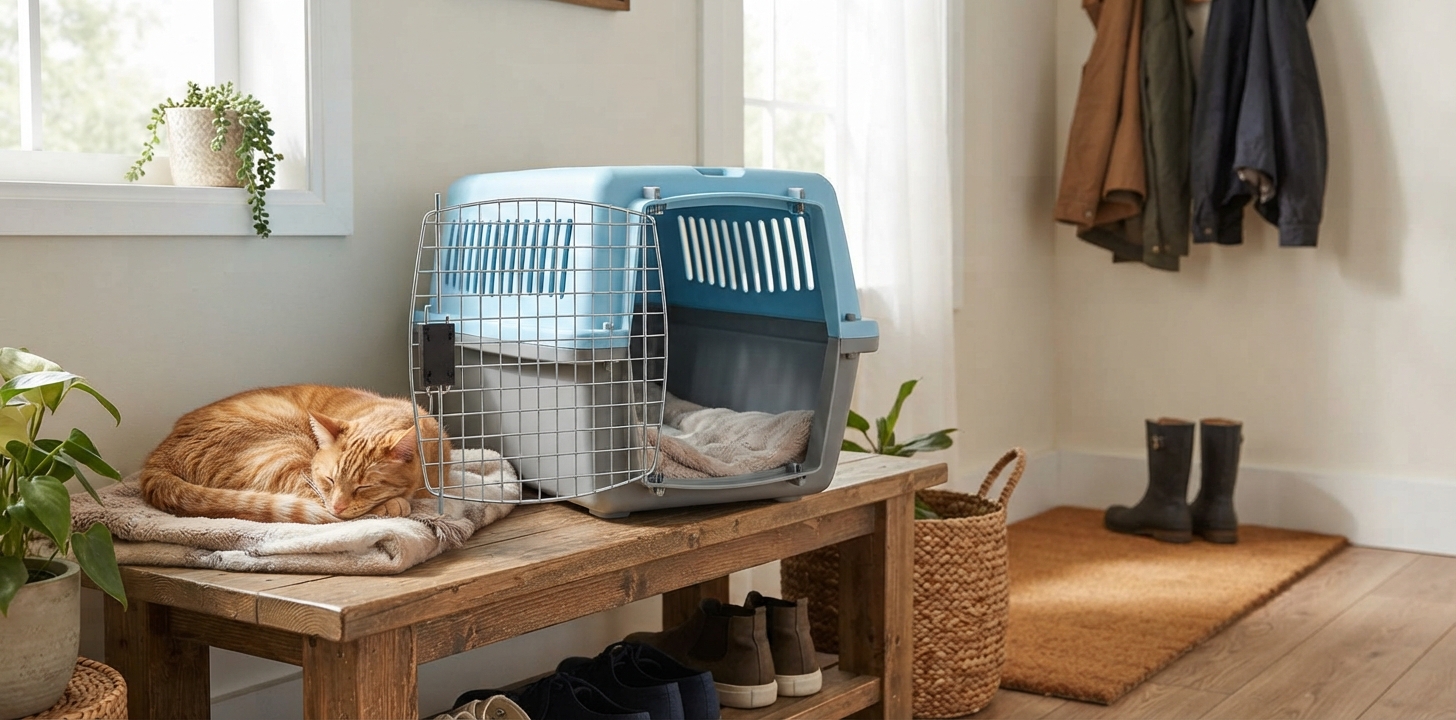
The best hard-sided cat carriers make loading, cleaning, and veterinary handling easier without compromising security. For most cats, the useful features are not decorative. Look for a rigid shell, secure door, good ventilation, and a base that stays level. The opening should also be wide enough that you do not have to push a reluctant cat through it. Top-loading or removable-top designs are especially valuable because they create more options at home and at the clinic. Current models such as Petmate’s E-Z Load kennels and Ferplast’s Atlas Open solve those problems differently. The right choice depends on your cat’s size, handling style, and storage needs.
| Carrier | Best for | Key advantage |
|---|---|---|
| Petmate E-Z Load Two Door Dog & Cat Kennel | Most routine vet trips | Front plus top access in a rigid plastic body |
| Petmate E-Z Load Top Load Cat Kennel | Cats easier to lower from above | Purpose-built top-loading access |
| Ferplast Atlas Open | Handling flexibility and removable top | Top grid opens and shell disassembles for cleaning |
| SportPet Travel Master Collapsible Carrier | Storage-limited homes and larger cats | Hard-sided structure that folds down between trips |
Do not pick by brand name alone. Measure the cat and compare the usable interior, door opening, weight limit, and handle design. A carrier can be rated for a cat’s weight yet still be too short for comfortable turning or too narrow for an anxious cat to enter voluntarily.
Petmate E-Z Load Two Door Is the Most Versatile Everyday Layout
Petmate currently lists its E-Z Load Two Door Dog & Cat Kennel within its plastic kennel line. The layout works well because a confident cat can walk through the front. The top door gives you another route when the cat will not. At a clinic, top access can also allow partial examination without dragging the cat through the front opening. A rigid lower shell catches urine or vomit more reliably than mesh-sided fabric and can be washed after the trip.
Check the exact size rather than assuming “cat kennel” means one standard interior. Add a thin towel or non-slip pad so the cat is not sliding on bare plastic. Avoid a thick cushion that reduces headroom or prevents the top latch from closing cleanly. Before every trip, lift the loaded carrier a few centimeters and confirm the doors stay secure.
Petmate E-Z Load Top Load Cat Kennel Is Good for Cats That Resist Front Entry
Some cats brace all four feet against a front opening the moment they see it. A large top door changes the geometry. You can lower a calm cat hind end first, or encourage the cat to step down into the carrier when it is already part of the room. Top loading should not become a wrestling technique. Its advantage is simply that you have another option besides pushing from behind toward a narrow doorway.
This model makes most sense for small-to-medium cats that fit comfortably within its listed dimensions. Larger cats need a carrier that allows a natural sitting position and enough room to turn. If the cat’s shoulders scrape the opening or the body has to curl tightly just to fit, choose a larger carrier even if the weight rating technically allows the cat.
Ferplast Atlas Open Is Strong When Removable-Top Handling Matters
Ferplast’s Atlas Open is a rigid plastic carrier with a front metal door, an opening top grid, side ventilation, snap latches. And a shell that can be disassembled for cleaning. The manufacturer currently lists Atlas 10 Open for animals up to 5 kg, Atlas 20 Open up to 8 kg. And Atlas 30 Open up to 12 kg. Those limits are useful, but body dimensions still matter. A long, broad cat may need the next size even when under the weight maximum.
The removable or openable upper section is especially useful for fearful cats that settle in the lower half. Cat-friendly veterinary handling often aims to examine a cat in the carrier base when possible rather than forcing removal. A carrier that allows access without tipping the cat out can therefore be more than a transport box. It can become part of lower-stress handling.
SportPet Travel Master Solves the Storage Problem Differently
Hard carriers are bulky, which becomes a real constraint in apartments. The SportPet Travel Master collapsible hard-sided carrier uses plastic and steel construction and folds down for storage. Current listings show a large version around 18.5 by 15.25 by 14.25 inches and an X-large around 23.13 by 17.25 by 18.75 inches. Its wide side-opening door is designed to let cats walk in rather than squeeze through a small front gate.
The compromise is that a collapsible design has more moving parts than a conventional two-piece shell. Practice assembling and locking it before you need it. Check every connection point and door lock after storage. If you have a very heavy or highly escape-motivated cat, inspect the structure carefully under load rather than assuming “hard-sided” automatically means equally rigid in every model.
Choose the Door Configuration Before You Choose the Color
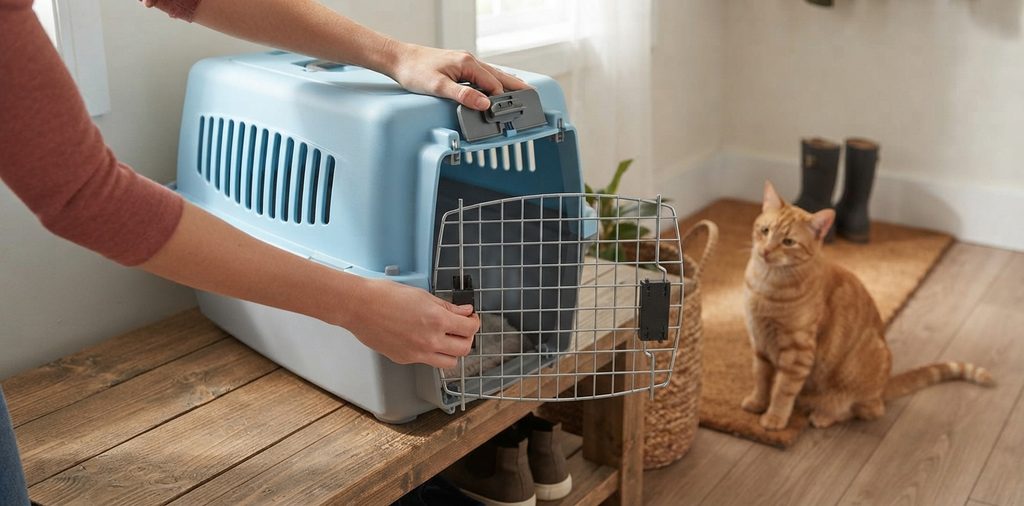
Door layout changes how you will use the carrier in a stressful moment. A front-only door works well for cats trained to enter voluntarily. Top access is helpful for cats that tolerate being lowered. A removable top is excellent when the veterinary team can work with the cat in the lower half. Wide side doors can help larger cats enter without crouching. The most flexible carriers give you at least two of these options.
- Front door: best for voluntary walk-in training.
- Top door: useful when gentle lowering is easier than front loading.
- Removable top: valuable for fearful or painful cats during examinations.
- Wide side opening: useful for large cats and cats that dislike narrow thresholds.
- Secure rigid base: important for stable carrying and accident cleanup.
This is why functional cat equipment that solves a real handling problem is more valuable than buying travel gear for appearance.
Large cats need special attention to the opening, not just the interior. Measure shoulder width and compare it with the narrowest part of the door. A broad Maine Coon may fit once inside but resist a front opening that requires twisting. In that case, a wide side door or fully removable top can matter more than an extra inch of floor length.
Fit the Carrier to the Cat You Actually Have
A carrier should be large enough for the cat to stand in a normal crouch or sit, turn around, and settle on the base. Oversizing can also be unhelpful if the cat slides around during transport. So choose usable room rather than maximum empty volume. For a large cat, pay attention to door dimensions and handle placement. A strong shell with a narrow top opening can still be awkward if the cat’s shoulders barely clear it.
Weigh the carrier itself too. A 7-kg cat in a heavy plastic kennel becomes a very different load when carried from a parking lot. A sturdy handle that keeps the carrier level matters. Some people find it safer to support the bottom with the other hand instead of letting the entire load swing from one handle. Never lift by a door or top panel unless the manufacturer explicitly designed it for that purpose.
Line the base with something that prevents sliding but does not block ventilation or latches. A thin fleece over an absorbent pad works well for many cats. Bring a spare liner in a sealed bag for the return trip. If the cat urinates from stress, replacing the wet layer can make the ride home much more comfortable.
Turn the Hard Carrier Into Furniture Before Vet Day
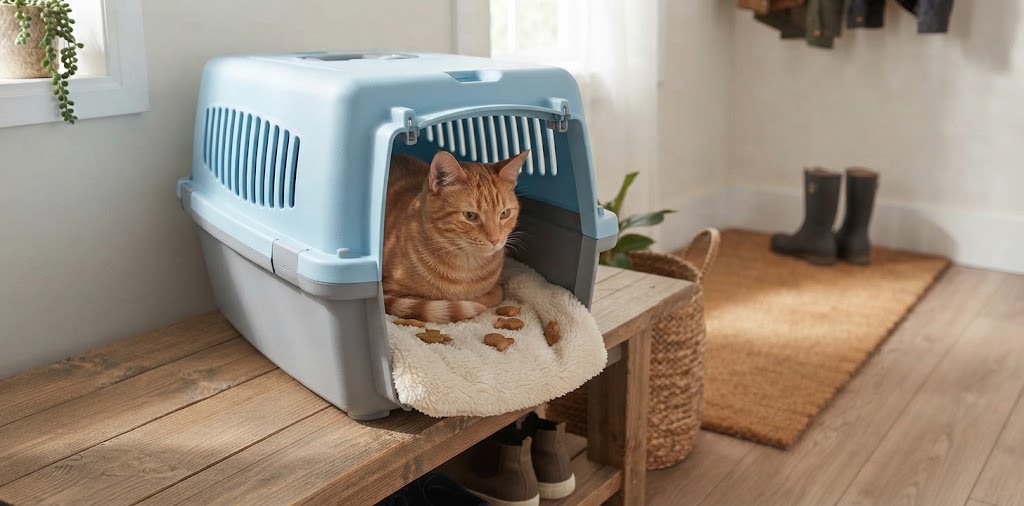
The best carrier cannot help much if it lives in a closet and appears only before an appointment. Leave it open in a familiar room with bedding that smells like home. Feed treats nearby, then inside. If the top removes, begin with the lower half as a bed. Once the cat enters casually, practice closing the door briefly, lifting the carrier, and setting it down again without leaving the house.
That progression changes the emotional meaning of the object. Carrier training is not about tricking the cat on appointment day; it is about reducing the number of unfamiliar events stacked together. Cat Friendly Homes recommends acclimating cats to the carrier well before veterinary visits. A rigid carrier with flexible access is especially useful because it can stay open as a resting space without collapsing around the cat.
Car travel adds one more fit question: can you secure the carrier so it does not become a projectile during sudden braking? Follow the carrier and vehicle manufacturer’s guidance rather than improvising with a seat belt through a handle that was not designed as a restraint point. Keep the carrier level, avoid the front seat because of airbags, and do not open the door in an unsecured parking area. A frightened cat can escape faster than most people expect.
For air travel, “hard-sided” alone does not mean airline approved. Cabin and cargo requirements vary by airline, aircraft, route, and destination. Check the airline directly before buying for a flight. A carrier that is excellent for veterinary visits may be too tall for cabin dimensions or lack required hardware for another travel mode.
Cleaning and Hardware Checks Matter More With a Long-Lived Carrier
Hard-sided carriers can last for years, which means latches, bolts, plastic tabs, and door hinges deserve periodic inspection. Wash the shell after accidents with a mild pet-safe cleaner and rinse thoroughly. Remove bedding before storage if it is damp. If the carrier separates into top and bottom halves, confirm every fastener is fully seated after reassembly. Plastic can crack with age, impact, or heat exposure.
Before each trip, close every door and pull gently against the latch from the outside. Check the handle and the points where it attaches to the shell. If a metal door is bent or a plastic hinge has whitened or split, replace the damaged part or carrier. The right time to discover a weak latch is at home, not in a parking lot with a frightened cat inside.
The Best Hard-Sided Cat Carrier Is the One That Improves Handling
For most cats, a two-door or removable-top rigid carrier is the strongest default. Petmate’s E-Z Load designs are practical for flexible loading, Ferplast Atlas Open adds excellent top access and disassembly, and SportPet’s collapsible design addresses storage in a way conventional kennels do not. None is universally best. A large cat, an arthritic cat, and a confident kitten may need very different openings and interior dimensions.
Choose around the hardest part of travel for your household. If loading is the problem, prioritize access. For cats that have accidents, prioritize cleaning. If the cat is examined while frightened, prioritize a removable top. When storage is scarce, consider collapsible rigidity. When the carrier fits the cat and becomes a familiar part of the home, the product is doing more than containing the animal—it is reducing friction before the trip even begins.
References
- Cat Friendly Homes — Your Role in Veterinary Visits — Feline-veterinary guidance for home care and behavior.
- Petmate — E-Z Load Two Door Dog & Cat Kennel — Current manufacturer specifications and dimensions.
- Ferplast — Atlas Open — Current manufacturer specifications and features.
