
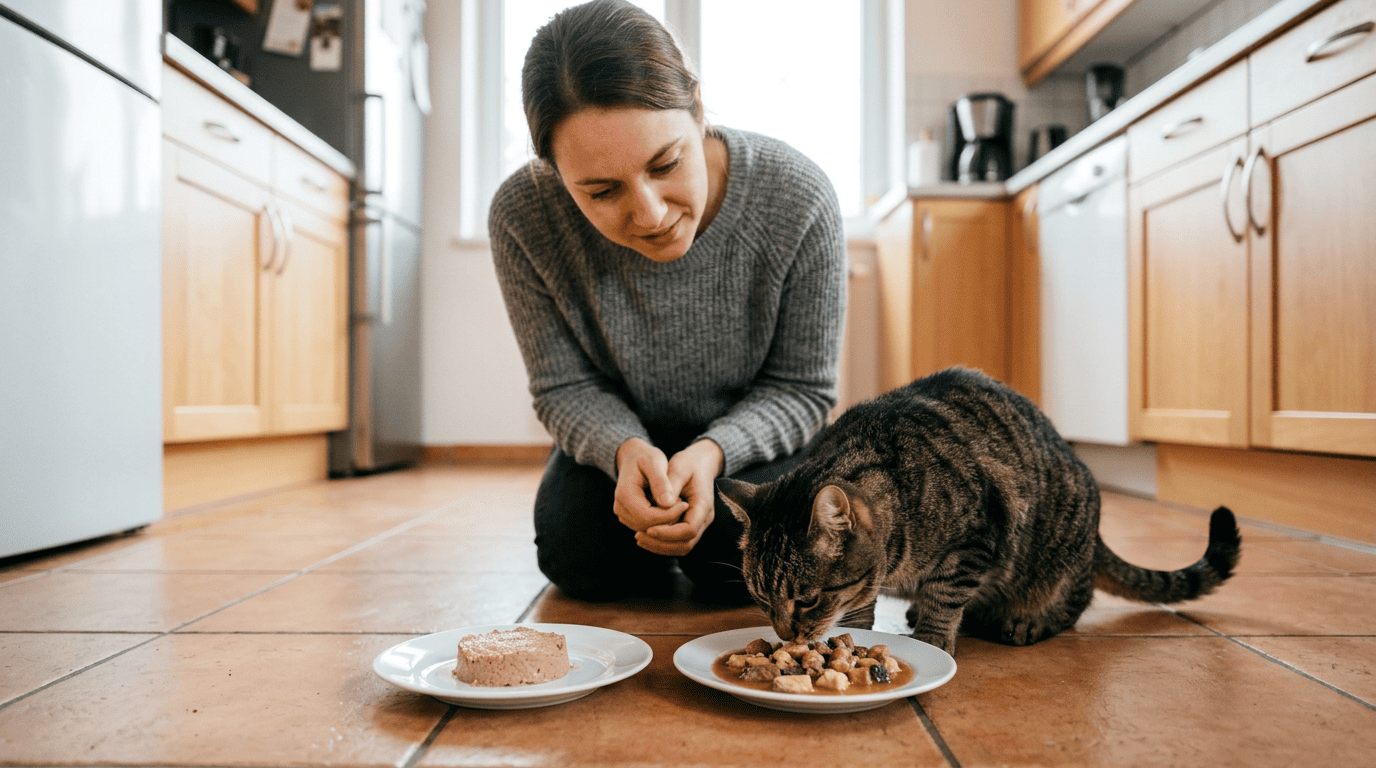
Pâté vs chunks in gravy is mostly a texture decision, not a simple nutrition ranking. Either format can be an excellent everyday food if it is complete and balanced for your cat’s life stage, provides an appropriate calorie amount, and your cat actually eats it well. The more useful question is what happens at the bowl. Some cats eat pâté evenly, while others lick gravy and leave the chunks. Dental comfort, appetite, food temperature, calorie density, and how much water is in the whole serving can matter more than whether the food looks smooth or chunky.
Start With What “Better” Needs to Mean for Your Cat
Before comparing textures, decide what problem you are trying to solve. A healthy adult that finishes either style and maintains a good body condition does not need a texture upgrade simply because one format sounds more premium. Texture becomes useful when it changes how much the cat eats, how comfortably the cat eats, or how consistently you can portion the food.
For example, a cat that licks only gravy may be getting far fewer calories than the serving suggests. Another cat may swallow soft pâté too quickly unless you spread it over a wide plate. The best texture is therefore the one that supports reliable intake without creating a new feeding problem.
A useful definition of “better” also changes with the household. If you need to measure medication intake through food, a uniform texture may make leftovers easier to interpret. If the cat is recovering appetite, a more aromatic gravy-style meal may be more tempting. Those are practical advantages, not proof that one texture is superior for every healthy cat.
Pâté vs Chunks in Gravy Is Not a Nutrition Shortcut
Texture does not tell you whether a food is nutritionally complete. Check the nutritional adequacy statement first. A product intended as a main diet should be labeled complete and balanced for the relevant life stage. Specialty toppers, broths, and complementary foods may look similar in a bowl but are not necessarily designed to supply all required nutrients.
Calorie density can also differ between two wet foods with similar moisture. Compare calories per can, pouch, or gram rather than assuming a thicker pâté is automatically richer. When you are deciding what belongs in your indoor cat’s daily diet, texture should come after nutritional adequacy, life stage, calorie needs, and any veterinary diet requirements.
Texture labels can hide major formulation differences. One pâté may contain 80 calories per can and another 180. One chunky recipe may be a complete maintenance diet, while another similarly packaged product is intended only as a topper. Comparing texture before checking the label can therefore answer the least important question first.
Serving vessel can change the experience too. Deep narrow bowls may make it harder to reach soft food at the edges, while a shallow plate lets the cat approach from different angles. If a cat appears to dislike pâté only after it has been pushed into the bowl corners, the issue may be presentation rather than the food itself.
Why Pâté Works Better for Some Cats
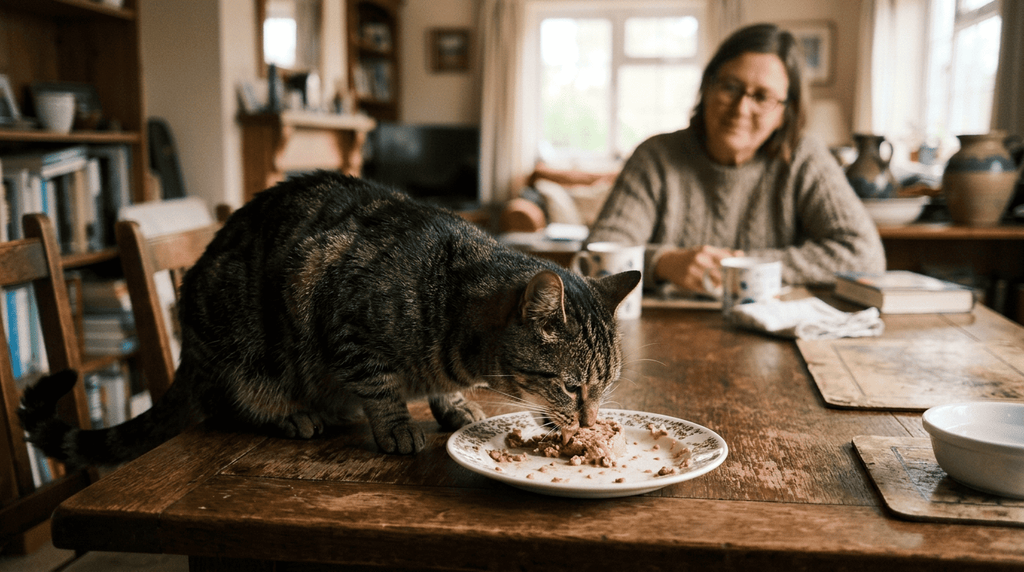
Pâté is uniform, which can make intake easier to judge. If your cat eats half the portion, you can be fairly confident it ate roughly half the food rather than only the liquid around it. That consistency can be useful when appetite monitoring matters or when several caregivers share feeding duties.
It is also easy to change the serving texture without changing the food. You can mash pâté flatter, break it into small pieces, or mix in a little water if your cat accepts that change. A cat that struggles with firm chunks may find a smooth texture easier, although new difficulty chewing or eating still deserves attention rather than being solved only by softer food.
Pâté can also be easier to portion when a cat eats several small meals. A kitchen scale lets you divide a can into predictable gram amounts without trying to count irregular pieces. For households tracking calories closely, that repeatability can be more valuable than any theoretical texture benefit.
For cats sharing a household, a uniform food can also simplify separation. It is easier to tell whether the slow eater finished its assigned grams when the serving is homogeneous. With chunky food, the faster cat may steal the solids after the first cat has licked the gravy, making intake harder to reconstruct later.
Why Chunks in Gravy Work Better for Other Cats
Chunks in gravy provide more variation in bite size, smell, and mouthfeel. Some cats are more interested in licking and chewing separate pieces than in eating a uniform paste. The gravy can also spread aroma across the plate, which may make the meal more appealing to a cat that is simply texture-selective.
The main drawback is selective eating. A cat may consume the gravy but leave much of the solid portion. That can make the bowl look “mostly eaten” even when a meaningful share of calories and nutrients remains. If this happens repeatedly, weigh or inspect leftovers instead of judging the meal by how much liquid disappeared.
Chunks in gravy can be useful for cats that enjoy more oral activity, but piece size matters. Large cubes may be carried out of the bowl or left behind, while smaller shreds may be easier to manage. If you repeatedly find intact pieces around the plate, the issue may be geometry rather than flavor.
Eating speed is another useful clue. A cat that gulps soft food may do better when the portion is spread over a wider plate or divided into smaller servings. A cat that spends a long time manipulating chunks may simply enjoy the texture. “Fast” and “slow” are not automatically good or bad; what matters is whether intake remains comfortable and consistent.
Watch How the Cat Eats, Not Just What the Bowl Looks Like
A short observation tells you more than the texture label. Does the cat take steady bites, lick only one component, push pieces to the rim, chew on one side, or walk away after several mouthfuls? Those behaviors help separate preference from a possible comfort problem.
- Finishes evenly: The current texture is probably workable.
- Licks gravy and leaves meat pieces: Actual calorie intake may be lower than it appears.
- Pushes pâté around without taking bites: Try a flatter serving or a small texture change.
- Drops food or chews awkwardly: Consider oral discomfort and veterinary evaluation.
- Eats eagerly, then vomits after gulping: Smaller portions or a slower presentation may help.
These observations are especially useful when appetite changes. Texture preference can be normal; a new inability to handle a familiar texture is different.
Also watch for “component eating.” Some cats lick the surface gravy first, walk away, and return later for the solids. Others never return. If you are monitoring intake for weight, illness, or medication, check the plate after the cat has truly finished rather than assuming the first enthusiastic licking means the whole meal was consumed.
Moisture Depends on the Whole Food, Not the Shape
Both pâté and chunks in gravy are wet foods, but the exact moisture percentage belongs to the individual product. Gravy may make a food look wetter without telling you the total water content. Check the moisture guarantee rather than estimating from appearance.
If you add water, do it gradually and keep the food palatable. A soupier bowl is not automatically better if the cat eats less of it. The useful goal is total fluid intake from food and drinking while still delivering enough nutrition. For cats on a veterinary diet or with a medical reason to alter water intake, follow the veterinary plan rather than changing texture on your own.
Moisture percentage should be read alongside calorie density. A very wet food can still be calorie-dense, and a lower-calorie food can still contain plenty of moisture. If weight management matters, use both numbers. That prevents a well-intended texture switch from quietly changing the cat’s daily energy intake.
Use a Three-Meal Test Instead of Buying a Case
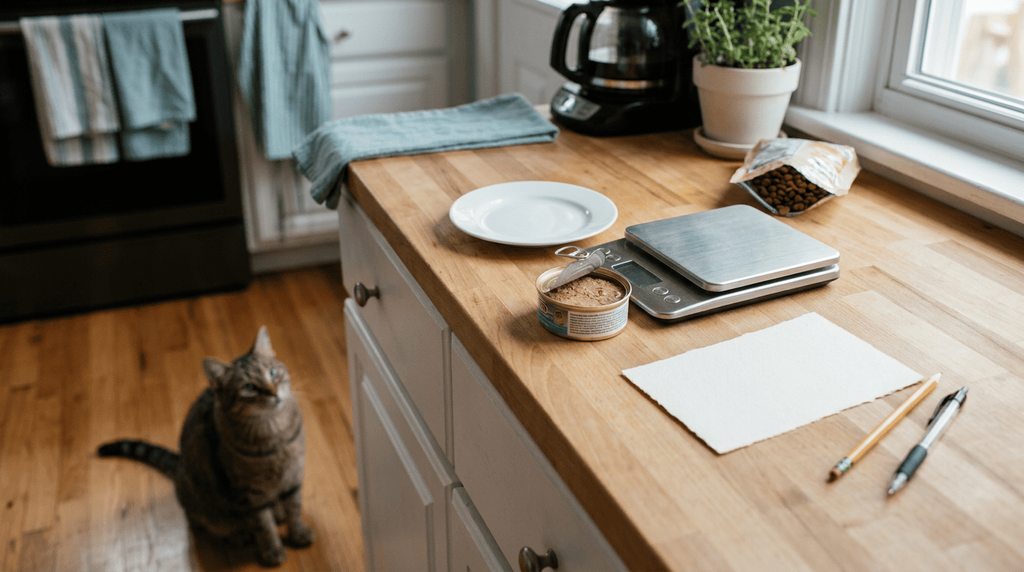
When comparing two textures from otherwise suitable foods, test small amounts under similar conditions. Keep meal time, plate, temperature, and portion size as consistent as possible. Offer the new texture for several meals while the familiar option remains available during the transition.
Record what is actually eaten, not just whether the cat approaches the bowl. A useful test notes the starting portion, leftovers, eating speed, and any vomiting or stool change. This prevents one unusually hungry or distracted meal from deciding the entire purchase. If the cat clearly rejects a texture, forcing repeated large servings usually teaches you less than a small controlled trial.
A small “preference test” can also separate temperature from texture. Many cats dislike food served refrigerator-cold. Warm the sealed portion gently to near room temperature or add a little warm water rather than heating unevenly. If the cat suddenly accepts both textures when temperature is controlled, the problem was not necessarily pâté versus chunks.
Texture Changes Can Expose a Health Problem
A cat that has always eaten chunks and suddenly wants only gravy or smooth food may be telling you that chewing has become uncomfortable. Dental disease, mouth pain, nausea, weakness, and other illness can all change eating behavior. The same is true when a cat approaches eagerly but cannot continue eating normally.
Contact your veterinarian when a texture change comes with weight loss, drooling, bad breath, food dropping, repeated vomiting, reduced appetite, or a clear decline in normal intake. Cats should not go for prolonged periods with very little food while you experiment with formats. The priority is finding out why eating changed.
For senior cats, repeated texture shifts deserve extra attention because dental disease and reduced smell can both change how food is handled. A cat may prefer softer meals because they are genuinely easier to eat. That preference can be accommodated while the underlying reason is assessed instead of forcing the old texture to prove a point.
Cost and waste belong in the decision as well. A food your cat consistently leaves half-finished is not a good value even if the price per can is low. Track edible waste for a week before buying a large case. The texture your cat reliably finishes can be the more economical option because fewer calories end up discarded.
Choose Texture by Intake, Comfort, and Consistency
There is no universal winner in the pâté vs chunks in gravy question. Pâté can make portions and leftovers easier to interpret, while chunks in gravy may suit cats that prefer distinct bites and more liquid around the food. Neither format is automatically more complete, more hydrating, or better quality.
Choose a food that is nutritionally appropriate, then judge the texture by the cat in front of you. If your cat eats enough, maintains healthy body condition, handles the food comfortably, and the format fits your routine, the texture is doing its job.
References
- “Complete and Balanced” Pet Food — FDA — Explains nutritional adequacy statements and why moisture differences affect how pet foods should be compared.
- Feeding Your Cat — Cornell Feline Health Center — Reviews wet and dry food, palatability, moisture, calories, and the importance of complete nutrition.
- Global Nutrition Guidelines — WSAVA — Provides tools for evaluating diets using nutritional adequacy, calories, manufacturer information, and the individual animal rather than marketing claims.
