

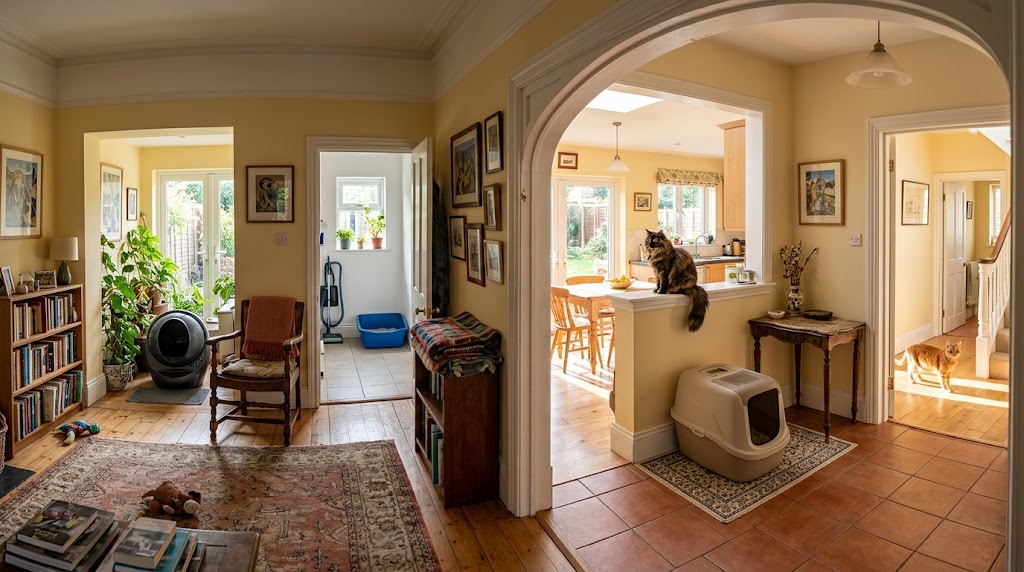
How many litter boxes do two cats need? A widely used starting rule is one box per cat plus one extra, which means three litter boxes for two cats. The number is useful because it creates choice and backup, but placement matters just as much as the count. Three boxes lined up in one laundry room may function like a single toilet area if one cat can block the doorway or if both cats dislike the same noisy location. The real aim is to give each cat reliable access to clean, comfortable toileting options without having to negotiate with the other cat.
Three Boxes Is the Starting Point, Not the Whole Answer
The one-per-cat-plus-one guideline gives two cats three options. It reduces the chance that one dirty box, closed door, or social problem removes every acceptable toilet. It can also accommodate cats that prefer one box for urine and another for stool. However, the rule assumes the boxes are genuinely available.
If all three boxes share one small room, one cat can control access to the entire group. A loud appliance can make all three unpleasant at once. A closed door can remove them all. Count separate usable toileting areas, not just plastic trays. In some homes, the most valuable improvement is not buying a fourth box. It is moving one existing box to a different route.
How Many Litter Boxes Do Two Cats Need When They Get Along?
Even friendly cats benefit from choice. Cats can share resources without obvious conflict, but that does not mean they want to eliminate side by side or use the same tray every time. One cat may prefer a quiet bathroom location while the other uses a hallway box. Preferences can also change with age, illness, visitors, or household routines.
Keep enough boxes that either cat can choose another location if a preferred tray is occupied or dirty. If both cats consistently use two boxes and ignore the third, you still gain backup. Before removing an apparently unused box, ask whether it becomes important at night, during cleaning, or when one cat is resting near another route.
Imagine three boxes sitting shoulder to shoulder in a laundry room. If one cat waits in the doorway, all three become unavailable to the other cat at the same moment. Move one box to a quiet bedroom edge and another to a different hallway, and the same number suddenly creates three access choices. This is why location can change the practical value of the count without changing the count itself.
Spread Boxes So One Cat Cannot Control All of Them
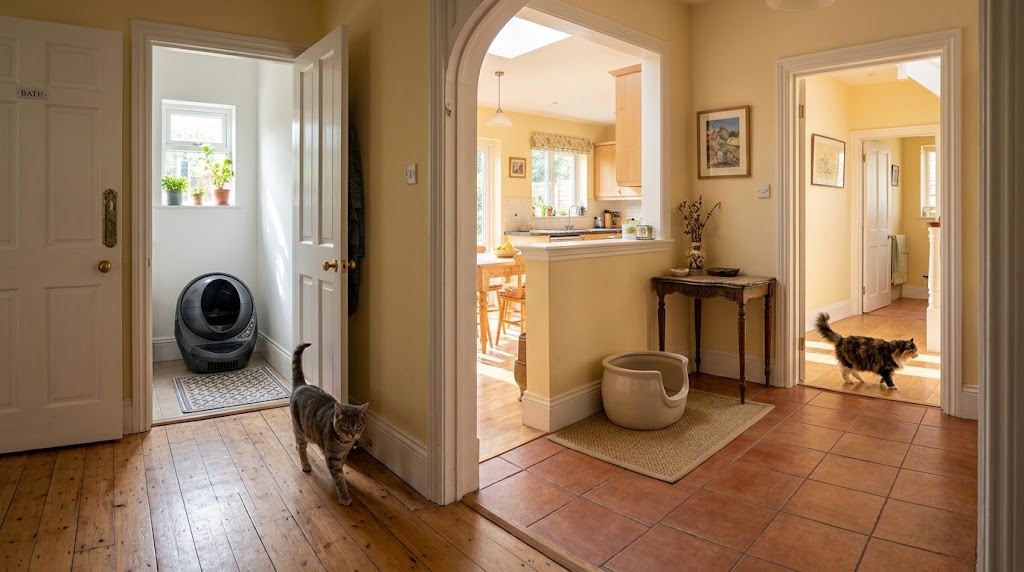
Separate locations are especially important when the relationship is tense or unequal. Blocking can be subtle. A confident cat may sit in a hallway, stare from a doorway, follow the other cat, or rest beside a box route. The less confident cat may wait, rush through elimination, or choose another surface without ever fighting.
This is why box size, placement, litter, cleaning, and access have to work together as one toileting setup. Place boxes where cats can approach and leave without feeling trapped. When possible, give important toileting areas more than one escape route. Avoid making every box dependent on one narrow corridor.
Nighttime access deserves a separate check. A door that is normally open can be closed by a guest. A robot vacuum can block a narrow route. One cat may sleep at the top of the stairs. Walk the route from the cat’s resting areas at the times the home is quiet. A box is not reliable backup if normal household habits can remove access for hours.
Different Floors Usually Need Different Toileting Access
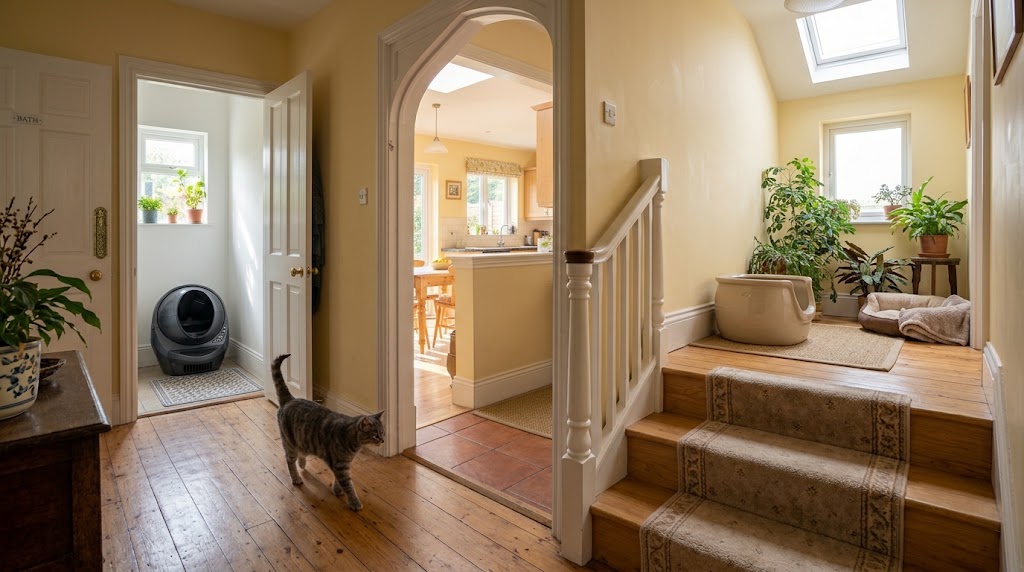
In a multi-level home, spreading boxes across floors can prevent long trips and create real backup. A cat should not need to pass the other cat on a staircase every time it needs to eliminate. This becomes even more important for kittens, seniors, or cats with mobility problems.
Think about where the cats actually spend time. A third box in a basement nobody visits is not equal to a box near the main living area. If one cat sleeps upstairs and the other spends most of the day downstairs, provide reasonable access in both zones. The count should support the cats’ routes rather than a human preference to hide every box in one remote place.
| Home pattern | Useful starting layout | Why |
|---|---|---|
| One-level apartment | Three boxes in separated zones | Creates route and location choice |
| Two-story home | At least one box per active floor | Reduces travel and bottlenecks |
| One cat blocks hallways | Boxes on different routes | Prevents one cat controlling access |
| Senior plus young cat | Include a low-entry easy-access box | Matches different mobility needs |
If the cats are different sizes, the boxes do not need to be identical. A large young cat may need more turning room. A senior may need a low entry. What should stay consistent is usability: each tray must be large enough, stable, and placed where the intended cat can approach comfortably. “Extra” should not mean lower quality.
Mark the box positions on a simple floor plan if the home is complicated. This makes bottlenecks obvious and helps you see whether the three choices are truly separated.
Box Size Still Matters When You Have the Right Number
Three cramped boxes are not automatically better than three comfortable ones. Many cats prefer boxes large enough to turn, dig, and posture without touching every side. A larger open tray may be more usable than a decorative enclosure. Entry height also matters for older or painful cats.
Do not make the extra box the worst box. If the third tray is tiny, strongly scented, or placed beside a dryer, the cats may effectively have only two acceptable options. Keep the basic setup consistent enough that each box is a realistic choice. Individual cats can still have preferences, so observe which features are used most reliably.
Track which box gets dirty fastest for one week. This may reveal a strong location preference or a box the cats avoid. If both cats use one tray heavily, scoop that tray more often. If one box remains untouched, investigate its location, size, litter, noise, or access before deciding the cats simply do not need it.
Cleaning Frequency Does Not Drop Because You Added More Boxes
More boxes provide choice, but they still need regular maintenance. Scoop at least daily and more often when use is heavy. If one box becomes dirty quickly because both cats prefer it, clean it more often rather than assuming the other boxes will compensate. Cats may continue to choose a preferred location until cleanliness falls below their tolerance.
- Keep a scoop near each separated box area when practical.
- Use a simple routine so no box is forgotten.
- Wash boxes with appropriate mild cleaning methods.
- Avoid using strong fragrance to mask poor maintenance.
- Replace damaged boxes that hold odor or become difficult to clean.
The extra box also gives practical backup during a full wash. One tray can dry while the others remain available. Continuous access is part of good litter-box management.
A small camera can help when patterns happen out of sight. You may discover that one cat enters only after the other leaves the room, or that a cat approaches a box and turns away when watched. Use video to understand access, not to police the cats. The useful question is whether each cat can toilet without being followed, stared at, or cornered.
Watch Which Cat Uses Which Box Before You Change the Count
You may discover that the cats divide the boxes by location, time, or elimination type. One may use a quiet bedroom tray for stool and a hallway tray for urine. The other may avoid one room entirely. These patterns are useful because they show whether every box is truly serving both cats.
If house-soiling appears, do not immediately remove or consolidate boxes. Record where accidents occur, which boxes were clean, and whether another cat was nearby. A new avoidance problem can have medical, environmental, or social causes. Sudden changes deserve veterinary attention as well as a setup review.
Temporary situations can justify a temporary box without changing the permanent plan. A cat recovering in one room may need a tray nearby. A visitor’s dog may make a usual hallway route uncomfortable. Construction may close access to part of the home. Add a box for the disruption, then reassess after normal movement returns. Flexibility is part of good resource planning.
More Than Three Boxes Can Make Sense in Specific Homes
Three is a starting point, not a maximum. A large home, several floors, mobility limitations, or persistent social tension may justify more. Temporary extra boxes can also help during recovery from surgery, diarrhea, a move, or a behavior reset. The question is whether another box solves a specific access problem.
A fourth box is less useful when it is simply placed beside the existing three. Add location diversity before adding tray count. If the home cannot physically support three well-separated boxes, prioritize the best possible size, access, cleanliness, and separation. Then watch behavior closely. Small homes require compromises, but the compromises should still respect the cats’ need for choice.
Recheck the setup after any major household change. New furniture can narrow a route. A baby gate can separate one cat from a box. Recovery from surgery may create a temporary mobility problem. The original three-box plan may still be correct in number but wrong in placement. Adjust the system around how the cats move now.
If space is the limiting factor, prioritize separation before decoration. A plain large tray behind a simple visual screen may work better than a compact covered box chosen to blend into furniture. The cats experience size, scent, route, and escape options. They do not benefit from a prettier box if the design makes toileting less comfortable.
Do not wait for a serious accident problem before using the third box. Prevention is easier when each cat already knows several acceptable locations. If one room becomes unavailable, the alternative is familiar rather than new. That matters during visitors, repairs, illness, or any household disruption that changes normal routes.
Use Three Boxes as a Practical Baseline for Two Cats
For two cats, three litter boxes is the most useful default starting point. Spread them so they function as separate resources, not one giant station. Make each box large, clean, accessible, and easy to leave. Adjust the number upward when home layout, age, illness, or social tension creates a reason.
The correct setup is the one both cats can use without hesitation. If one cat starts waiting, rushing, eliminating outside the box, or avoiding a location it previously used, treat that change as information. The count may be adequate on paper while access is failing in real life.
References
- Client Education: What Your Cat Needs to Feel Secure — FelineVMA — States the common one-box-per-cat-plus-one rule and emphasizes separated resources, easy access, and clean toileting areas.
- Setting Up the Environment for Success — FelineVMA — Explains dispersed resources, litter-box access, social blocking, and environmental factors that can affect elimination behavior.
- Feline Behavior Guidelines — FelineVMA — Provides practical guidance on litter-box number, separate locations, box size, litter preferences, cleaning, and access in multi-cat homes.
