

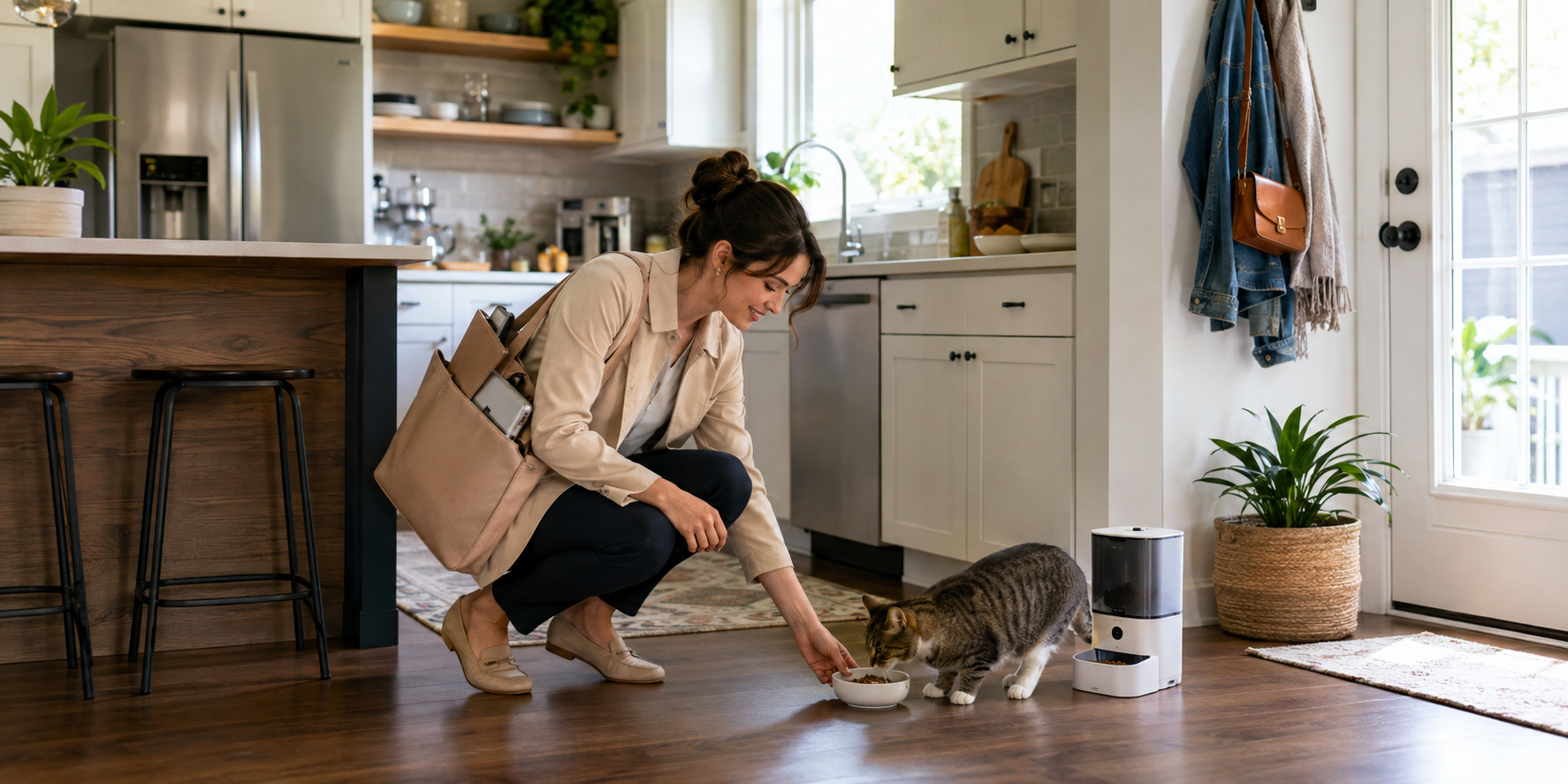
The best feeding schedule for indoor cats is not one universal clock. It is a repeatable way to divide the correct daily ration across the day. The timing should also be realistic for your household. Two large meals may suit one healthy adult. Another cat may do better with breakfast, a timed midday portion, dinner, and a small bedtime meal. The schedule should solve real problems such as long gaps, fast eating, or early-morning waking. It should not quietly increase total calories. Set the day’s food amount first, then decide when each part will appear.
Build the Schedule Around the Full Day of Food
Meal timing should begin with the total daily ration, not with the number of feeding events. If your cat needs a measured amount of food for the day, divide that amount before breakfast. This prevents a common schedule mistake: adding a new midday or bedtime meal on top of the old breakfast and dinner portions. Put the day’s dry food in one container or pre-portion wet meals so everyone in the home can see what remains. Treats and puzzle-feeder food belong in the same daily total.
This separation between amount and timing also keeps this topic distinct from calorie planning. The schedule answers when the food appears. Food type, moisture, life stage, and the total amount your cat eats across the day are separate decisions that should already be reasonably settled. Once the daily ration is known, timing becomes a behavior and routine problem rather than a guessing exercise.
One easy household rule is to measure the day’s food once, then treat that container as the only source for meals, feeders, and rewards. When it is empty, the day’s ration is finished. This prevents the schedule from changing calorie intake simply because different people are involved.
The best indoor cat feeding schedule is therefore a stable framework with room for small corrections. It should make the correct daily amount easy to serve, give the cat predictable food access, and fit the humans well enough to continue for months. When those three pieces line up, there is little reason to chase a supposedly perfect number of meals or a universal set of feeding times.
Use Your Workday to Choose a Realistic Meal Pattern
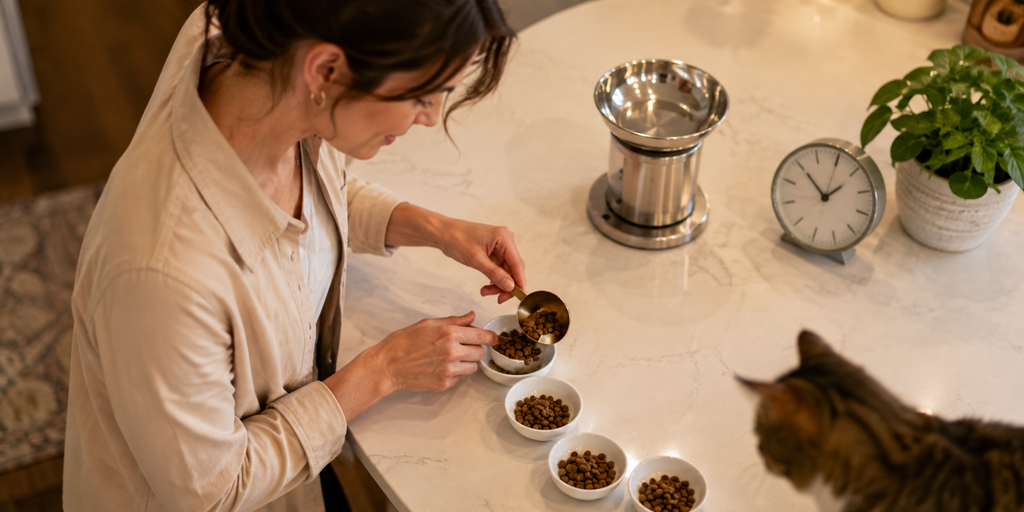
A feeding plan that looks ideal on paper but fails on busy weekdays is not a good schedule. Map the hours when someone is reliably home, then decide where a timed feeder can fill a long gap. Someone who leaves at 8 a.m. and returns at 6 p.m. might use four feeding events. These could be breakfast, a small automated afternoon portion, dinner, and a modest bedtime meal. Someone who works from home may offer three or four small meals directly. Both can work if calories and appetite stay stable.
| Household pattern | Possible schedule | Why it may fit |
|---|---|---|
| Long workday | Breakfast, timed midday meal, dinner, bedtime portion | Breaks up a long daytime and overnight gap |
| Home most of the day | 3–4 small measured meals | Easy appetite monitoring and smaller servings |
| Two predictable routines | Breakfast and dinner | Simple if the cat stays comfortable between meals |
| Early-morning waking | Dinner plus reserved timed pre-dawn portion | Moves the food cue away from the bedroom |
Do not copy the clock from another household. Consistency matters more than choosing fashionable meal times.
Weekend routines should not swing wildly if the cat is sensitive to timing. Sleeping two hours later on Saturday can create early-morning demands or stomach upset in some cats. A timed feeder can preserve one stable meal while humans keep a more flexible weekend schedule.
A Feeding Schedule for Indoor Cats Can Use Smaller Meals Without Adding Calories
Cats are adapted to consuming multiple small meals. Some indoor cats are more comfortable when the day is divided into several feeding opportunities. Smaller servings can help a cat that bolts a large meal, becomes frantic after long gaps, or benefits from more activity points through the day. A puzzle feeder can turn one portion into a longer foraging event. A timed feeder can release a planned serving when no one is home. The extra event should come from the existing ration.
Watch what happens after the change. A cat that eats a small meal, grooms, and rests is responding differently from one that immediately searches every room for food or repeatedly regurgitates. Do not assume every request for attention is hunger. If body condition is healthy and calories are appropriate, some food-seeking may be learned routine. Use play, training, window time, or social interaction as other predictable events so food does not become the only thing that structures the day.
If small meals create more begging instead of less, look at the total ration and the cues around feeding. Constant food preparation noises can teach the cat to anticipate meals all day. Pre-portioning meals in advance reduces repeated measuring rituals and can make feeding events clearer.
A schedule is mature when it disappears into daily life. You should not need constant negotiation with the cat or repeated calculations. If the routine remains difficult after several weeks, identify the one recurring failure rather than redesigning every meal time at once.
Wet and Dry Food Need Different Timing Logistics
Dry food is easy to place in many timed feeders and can be measured in advance, but it is calorie dense and easy to over-serve by volume. Wet food adds moisture and may be more appealing, yet it requires more attention to safe handling and freshness. If you use both, decide which meals are easiest to serve fresh and which portion can be automated. For example, wet breakfast and dinner with a measured dry midday feeder can be more practical than trying to leave wet food available for a long workday.
Some timed feeders are designed for chilled wet food. The product only helps if you can clean it thoroughly and your cat accepts its sound and motion. Test a new feeder while you are home before relying on it. Keep the overall diet nutritionally complete and balanced, and do not let convenience turn a small automated snack into an unmeasured extra meal.
For wet-food schedules, serve smaller fresh portions rather than leaving one large serving out for many hours. A cat may eat only the freshest part and leave the rest. If intake is hard to judge, weighed servings and leftovers can show whether the problem is timing, freshness, or appetite.
Early-Morning Hunger Needs a Timing Fix, Not a Bigger Day
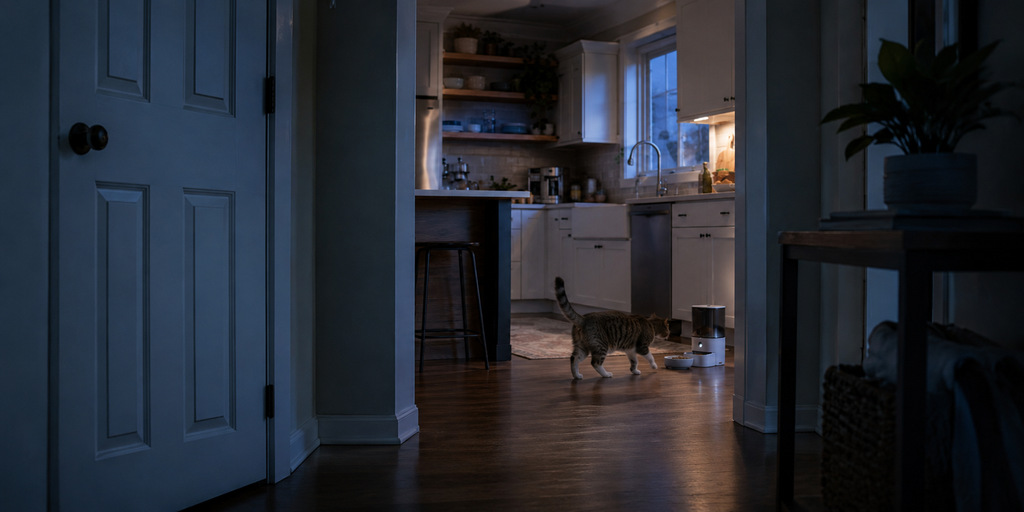
If your cat wakes you before dawn, feeding immediately can strengthen the connection between waking you and food arriving. Moving breakfast earlier each week can make the cycle worse. A more useful strategy is to reserve part of the normal daily ration for a timed feeder that opens before the usual wake-up campaign. The cat can learn that the device, not your movement in bed, predicts food. Keep the human-served breakfast at a stable later time rather than chasing the cat’s earlier requests.
A planned evening play session followed by dinner can also make the night more structured. Some cats benefit from a small bedtime portion if the gap until morning is long. Shift calories rather than adding them. Give a new schedule at least several days before deciding it failed, unless appetite or health changes. Strong food routines can take time to move because the cat has already learned the old cues.
Do not respond to a 4 a.m. wake-up by adding a second breakfast. Shift part of dinner or the existing morning calories. If the cat still wakes but body condition and intake are appropriate, the behavior may need a routine change rather than more food.
Multi-Cat Homes Need Schedules That Protect Individual Access
A shared feeding time can hide unequal intake. One cat may eat quickly and move to another bowl while a cautious cat backs away. Free feeding can make the problem harder to see because you know food disappeared but not who ate it. If cats have different calorie needs, diets, or eating speeds, separate rooms, visual barriers, microchip feeders, or supervised meal windows can make individual intake measurable. Distance often matters as much as the clock.
Watch who leaves first, who waits at the edge of the room, and whether one cat guards the route to food. A cat that seems “picky” may simply avoid eating near a confident housemate. Scheduling separate access can solve a social problem without changing the diet. Keep water and other resources distributed too, because feeding tension rarely exists in isolation when one cat controls important areas of the home.
In a tense multi-cat home, simultaneous feeding can be the wrong goal. One cat may need to eat behind a closed door while another eats elsewhere. The schedule can remain synchronized while the locations differ, giving each cat a predictable meal without social pressure.
Use Timed Feeders for Specific Jobs
Automatic feeders are useful when they solve a timing problem you cannot solve consistently yourself. Good uses include a measured midday meal during work, a pre-dawn portion for early waking, or several small dry-food servings for a cat that eats too fast. They are less useful when the real issue is an incorrect daily portion, another cat stealing food, or a cat refusing the diet. Technology does not replace knowing how much food is being dispensed.
- Weigh several feeder portions to confirm what one compartment actually delivers.
- Test the sound and motion while you are home.
- Keep the feeder clean enough that old food does not affect appetite.
- Use part of the normal ration rather than adding extra calories.
- Check that another pet cannot break into or monopolize the feeder.
If the feeder causes fear, missed meals, or competition, return to a simpler method and solve that problem first.
Use the feeder as a tool, not a black box. Check occasionally that it opened, that the portion was eaten by the intended cat, and that leftover food has not spoiled. A missed automated meal can look like appetite loss if nobody verifies what the machine actually did.
Medical Plans Can Override a Convenient Household Routine
Diabetes, gastrointestinal disease, kidney disease, obesity treatment, medication timing, nausea, dental pain, and other conditions can change how meals should be distributed. A cat that needs food with medication may require a different clock from a healthy adult. A cat with poor appetite may benefit from small frequent fresh offerings, while a veterinary weight-loss plan may use tightly measured portions. Do not copy a disease-specific schedule from another cat because food, medication, and clinical goals vary.
A sudden appetite change also matters more than preserving the schedule. If a cat that normally appears for every meal begins missing them, take note. Contact your veterinarian if the cat also leaves much of the ration, vomits repeatedly, or loses weight. The feeding routine is useful partly because it makes these deviations visible. A predictable schedule should help you detect health changes, not pressure a sick cat to keep performing the old pattern.
If a medical plan changes, rewrite the feeding instructions for everyone in the home. Old habits persist easily when one person remembers the previous schedule. Put the updated timing, amount, medication relationship, and treat rules in one place so the treatment plan is not diluted by household inconsistency.
Adjust the Clock When the Cat Shows You a Specific Problem
Review the schedule after two or three weeks. Look at body condition, weight trend, appetite, meal behavior, vomiting or regurgitation, sleep disruption, and household practicality. Change one feature at a time. If breakfast begging is the problem, shift a portion to a timed feeder. Large dinners that trigger fast eating can be divided instead. When one cat steals food, separate access before assuming the slower cat needs a different meal frequency.
References
- How Often Should You Feed Your Cat? — Cornell Feline Health Center — Discusses meal frequency by age, health, food type, household schedule, and the benefits and limits of free feeding.
- Feline Feeding Programs: Addressing Behavioral Needs — FelineVMA — Supports feeding programs that allow small meals, foraging, separated feeding, and individualized schedules in indoor and multi-pet homes.
- Feeding Your Cat — Cornell Feline Health Center — Current nutrition guidance on complete diets, body condition, feeding environment, appetite, treats, and weight management.
