

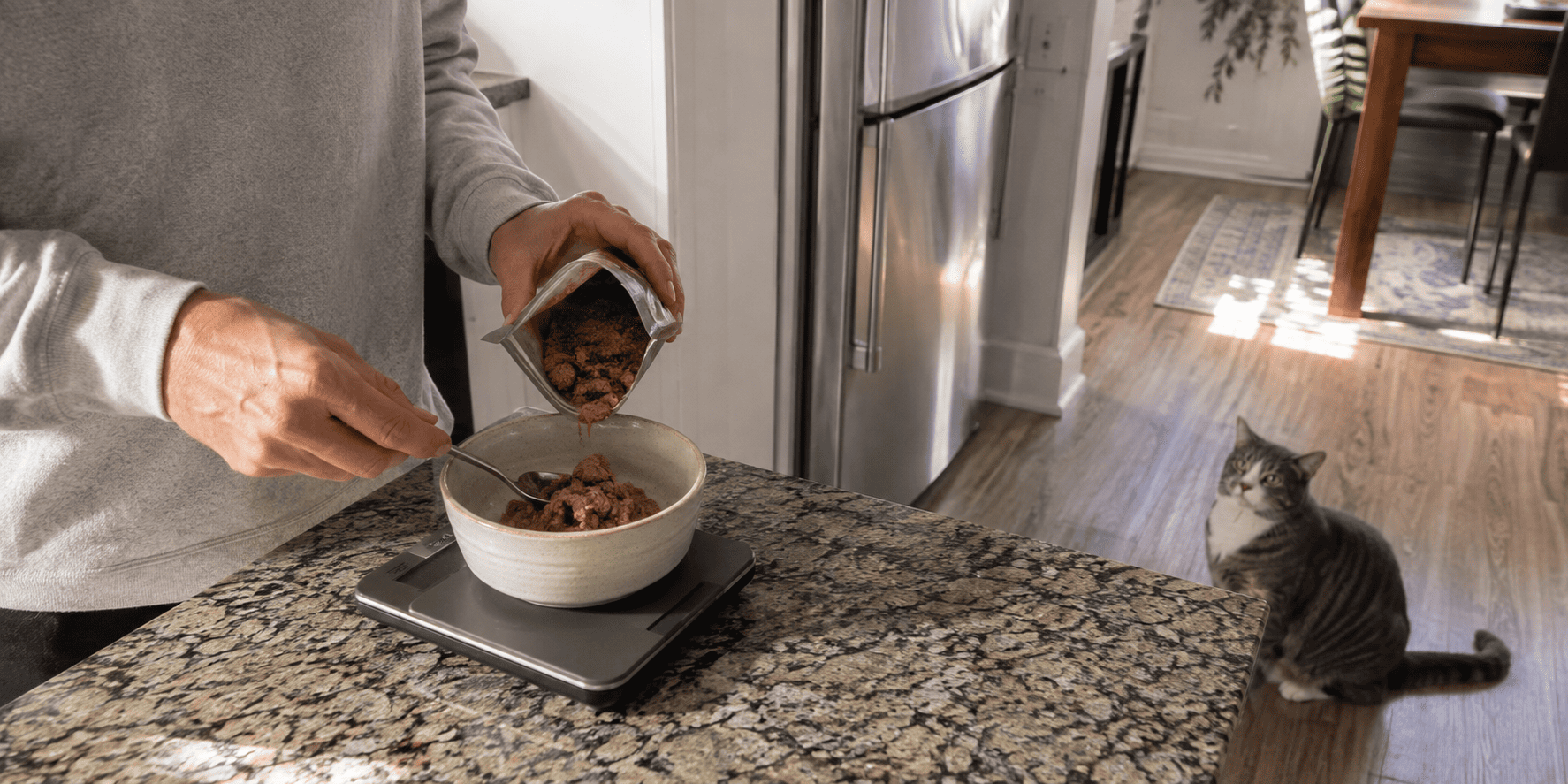
How much should an indoor cat eat each day? The answer is not a universal number of cups, cans, or pouches. It comes from the cat’s energy needs, the calorie density of the exact food, and whether the portion keeps that individual cat at a healthy body and muscle condition. This article is about daily quantity, not meal frequency: calculate the whole day first, then decide how many meals to divide it into.
Start With a Worked Portion Example
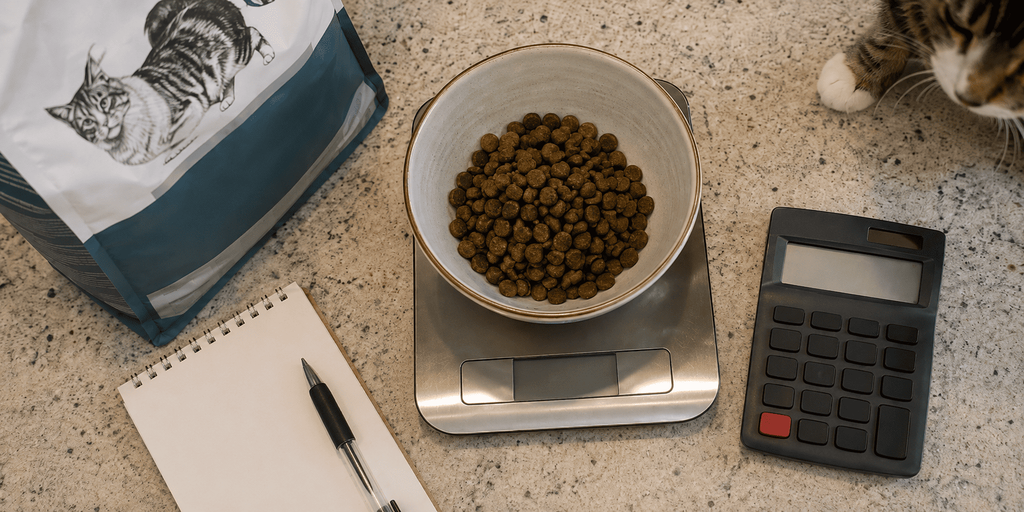
Find the calorie statement on the food package or manufacturer information. It may be listed as kcal per can, pouch, cup, kilogram, or serving. Once you know the calories in the food and the target for the day, the math becomes practical. These numbers are examples, not a recommendation for a particular cat. Use the calorie value of the exact food you feed. Treats and toppers count too. Once you know the grams that maintain your cat’s healthy weight, write the number somewhere near the food. This prevents portion drift when different people feed the cat. It also makes temporary changes easier to track if a veterinarian later recommends adjusting calories. Mixed feeding requires one combined calculation.
Decide how many wet-food calories you want to serve, subtract them from the daily target, then calculate the dry portion from what remains. This is more accurate than feeding a full dry ration and adding a can because it seems small.
| Example | Calories | How it fits a 220 kcal day |
|---|---|---|
| Wet food can | 90 kcal per can | Two cans provide 180 kcal, leaving about 40 kcal |
| Dry food | 400 kcal per cup | About 0.55 cup would provide 220 kcal if fed alone |
| Mixed diet | 90 kcal wet can + 400 kcal/cup dry | One can leaves about 130 kcal, or roughly 0.33 cup dry |
How Much Should an Indoor Cat Eat Each Day? Calculate Calories Before Volume
Calories are more useful than cups because foods vary so much in energy density. A dry food may contain several hundred calories per cup, while a can of wet food may contain far fewer calories even though it looks like a larger serving. For a healthy adult cat, calorie charts can provide a starting estimate. Individual needs can still differ substantially. Indoor cats that are neutered and less active may need fewer calories than a very active cat of the same weight. If you are still deciding between wet food, dry food, or a mixed feeding plan, settle that choice first because calorie density changes what a practical daily portion looks like. Do not use a calorie formula as a reason to ignore body condition.
The number is useful only when it keeps your real cat at a healthy weight. If the package lists calories only per kilogram, check the manufacturer’s website or contact the company for a practical per-can, per-cup, or gram value. Using the correct number matters more than copying a serving from another food with a similar name. Energy needs also change after growth stops. A portion that suited a late-stage kitten can become excessive once adult calorie needs settle. Recheck the serving when life stage changes instead of continuing the same volume by habit.
Convert kcal per Kilogram Into Grams Without Guessing
Some labels make portion math look harder because they list energy as kcal per kilogram instead of calories per cup or can. The conversion is simple: divide kcal/kg by 1,000 to get kcal per gram. A dry food listed at 4,000 kcal/kg provides about 4 kcal per gram. If a veterinarian or feeding plan gives a 220-kcal daily target, that example food would work out to about 55 grams for the entire day before treats or other foods are added.
Mixed feeding uses the same logic. Calculate the calories supplied by the wet portion first, subtract them from the daily total, and use the remaining calories for the dry food. Keep the example separate from your cat’s actual target. The useful part is the method, not the number 220. Different foods can vary enough that copying grams from a previous bag can quietly change calorie intake even when the bowl looks almost identical.
Use Grams When Scoops Keep Drifting
Small measuring errors matter when a cat’s entire daily ration is compact. A rounded scoop today and a heaped scoop tomorrow can create a meaningful calorie difference over weeks. A digital kitchen scale makes portions repeatable. Put the empty bowl on the scale, tare it to zero, then add the number of grams you intend to feed. The manufacturer may list grams per cup, or you can weigh a measured cup once to estimate the grams in your particular food. For wet food, cans and pouches are often easier to divide by weight than by eye. If a can contains two meals, weigh the full contents and split it into equal portions. Refrigerate the unused part safely. Consistency gives you better information. If weight changes, you can adjust a known portion instead of guessing how much the scoop has changed.
Once you switch to grams, use the same scale and the same routine. Tare the empty bowl, add the planned amount, and avoid “rounding up” by eye. If several people feed the cat, pre-weighing the day’s food can prevent accidental doubles. This is especially useful with calorie-dense dry food, where a small visual difference can represent more energy than it appears to.
Treats Belong in the Same Daily Number
Treats should come from the same daily calorie budget, not sit on top of it. In a small cat, a few extra calories every day can become significant. Measuring the day’s treat allowance in advance can prevent several people from unknowingly giving the same cat repeated snacks. Activity is not constant across the year. A cat may play more when windows are open, move less during hot weather, or become quieter after a household change. If weight starts shifting, look at routine as well as food before assuming the original calorie estimate was simply wrong. Training does not require large treats. Cats usually respond to the reward value and timing, not the size of the bite. Tiny pieces allow more repetitions without using a large part of the calorie budget.
- Keep treats and extras to a small share of total daily calories.
- Check calorie information on dental treats and larger snacks.
- Break treats into small pieces when using them for training.
- Reserve part of the normal kibble ration for rewards when practical.
- Count calorie-dense toppers, lickable treats, and human-food tastes.
- Make sure the complete and balanced diet remains the nutritional foundation.
Body Condition Can Override the Calculator
Weight alone does not tell you whether a cat is carrying too much fat or losing muscle. Two cats can weigh the same and have very different body composition. Body condition scoring adds context. Gently feel the ribs. At an ideal condition, you should usually feel them under a light covering rather than pressing through a thick layer of fat. Look from above for a visible waist behind the ribs. From the side, the abdominal line should not simply hang as a large rounded mass. Muscle condition is separate. Older cats can lose muscle even when their body weight looks stable. Pay attention to the spine, shoulder blades, skull, and hindquarters. If you are unsure what your cat’s ideal condition looks like, ask your veterinary team to show you at the next visit. A hands-on demonstration is more useful than comparing your cat with internet photos alone.
Recheck the plan whenever the food changes. A new recipe can change calories per gram even when the serving looks the same.
Use Weight Trends to Make Small Corrections

Your cat’s body gives better feedback than a calculator. Do not make dramatic cuts because your cat gained a little weight. Cats should lose weight gradually under a safe plan. If your cat is overweight, your veterinarian can help set an ideal target and calorie level. Take a simple photo from above every month or two under similar lighting. Photos do not replace hands-on body condition scoring, but they can reveal gradual changes that are hard to notice when you see your cat every day. Use them alongside weight, not as the only measure. Use trends rather than reacting to one weigh-in. Hydration, a recent meal, and scale variation can shift the number slightly. Repeated movement in the same direction is more useful, especially when body condition changes at the same time.
- Weight is steadily increasing over several checks.
- Ribs are becoming difficult to feel under the fat layer.
- The waist is disappearing when viewed from above.
- Weight is falling without an intentional diet change.
- Muscle over the spine or hindquarters appears to be decreasing.
- Your cat is persistently hungry despite an appropriate measured ration.
- Activity, age, or health has changed since the portion was set.
A Simple Adjustment Loop for the Next Month
The answer to how much should an indoor cat eat each day is a measured starting portion followed by observation. Calculate from calories, measure the actual food, include treats, and track body condition and weight over time. If weight stays stable and body condition is healthy, the portion is probably close to right. If the trend moves steadily up or down, make a small adjustment or ask your veterinarian for help. The goal is not to hit a universal number. It is to feed the amount that keeps your cat healthy.
Make the adjustment process boring and repeatable. Hold the measured portion steady long enough to see a trend, unless your veterinarian has asked for a faster change. Weigh under similar conditions, note body condition, and record major changes in activity or treats. If weight is moving in the wrong direction, change the daily amount modestly rather than swinging between generous and restrictive days. A known starting portion is useful because every later decision has something real to compare with.
Also look for reasons the calculation may be misleading. Someone else may be feeding snacks, a second cat may be sharing the bowl, or the food may have changed calorie density after a formula switch. Before cutting the ration, verify what is actually being eaten. When the measured intake and the body trend disagree, the discrepancy is information worth investigating rather than proof that the scale or the cat is “wrong.”
Kittens, Seniors, Weight Loss, and Medical Diets Need Different Math
Generic calorie math is a starting tool for healthy adults, not a universal prescription. Growing kittens, pregnant or nursing cats, seniors losing muscle, and cats on therapeutic diets need a plan matched to life stage and health. Weight-loss feeding also deserves veterinary guidance because severe restriction can be dangerous for cats. If weight changes despite a measured ration, bring the food label, daily grams, treat calories, and recent weight trend to your veterinary team.
References
- Feeding Your Cat — Cornell Feline Health Center — Current overview of complete and balanced diets, body condition, calorie needs, food formats, and weight management.
- Obesity — Cornell Feline Health Center — Explains why body condition and weight trends matter when setting and adjusting portions.
- Feline Feeding Programs: Addressing Behavioral Needs — FelineVMA — Summarizes the AAFP/FelineVMA feeding framework, including measured feeding and ways to support normal feline feeding behavior.
